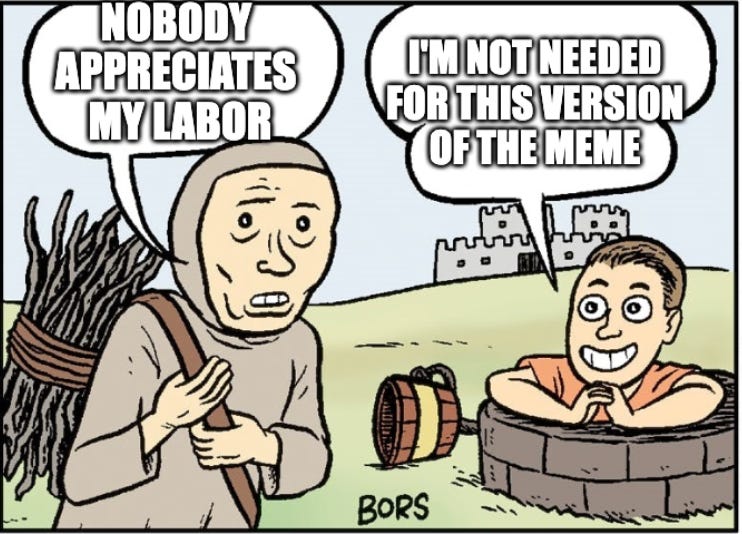
Not long ago, I wrote about a prank my college professor played on our psychology class. He made everyone take a personality test, gave everyone identical results, and then asked how many of us found the results to be accurate. Almost everyone in the class, across gender and other demographic lines, agreed with the results of the test, which mostly said things like “You do so much for other people and nobody appreciates it” and “You frequently sacrifice your own comfort to make sure other people are happy.” Apparently, people (myself included!) were very eager to see themselves as a sacrificial victim.
This is the kind of behavior that often gets pulled into the genderslop ecosystem, where depending on the particular type of labor being discussed, people can dismiss men or women of being obsessed with their victimhood status and having an outsized idea of how much they suffer compared to everyone else. And yes, men and women describe the role of Supreme Victim very differently, in part because men and women often feel unappreciated for different things. But ultimately, the drive is the same: I do everything, nobody else appreciates it, I don’t enjoy any of it, and I don’t even enjoy the outcome. It’s all for everyone else, and I don’t gain anything.
But surely, the entire world cannot be made up of people never reaping the rewards of their own labor and selflessly sacrificing for others while nobody does anything for them, because someone has to be the “others.” And this week, I was lucky enough to witness two completely unrelated, and somehow entirely harmonious pieces of Discourse which show how both men and women fashion themselves the Omelas Child of their own lives—using different words, but with the same underlying and self-serving motivation.