In the summer of 1835, Abraham Lincoln was a young man with no hint of the greatness that lay ahead. He was living in the frontier village of New Salem, Illinois, trying to build a life for himself. There he fell in love with Ann Rutledge, a young woman remembered for her intelligence, warmth, and kindness.
Things did not go well. Ann contracted typhoid fever, a common and often deadly illness in an age before modern medicine. At just twenty-two years old, she died. Lincoln was devastated.
Friends watched him sink into a profound depression. He wandered alone. He spoke little. He reproached himself so intensely that those around him feared for his safety. Although Lincoln had nothing to do with Ann’s contracting typhoid, he reproached himself for it.
Lincoln had done nothing wrong. He had not caused Ann’s illness. He had not neglected her. He possessed neither the knowledge nor the means to save her. No human being could reasonably have prevented what happened. Yet he reproached himself anyway.
Like so many people who experience a painful loss, Lincoln tormented himself with thoughts of what he might have done differently. He searched for responsibility where none existed. His mind turned a natural tragedy into a personal failure. His self-reproach deepened the grief caused by Ann’s death.
Lincoln was no exception. A parent whose child becomes ill wonders whether they missed some warning sign. A survivor of an accident asks why they lived when others did not. A son or daughter replays the final conversation with a deceased parent, wishing they had said something different. In each case, the mind desperately searches for a way the outcome might have been changed and then condemns itself for failing to do the impossible.
Self-reproach is guilt’s elder sibling. Guilt is the feeling that I have done something wrong. Self-reproach goes further. It says: Not only have I done something wrong, but I am a lesser person because of it. We may feel guilty about spreading a false rumour about someone. With self-reproach, we condemn ourselves for having done so and begin to see ourselves as flawed, defective, or unworthy.
The main source of self-reproach is cultural conditioning. In many cultures, guilt is deliberately induced in children and others so they will conform to social, cultural, and religious norms, making us feel remorse for hurting others. As we grow up, we internalize this conditioning and admonish ourselves for whatever we think we should not have done. To make our guilt even more vivid, we imagine the harm we might have caused and criticize ourselves for it. It is a way of punishing ourselves.
Sometimes we feel remorse about things we had no direct part in causing. Self-reproach, like guilt, often results from such conditioning rather than from a genuine recognition of harm. We see people feeling responsible for things they did not directly cause, such as global warming, poverty, and environmental degradation.
Some people believe that self-reproach is noble because it reflects a higher standard. They confuse self-reproach with remorse.
Remorse is the realization that you have had an ethical lapse. It is your conscience speaking.
Bad deeds are lashed by the whip of conscience, and that conscience is tortured to the greatest degree because unending anxiety drives and whips it on, and it cannot rely upon the guarantors of its own peace of mind. — Seneca,Moral Letters 97
Remorse can lead to making amends or correcting future behaviour. For example, suppose you took advantage of someone who trusted you. When you feel remorse, you acknowledge that what you did was wrong. You can make amends and resolve not to repeat such behaviour in the future. In this sense, remorse serves a purpose.
Self-reproach is entirely different. It leads nowhere. We saw that in Lincoln’s self-reproach. Here’s another example.
I know of a woman who reproached herself for years over a decision she made during a long journey to see her dying father.
She was driving a long distance to reach him. It was late at night, and she was exhausted. Recognizing the danger of continuing to drive while fatigued, she stopped midway and rested for a few hours before resuming her trip the next morning.
When she finally arrived, she learned that her father had died just two hours earlier.
For years afterward, she condemned herself for stopping to rest. If only she had kept driving, she told herself. If only she had pushed through her exhaustion. If only she had arrived a little sooner. Then she could have seen him one last time.
And yet she could not have known when her father would die. She could not have foreseen that a few hours would make the difference. Nor could she have known whether continuing to drive while exhausted might have caused an accident, injuring her or preventing her from reaching him at all.
Her self-reproach was built on the illusion that she possessed knowledge she did not have. It rested on the false belief that she could have chosen differently when, in fact, she made the best decision she could with the information available to her at the time.
What purpose did her self-condemnation serve? It did not bring her father back. It did not teach her a useful lesson for the future. It did not guide her behaviour in any meaningful way. It merely prolonged her suffering.
This is often the case with self-reproach. We judge our past decisions using information that was unavailable when those decisions were made. We act as though we should have known the future and then punish ourselves for failing to do so.
Remorse can be a useful guide to future behaviour. Self-reproach goes no further than making us feel bad about things we cannot control.
So how do we avoid falling into self-reproach?
One of the main reasons we reproach ourselves is that we confuse remorse with self-reproach. Whenever you feel like criticizing yourself, step back and examine that impression. Is this something I can learn from or make amends for? If the answer is no, then you are reproaching yourself. You are trying to take responsibility for something you are not responsible for and cannot control.
Self-reproach, while accomplishing nothing worthwhile, makes us feel guilty. We feel that we have done something wrong and somehow escaped punishment. We then try to punish ourselves.
When we feel guilty, we live in fear. A person may avoid being caught or punished by others, but they cannot so easily escape their own conscience. The punishment often comes in the form of worry, anxiety, and fear.—Seneca, Moral Letters 97
However, once you examine your situation and realize that you are reproaching yourself for something that was not under your control, and that you can neither make amends nor alter your future behaviour, you can let go of self-reproach.
It is not uncommon for parents to blame themselves for their children's behaviour, even after they are grown up. Some battered wives may believe they are responsible for their husbands’ violent actions. People may take responsibility for the erratic behaviour of their leaders. Socially conscious individuals may feel responsible for the state of the world.
Some such beliefs may even sound logical. But when you look at them rationally, you did not single-handedly create any of these situations. You can guide your children, but how they turn out is not up to you. You have no role in creating the violent behaviour of your spouse. Your leader was not trained by you. You did not create society’s problems. Nor can you solve them by yourself.
It makes no sense to reproach yourself for things that are not up to you.
If you think you can control the things over which you have no control, you will be hindered and disturbed. You will start complaining and become a fault-finding person.—Epictetus, Enchiridion1
We may have a collective responsibility for many things. But we are not individually responsible for things we cannot accomplish on our own.
Self-reproach is an inappropriate response to things that are not under your control. You are not responsible for them, and you can let go of self-reproach.
When you reproach yourself, review your actions to see whether you acted appropriately. Lincoln did nothing to cause Ann’s typhoid. My acquaintance acted appropriately by not driving while exhausted. Their actions were appropriate, even though the outcome was not to their liking.
But we can control only our actions, not the outcome. As long as our actions are virtuous, they are appropriate.
It should make no difference to you, as long as you are acting appropriately.—Marcus Aurelius, Meditations 6.2
When you have acted appropriately, what happens afterward is not up to you. When you reproach yourself because events turned out as they did, you are assuming responsibility for something that has nothing to do with you.
The appropriate response is to let go of self-reproach.
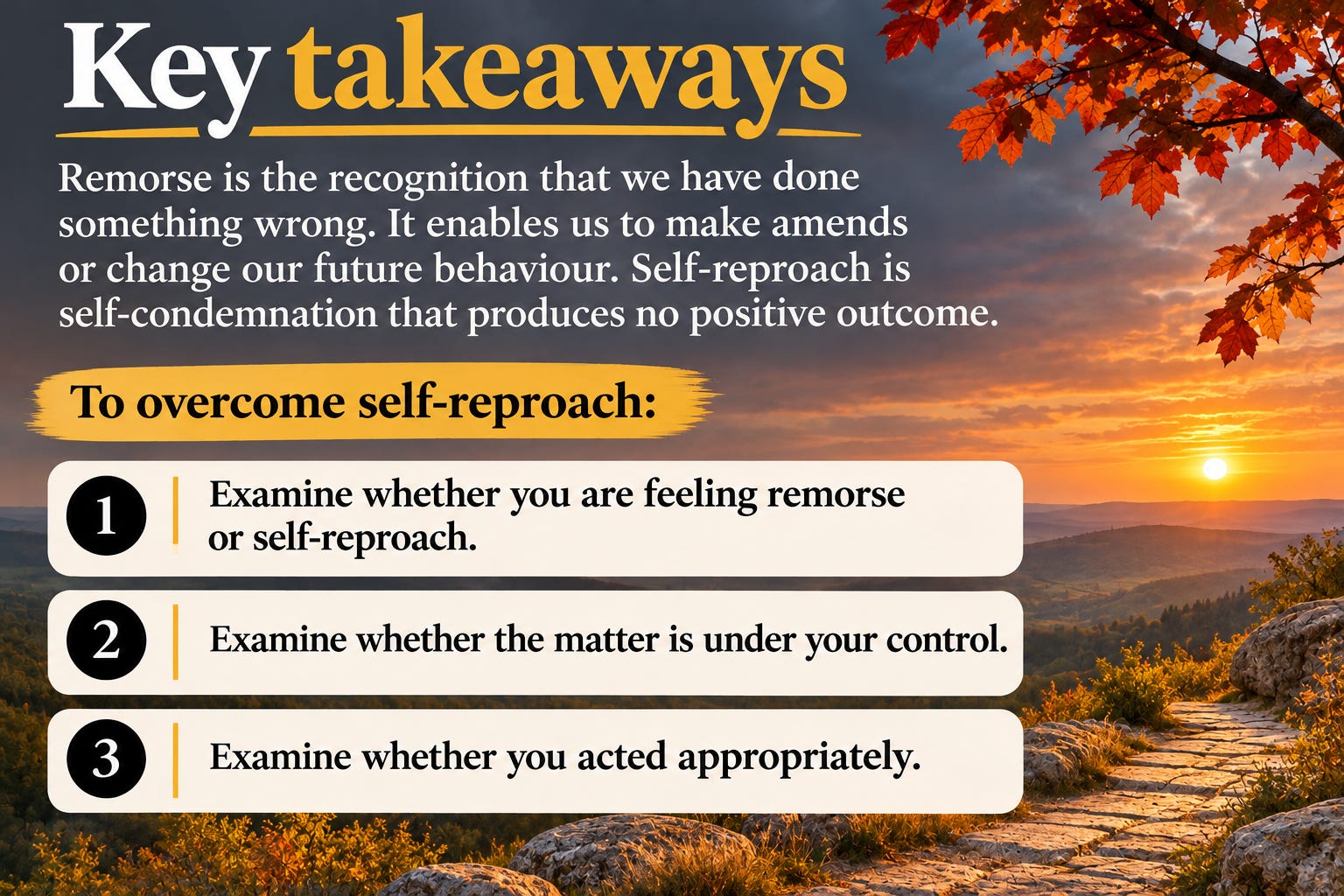
Remorse is the recognition that we have done something wrong. It enables us to make amends or change our future behaviour. Self-reproach is self-condemnation that produces no positive outcome.
To overcome self-reproach:
Examine whether you are feeling remorse or self-reproach.
Examine whether the matter is under your control.
Examine whether you acted appropriately.
Think of something you still reproach yourself for.
Write down exactly what happened. Now answer these three questions:
Is there any wrongdoing for which I can make amends?
Was the outcome fully under my control?
Given what I knew at the time, did I act as reasonably and appropriately as I could?
Think through and answer each question in writing.
If you cannot make amends, could not control the outcome, and acted appropriately with the information available to you at the time, then what remains is probably not remorse but self-reproach. Contemplate on the question,
“I may wish things had turned out differently, but I was not responsible for what was beyond my control. I will learn what I can and let go of the rest.”
Ask yourself,
What useful purpose does continuing to punish myself serve?
141126