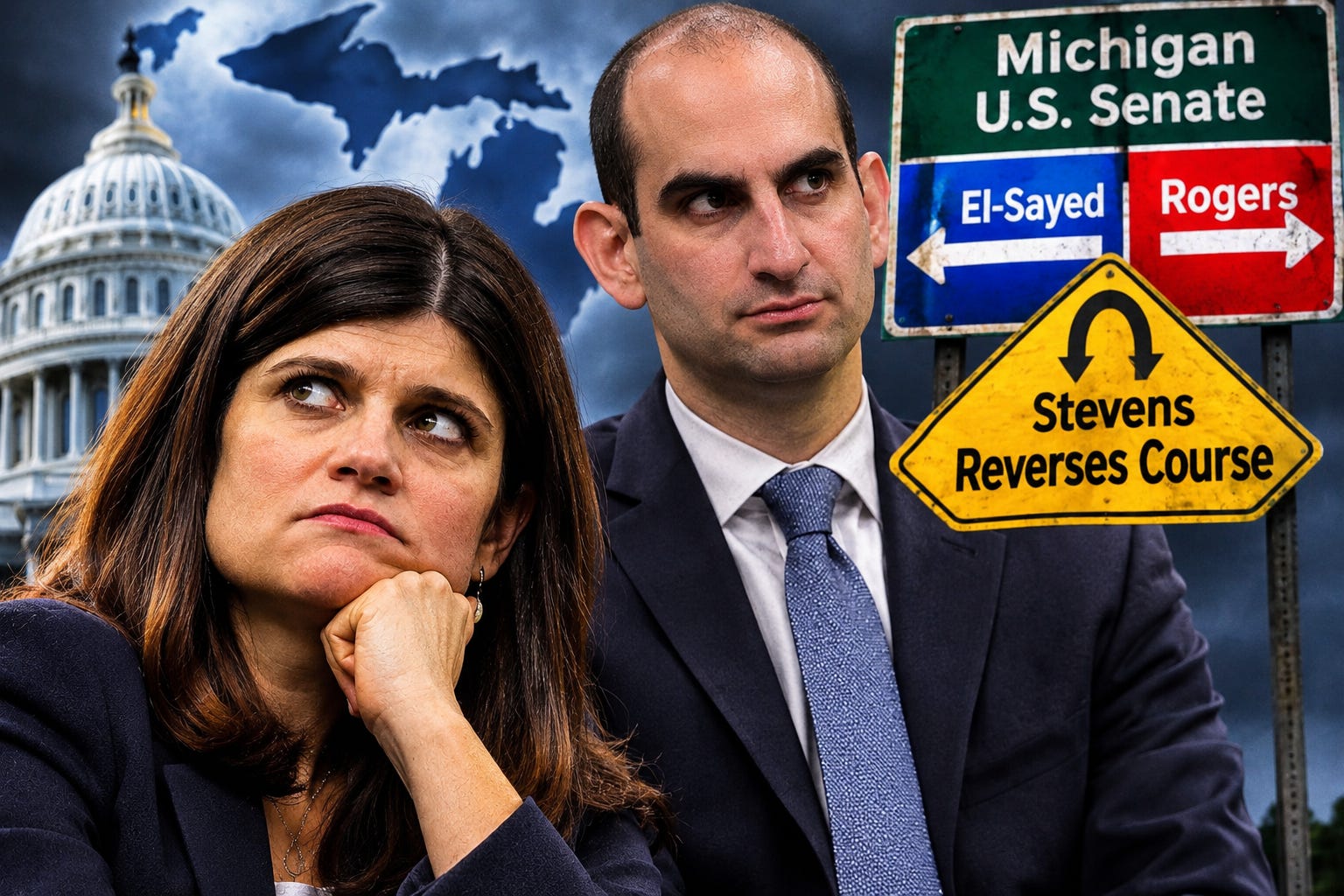
After writing two articles about Haley Stevens and her astonishing decision to endorse Republican Mike Rogers for the United States Senate, I figured I had devoted more than enough of my life to this woman. There are approximately 330 million people in this country, and I would genuinely like to spend some time discussing a few of the others. Unfortunately, Stevens has demonstrated a remarkable ability to turn a political embarrassment into a serialized television drama. Just when I think the credits are rolling, somebody walks into the room with another revelation, and the damn thing gets renewed for another season.
A number of readers responding to my articles suggested that Stevens’ fiancé, Jason Turkish, might have influenced her decision. I didn’t push back against that possibility because, frankly, I had considered it myself. I’ve studied political behavior and political psychology for years, and I know how much influence intimate relationships can have on a person’s beliefs. I’ve also been in enough relationships to understand that love can occasionally make perfectly reasonable adults behave like they have suffered a traumatic encounter with a falling refrigerator.
I explored this subject in an earlier article titled If You Believe in Nothing, Someone Will Believe in Something for You. My argument was that people without strongly developed beliefs are especially vulnerable to adopting the convictions of people they love, admire, or depend upon. Sometimes the consequences are trivial. You start watching a football team you previously couldn’t have identified if its entire roster knocked on your front door. Sometimes the consequences involve politics, religion, or decisions that permanently alter the direction of your life.
After reading the latest Mother Jones reporting and a deeply revealing CNN investigation, however, I began wondering whether Turkish’s influence might have been considerably more extensive than some of us initially suspected.
And holy shit, there is a lot to unpack.
Before I get to the allegations, I want to give Turkish credit where he deserves it. He’s an accomplished attorney whose work has advanced disability rights. He is legally blind and serves as president and managing partner of Nyman Turkish, a law firm specializing in disability advocacy. His legal work includes a case that helped bring about the elimination of the logic-games section of the Law School Admission Test, a section that disadvantaged certain blind test-takers.
As someone who lives with a disability, I can appreciate the significance of that accomplishment. Disabled people routinely encounter institutions that congratulate themselves for being inclusive while maintaining procedures that make participation unnecessarily difficult. Challenging those barriers takes legal expertise, persistence, and a willingness to confront organizations that would prefer everyone accept the status quo. Turkish deserves recognition for that work.
I also have no particular reason to believe he’s a terrible human being. He could be a wonderful friend, a devoted partner, and the kind of attorney who goes to extraordinary lengths for his clients. I don’t know the man personally, and I’m not interested in manufacturing an indictment of his entire character from his political activities.
But the more I examined those activities, the more concerned I became about his approach to Israel and the influence former Stevens staffers say he exercised.
Turkish is a substantial political donor who has contributed more than $200,000 in federal elections during the current cycle. His contributions have gone largely to Democrats, although he has also supported politicians from both parties who share his commitment to Israel. He describes himself as a lifelong Democrat. His political disagreement with Abdul El-Sayed is sufficiently intense that he publicly announced his support for Mike Rogers, attended a Republican Jewish Coalition event, and found himself receiving praise from Ted Cruz.
Now, I’m not sure how Turkish feels about receiving compliments from Ted Cruz, but if that man started praising my political judgment, I would seriously consider having my judgment examined by a licensed professional. I would at least want a second opinion.
Turkish has argued that El-Sayed’s rhetoric concerning Israel and antisemitism makes Jewish Michiganders less safe. Those concerns deserve to be described accurately, just as El-Sayed’s position deserves to be represented accurately. El-Sayed has condemned antisemitism and maintained that criticism of the Israeli government should not be conflated with hostility toward Jewish people. Jewish Democrats, including Senator Elissa Slotkin, have supported him despite disagreements about Israel.
From the outside looking in, I think Turkish has developed an extraordinarily consequential blind spot concerning Israel. By that, I mean his political judgment on this issue seems capable of overriding commitments he has maintained elsewhere. His willingness to support Rogers demonstrates how far that disagreement has taken him. Whether he would make the same choice on an unrelated issue is another question entirely.
I am also aware that Turkish’s Jewish identity, his family’s history, and his religious commitments are deeply personal. His grandparents were Holocaust refugees, and his father was born in Haifa. Those are meaningful elements of his background. But Jewish Americans hold a wide range of political views, and neither his faith nor his family history should be treated as a substitute for examining what he actually says and does.
And what he allegedly did inside Stevens’ political operation is where this story becomes especially interesting.
According to CNN, six people who worked in Stevens’ congressional office or Senate campaign described Turkish as an overbearing presence who repeatedly involved himself in matters ordinarily handled by professional campaign staff. The allegations include belittling employees, interfering with fundraising operations, attempting to influence debate preparation, and disregarding requests that he limit his communications to designated senior personnel.
One episode is so ridiculous that I had to read it twice.
Former campaign staffers told CNN that Turkish wanted to assume control of Stevens’ online fundraising platform after receiving a fundraising solicitation himself. He reportedly believed that receiving another request for money, despite having already donated, demonstrated that the operation was improperly targeting contributors.
Folks, campaigns ask existing contributors for money all the time. Fundraising operations routinely contact supporters who have donated before. Campaign professionals understand this. It’s one of the reasons the political fundraising industry exists, and also one of the reasons opening your email during election season can feel like being trapped in a room full of people who all need twenty-seven dollars before midnight.
Turkish, an accomplished attorney and political donor, allegedly saw a routine solicitation and concluded that he needed to take over the operation.
That’s quite a promotion to give yourself because you received an email.
Former staffers also told CNN that Turkish urged Stevens to begin a debate with El-Sayed by delivering an elaborate defense of Israel, described by one source as an Aaron Sorkin-style speech. I have nothing against Aaron Sorkin, but campaign debates generally work better when the candidate answers questions instead of auditioning for a revival of The West Wing. Michigan voters had concerns about affordability, healthcare, and the direction of their government. Opening a Senate debate as though you were delivering the climactic monologue in a courtroom drama would have been an interesting strategic choice.
Then there was Turkish’s reported habit of sending Stevens negative social-media commentary about herself.
Stevens had decided to step away from social media because she didn’t want to be distracted by insults about her appearance, speaking style, or political positions. Three former campaign employees told CNN that Turkish continued forwarding precisely that material to her. One aide described the resulting dynamic as a cycle in which he upset her and staff members had to calm her down afterward.
Think about that for a moment. A candidate establishes a reasonable boundary to protect her concentration during a demanding campaign. Someone close to her allegedly keeps bringing her material she specifically wanted to avoid. Her employees then have to spend time managing the resulting frustration.
If those accounts are accurate, I would love to know what Turkish thought he was accomplishing. Was he trying to prepare her for criticism? Motivate her? Demonstrate that the internet contains unpleasant people? I can assure everyone involved that politicians are generally aware of that last discovery. They don’t need a daily guided tour through the comments section.
Stevens and Turkish dispute the characterization offered by former staffers. Turkish provided CNN with emails showing that campaign employees included him in certain meetings and argued that the campaign had problems worth addressing. Those responses deserve consideration. Being invited into some conversations, however, doesn’t settle whether other interactions crossed professional boundaries.
The broader issue is organizational authority. Campaigns need clear responsibilities and decision-making structures. When someone with a personal relationship to the candidate becomes involved in operations without a clearly defined professional role, staff can find themselves dealing with conflicting expectations. And when employees believe that person has the candidate’s ear, challenging questionable advice becomes considerably more complicated.
As someone who studies organizational leadership, I find that aspect of the reporting particularly troubling. The influence of an intimate partner can become difficult to separate from the authority of the person holding office or seeking election. Staff members may feel pressure to accommodate someone who has no formal power over them because that person enjoys considerable informal access to the person who does.
Former Michigan governor Jim Blanchard provided another revealing account. He said he attended a dinner with Stevens, Turkish, and Stevens’ mother shortly before the endorsement reversal. According to Blanchard, Turkish repeatedly emphasized that people were disappointed Stevens had supported El-Sayed after losing the Democratic primary. Blanchard defended her earlier endorsement as the gracious conduct of a team player.
Turkish told CNN that he remembered the dinner differently and objected to Blanchard’s account becoming part of a media story.
I wasn’t at that dinner. I have no intention of pretending I know what anyone was thinking while the appetizers were being served. But Blanchard’s account is relevant because it places the question of Turkish’s influence outside the anonymous staff allegations. It describes a specific conversation, witnessed by a former governor, in which Turkish reportedly challenged the political decision Stevens had previously made.
And remember, by this point Turkish had already made his own preference clear. He wanted Rogers.
Only days before endorsing Rogers herself, Stevens was publicly describing their relationship as a politically divided household and saying she still wanted El-Sayed to win. Then came the announcement, the church appearance, and the spectacle of a Democratic congresswoman endorsing the Republican nominee against the winner of her own party’s Senate primary.
We’ve covered that theatrical production extensively in my previous articles. I have no desire to provide Stevens with another full-length review of her performance. Broadway has canceled shows with less drama, and those productions generally had the courtesy to leave their audiences with something resembling a coherent plot.
Still, the sequence raises a legitimate question: Was Stevens already privately moving toward Rogers, or did her fiancé’s political preferences contribute to her reversal?
The answer matters because political beliefs don’t develop in isolation.
A 2026 study published in Personality and Social Psychology Bulletin examined 1,613 heterosexual couples in New Zealand over ten annual waves of data. Researchers found that changes in one partner’s support for political parties predicted subsequent changes in the other partner’s support. The influence generally worked in both directions.
That research is relevant because we tend to think of political socialization as something that happens primarily during childhood and adolescence. Parents teach children, schools transmit civic norms, and communities expose individuals to political ideas. But romantic relationships can continue that process throughout adulthood. The person sharing your home, your meals, your disappointments, and your plans for the future can become a powerful source of political information and reinforcement.
Of course, relationships also bring together people who already share similar views. Similarity doesn’t automatically demonstrate persuasion. But it would be foolish to ignore the possibility that partners influence one another, particularly when one partner is intensely committed to an issue and repeatedly discusses it.
Religion introduces another dimension.
According to reporting from The New York Times, Stevens has considered converting to Judaism as she prepares to marry Turkish. She has reportedly met with a rabbi to explore the possibility.
I want to be careful about what that tells us. Religious conversion is a personal decision, and people have many legitimate reasons for exploring a faith. Stevens is entitled to make that decision without strangers treating her religious interests as evidence of some defect in her character. We also have no evidence that Turkish pressured her to convert.
But the situation illustrates why the relationship between religion, politics, and intimate partnerships deserves serious examination. Stevens is considering joining the religious tradition of her fiancé. Turkish, as far as public reporting indicates, isn’t contemplating adopting a religion associated with Stevens. That difference doesn’t establish an unequal relationship, but it does make the direction of this particular contemplated change worth observing.
Political scientist Michele Margolis explored the relationship between partisan commitments and religious identity in her 2018 book, From Politics to the Pews: How Partisanship and the Political Environment Shape Religious Identity. Her research demonstrates that political identity can influence religious engagement and religious choices. The relationship between religion and politics op…