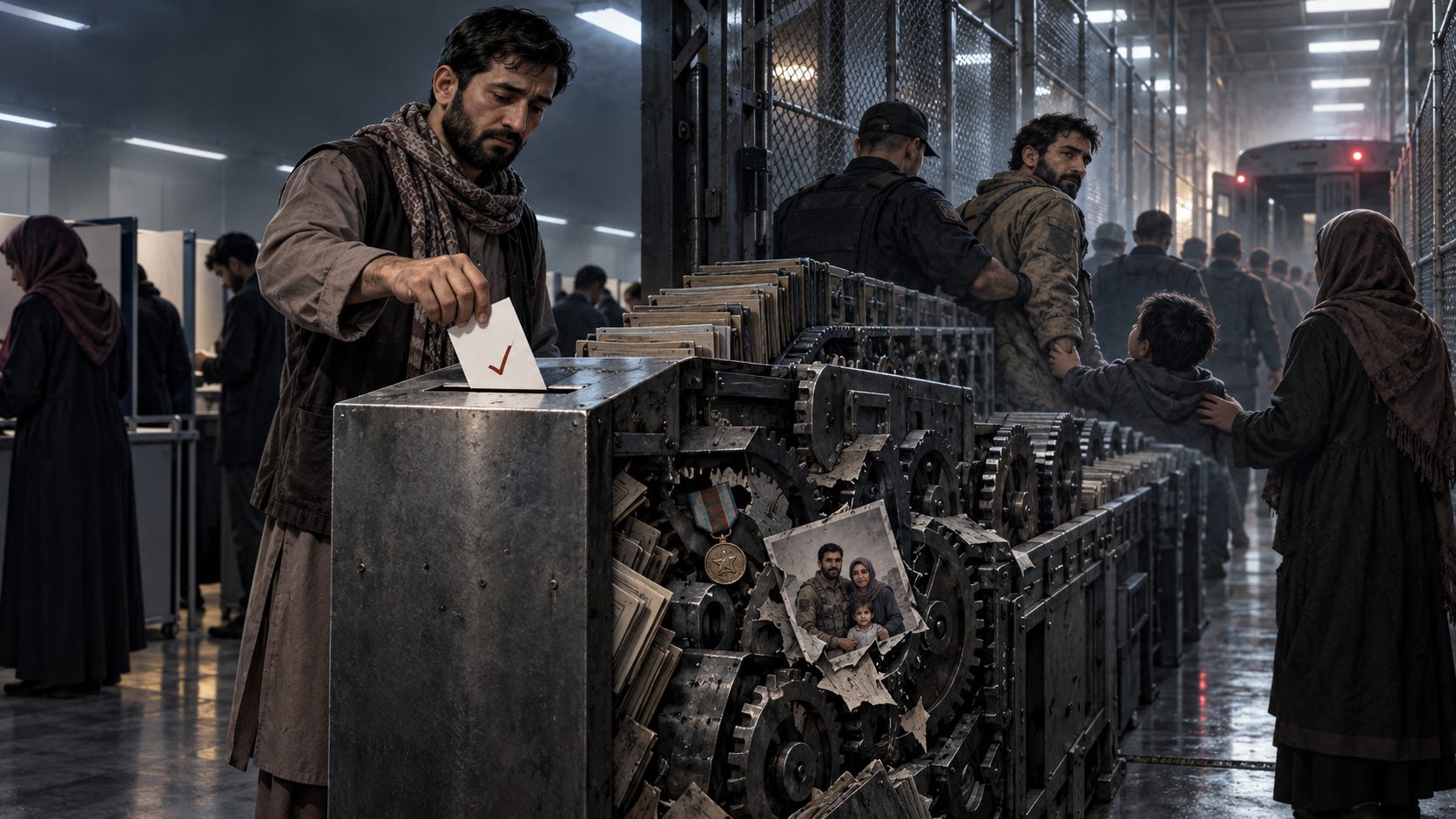
Last month, I wrote about Chef Wilkinson “Ken” Sejour, a Haitian immigrant in Miami who watched the same Trump-Harris debate the rest of us did and voted for Trump anyway. Chef Ken apparently heard “the largest deportation operation in American history” and mentally added an unpublished footnote: excluding me, obviously. He believed proximity to whiteness, legality, hard work, or whatever gold-star sticker he had awarded himself would place him safely outside the blast radius. Then the administration treated his exception exactly as Trump had promised to treat everyone else’s: as something that did not exist.
These stories are not becoming rarer. They are becoming more grotesque. Chef Ken’s encounter with reality threatened his restaurant by driving away workers and customers. Naseer Paktyawal’s lesson arrived in a body bag containing his brother.
The parallel is brutal because neither man lacked information. Trump did not conceal his intentions inside some 900-page policy manual available only to people willing to sacrifice a weekend and several functioning brain cells. “The largest deportation operation in American history” was not a dog whistle. It was the slogan. He repeated it at rallies, in interviews, and on debate stages with all the subtlety of a man yelling through a bullhorn while pointing at the people he intended to target. Chef Ken heard it and decided Trump must mean some other immigrants. Naseer heard it and made Trump the beneficiary of the first presidential ballot he ever cast as an American citizen.
Nazeer, the brother who died, deserves none of that blame. He had served in Afghanistan’s special forces alongside U.S. troops, fled after the Taliban’s return, and entered the United States through a legal humanitarian-parole process in 2021. His asylum application was still pending when ICE arrested him. I have found no evidence that he supported Trump, voted for Trump, or helped return this administration to power. He was a father of six preparing to take his children to school when federal agents arrived. The political judgment belonged to Naseer. The punishment landed on Nazeer.
Naseer’s grief is real, but grief does not retroactively transform a catastrophic political decision into an unforeseeable accident. He was not deceived by a secret agenda or ambushed by a policy Trump had carefully hidden behind a stack of classified documents at Mar-a-Lago. He possessed the same publicly available evidence as everyone else and voted for a man who had spent years explaining, repeatedly and enthusiastically, what he intended to do to immigrants from countries he considered undesirable. What happened to Nazeer was not the administration betraying its program. It was the administration implementing it.
Naseer says he believed Trump would protect immigrants like him and his brother. That qualification—immigrants like us—is where the entire pathology lives. He did not hear a universal threat against immigrants; he heard a sorting mechanism. Somewhere in his imagination, there was a federal concierge reviewing résumés at the deportation line: military service over here, translators over there, hardworking fathers in the expedited-exemption lane. The bad immigrants would be taken, while the properly credentialed ones would receive a thank-you card and perhaps a commemorative MAGA mint. Unfortunately, authoritarian exclusion does not operate like an airline loyalty program. There is no platinum-status boarding group for the people who helped load the plane.
The brothers had earned precisely the kind of record that Naseer assumed would purchase protection. Nazeer fought alongside U.S. Special Forces. Naseer worked as a translator for American troops, later received a special immigrant visa, became a citizen, and wanted to continue serving the United States. Yet the administration had already demonstrated how little such distinctions mattered. A federal rule cost Nazeer his Class A commercial driver’s license because of his immigration status, pushing a father of six out of trucking and into lower-paid grocery-store work. That was not an administrative hiccup. It was the warning label. Naseer simply read it as if it had been printed for somebody else.
The reasoning that led Naseer and Chef Ken to believe they would be spared is neither mysterious nor new. It reflects several familiar patterns from political psychology: motivated reasoning, in-group exceptionalism, identity-protective cognition, and selective empathy. Those terms sound more sophisticated than the underlying thought process, which was essentially: Surely he means the other immigrants.
First comes the exceptionalism fallacy. An immigrant hears the threat and mentally inserts an exemption the candidate never offered: He means the criminals, the undocumented, the people who did not serve, work hard, or follow the rules—not families like mine. Trump supplied the threat. Naseer supplied the imaginary fine print. Then he treated his own unauthorized amendment as official administration policy.
Closely related is the “good immigrant” myth—the belief that immigration enforcement operates according to a stable hierarchy of deservingness. Under this theory, military service, legal entry, a pending asylum application, steady employment, or a clean record should move someone into a protected category. Nazeer had all of it, and none of it mattered. Apparently, the résumé-review portion of the arrest never made it onto the schedule.
Then there is sunk-cost patriotism. Both brothers had organized significant parts of their identities around service to the United States, and Naseer, in particular, still hoped to work for the federal government himself. That history made loyalty to the United States more than a political preference; it became part of Naseer’s understanding of who he was. Once an identity carries that much personal investment, contradictory information can feel less like evidence and more like an insult. People begin defending the institution to preserve their image of themselves—even when the institution has stopped defending them.
Single-issue filtering likely played a role as well. Whether Naseer’s vote was driven by the economy, frustration with immigration backlogs, employment concerns, or something else, those considerations displaced the most directly relevant promise Trump made: mass deportation. That is motivated reasoning in practice. People do not necessarily fail to hear inconvenient information; they downgrade it until it no longer interferes with the conclusion they already prefer. The brain is a remarkably talented attorney when it has been retained to defend a decision the evidence does not support.
These concepts explain Naseer’s decision. They do not excuse it. An explanation identifies the mechanism by which someone rationalized a choice; an excuse diminishes responsibility for making it. Chef Ken and Naseer appear to have relied on the same invented exemption, and neither can reasonably claim that Trump concealed his immigration agenda. The misunderstanding was not created by ambiguity in the campaign’s message. It arose because each man assumed the message’s harshest consequences were intended for somebody else.
That is why Naseer’s guilt cannot simply be waved away as an unfortunate side effect of grief. He has said that his 2024 ballot was his first presidential vote, that he voted for Trump, and that he would regret the decision for the rest of his life. His brother’s death was not something Naseer intended, and casting one ballot does not establish direct causal responsibility for one person’s death. But moral responsibility is broader than direct causation. Naseer supported an administration that openly promised an enormous expansion of immigration detention and deportation, then discovered that his family’s service did not create the exemption he had imagined.
That guilt is therefore something Naseer will have to confront rather than something the rest of us are obligated to erase for him. Unfortunately for him, some guilt is appropriate—not because he wanted his brother harmed, but because the danger was publicly advertised and none of this needed to happen. The useful question is what he does with that guilt now. It can become a private ceremony of self-forgiveness, complete with tears, regret, and no change in behavior. Or it can become accountability: the recognition that remorse matters only when it alters what a person is willing to oppose, defend, and do next.
That raises a harder question: before ICE detained Nazeer, how much did Naseer care when the same system harmed other immigrant families?
There is no evidence that Naseer celebrated other arrests or joined the Trump supporters posting “womp womp” beneath videos of frightened families. It would be unfair to invent that history for him. But there is also no public evidence that he was loudly opposing the administration’s detention campaign before March 13. By the time ICE detained Nazeer, at least eleven other people had already died in ICE custody in 2026 alone, and families had already been separated during highly publicized enforcement operations. The danger did not become real when it reached the Paktyawal family. It merely became impossible for Naseer to treat it as somebody else’s problem.
We don’t talk enough about the real defect at the heart of stories like Naseer and Chef Ken. It’s not just that they thought they’d get a pass from the deportation machine. It’s that the machine grinding through other people’s families was totally acceptable background noise—right up until it picked up someone with their last name. Empathy that only kicks in once the cuffs go on your own relative isn’t empathy. It’s just grief wearing empathy’s hand-me-downs.
Would Naseer even be making tearful videos if it had been some other Afghan father arrested outside some other apartment complex in Richardson? Or would he have scrolled right past it, filed it away as a shame, and gone on with his day? I’m not accusing him of malice. I’m accusing him—and Chef Ken, and everyone like them—of something far more common and much less defensible: deliberate indifference, right up until indifference stopped being an option.
If Naseer’s indifference is the sad version of this delusion, Milo Yiannopoulos is the comedy special. Milo spent a decade as MAGA’s favorite professional troll, treating ICE like a punchline to use against his enemies and hurling deportation threats at anyone who looked at him wrong. He genuinely believed his performative tap-dancing—and being the exact kind of “blonde-haired British immigrant” Joe Rogan cheered for—made him bulletproof.
He found out the hard way that the token only works until the machine gets hungry. When ICE finally packed him up and shipped him back to the UK, they used the exact same cold, procedural language he’d cheered on for years. Milo built a career waxing the gears of a political meat grinder, only to act shocked when it caught his sleeve. The gears don’t have a sense of humor, and they don’t care who bought the grease.
Naseer at least has the excuse of loving a family member caught in the crosshairs. Milo didn’t even have that. He was just a court jester who thought his crown would protect him from the executioner. It didn’t. It never does. Whether you’re an immigrant who thought playing by the rules made you safe, or a professional troll who thought being useful made you invincible, the realization is the same: this movement was never selling safety. It was only leasing out the illusion of it.
I also want to be fair about who gets what level of grace here, because not every mistake carries the same weight.
Voting for Trump in 2016 was a mistake, but I get it, at least a little. He was a blank slate then—a reality TV host running as an anti-establishment wrecking ball, and a lot of people genuinely believed the system needed disrupting, with no real track record to judge him by beyond promises and low information. Bad judgment, forgivable ignorance. I don’t like it, but I get it.
Voting for him again in 2020, after four years of watching the governing style, the chaos, the cruelty, and the administrative dumpster fires—that’s worse. But I’ll still extend a sliver of grace here, because plenty of people looked at that first term and genuinely believed it delivered for them, whether that was the tax cuts, the judges, or something else. Wrong, in my opinion, but not inexplicable. Still forgivable.
The third vote is where my patience runs completely out. By 2024, there was no fog of war left to hide behind. You had already witnessed January 6th, complete with an incited mob chanting to execute the Vice President. You saw the E. Jean Carroll verdict. You watched thirty-four felony convictions roll in. The informational bar was no longer sitting low; it was lying flat on the floor. A “triple Trumper” isn’t someone who got conned. They are someone who looked at the itemized receipt for civil collapse, saw every single charge, and signed the credit card slip anyway.
And let’s clarify what “triple Trumper” actually means here. It isn’t just about counting physical ballots across three election cycles; it’s about institutional awareness. It includes the people who sat out 2016 or 2020 and decided to cast their very first presidential vote for him in 2024. Naseer falls right into this category. It was his inaugural vote, so technically he looks like a “single” on paper—but first-time status doesn’t grant you an amnesia waiver. By 2024, the evidence wasn’t hidden in a classified vault. It was broadcasting in high definition. You didn’t need a doctorate in comparative politics to figure out the platform; you just had to be paying attention to the news cycle right in front of you.
This is precisely why I can’t offer Naseer—or Chef Ken—the same grace I might extend to a naive 2016 voter. They didn’t lack information. They suffered from a classic case of exceptionalism bias: the psychological delusion that the leopards eating everyone else’s face would suddenly go vegetarian when they reached theirs. They knew what the machine did. They just assumed they held an administrative VIP pass.
So let’s lay out what actually happened to Nazeer Paktyawal. The raw timeline is damning enough without needing an ounce of embellishment.
March 13, 2026. Nazeer is getting ready to drive several of his six children to school from their apartment in Richardson, Texas. Before he can even turn the key, two unmarked SUVs pull up. Seven or eight agents in tactical gear leap out, yank him from the driver’s seat, and slap on hand irons—all directly in front of his kids. His twelve-year-old son, Imrain, watches the entire abduction unfold. That isn’t a minor detail; that’s a child who will carry that trauma for the rest of his life, just as Naseer will carry his ballot choice.
Nazeer is hauled to the Dallas ICE Field Office. By evening, he calls his brother, gasping for air, explaining his body is in agonizing pain. Alarmed, Naseer drives to the facility himself, dials 911, and watches the ambulance arrive. Later, his brother calls back: the medics never actually treated him. It isn’t until 11:30 p.m. that Nazeer is finally transferred to Parkland Memorial Hospital, where he receives an emergency breathing treatment and is kept overnight.
March 14, the next morning. While eating breakfa…