In the final years of his life, the physician and writer Oliver Sacks was diagnosed with terminal cancer. Faced with the knowledge that his remaining time was short, he wrote that he felt neither bitterness nor regret. Instead, he felt an intense desire to focus on what truly mattered: friends, meaningful work, reading, writing, and contemplation.
The prospect of death did not make him crave more distractions, entertainment, or busyness. It clarified his priorities. What mattered was not how much time remained, but how he chose to spend it.
We need not wait for the approach of death to start living well, or to understand what matters in life and what doesn’t.
Our lives are made of time, and time moves faster than we realize. Many of us postpone living. We tell ourselves that we will enjoy life once our problems are solved, our goals are achieved, or our insecurities are overcome. Then, often too late, we discover that life was never waiting for us on the other side of those conditions. Life was happening all along. Can you say your life is well lived and that you have no regrets? If so, this article is not for you. However, if you suspect that life is somehow passing you by and that you have not lived fully, the Stoics have something to say about it.
Life is precious. It is only natural that we want a life that flows well, even if we are not desperate to prolong it. How well we live matters more than how long we continue to breathe.
Our lives are made of time, and time is fleeting, moving faster than we realize.
Just a moment ago that I sat as a young man in the school of the philosopher Sotion; just a moment ago that I began to plead in courts; just a moment ago that I lost the desire to plead; and, just a moment ago that I lost the ability. The flight of time is infinitely swift, as those who look back see more clearly.—Seneca,Moral Letters 49
Many of us have a vague feeling that we are not living up to our full potential. Life passes by while we postpone living. We tell ourselves that we will enjoy life later, after we have solved our problems, achieved our goals, or overcome our insecurities. Then, perhaps too late, we realize how much time has slipped away.
The child says, “When I am a big boy.” But what is that? The big boy says, “When I grow up.” And then, grown up, he says, “When I get married.” But to be married, what is that after all? The thought changes to, “When I retire.” And then when retirement comes, he looks back over the landscape traversed; a cold wind seems to sweep over it; somehow he has missed it all, and it is gone.—Stephen Leacock, Feast of Stephen
We often learn too late that life is not what we imagined it would be after we had sorted out all our problems and insecurities. Life is what is happening now, with all its anxieties, uncertainties, and imperfections.
How do we live a life that focuses on what is happening now rather than dwelling on past regrets and future anxieties? The Stoics offer three practical lessons:
**Be aware of the flight of time.**Time disappears whether we pay attention to it or not. Treat it as your most valuable possession.**Have a clear vision.**Know what matters and what does not. Without a clear purpose, distractions multiply and busyness masquerades as progress.**Focus on today.**The future is shaped by what you do now. Direct your attention to the present day while remaining flexible enough to revise your plans when reason requires it.
No one intentionally squanders time. We waste it because we are unaware of how limited it is.
Hold an ice cube in your palm and close your hand. Open it a few minutes later, and the ice cube will have melted away. You do not have to do anything for it to disappear. Time is like that. If we do not live consciously and intentionally, time vanishes, and we wonder where our lives have gone.
Few of us plan to waste our lives. Yet we let time slip through our fingers without realizing it. We fail to understand that it is limited, even when we are not consciously wasting it.
We were entrusted by nature with the ownership of this single thing [time], so fleeting and slippery that anyone who will can oust us from possession. — Seneca,Moral Letters 1.3
When we are not in charge of our time, and therefore our lives, one of two things happens: either someone else takes charge of it, or we fritter it away ourselves. Either way, our lives pass us by before we realize, if we ever do, that we have thrown them away without meaning to.
No matter what has happened in the past or what may happen in the future, the only way to ensure that our lives are well lived is to focus on what is happening now and how we choose to spend our time today.
Why do we waste so much time? Why do we move from one thing to another without a clear purpose? Why, after all our activity, do we still feel that we are frittering our lives away?
Because we lack a clear vision.
Without a clear vision, every shiny object attracts us. When we are aimless, it is easy to drift from one distraction to another. Our days become crowded, yet we have little to show for them. A sense of dissatisfaction follows, all because we are not sure what we want out of life.
You do not know what you want. You are better at approving the right course than at following it out. You see where the true happiness lies, but you have not the courage to attain it. — Seneca, Moral Letters 21
We can avoid both inaction and pointless activity by cultivating a clear and consistent vision. A clear vision sustained people like Gandhi, Martin Luther King Jr., and Nelson Mandela through difficult times. We may not have such grand ambitions, but we can still decide what is important in our own lives and devote our attention to it instead of being carried away by whatever happens to come along.
See clearly for yourself what is necessary and what is superfluous.—Seneca, Moral Letters 110
Because our time is limited, every meaningless activity takes time away from what is meaningful.
Activity for its own sake is destructive. It often reveals a restless and uneasy mind. Filling our days with purposeless busyness is not the same as living well.
You will find that the largest portion of our life passes while we are doing ill, a goodly share while we are doing nothing, and the whole while we are doing that which is not to the purpose. — Seneca,Moral Letter 1
An agitated mind is not the same as an active mind. We should distinguish between useless activity and focused action. Focused actions are those that align with our vision. Mere activities are done simply to keep us busy.
When we have a clear and consistent vision, we know how to use our time.
One reason we are not fully present each day is that we worry about the future. Yet if we concentrate on what needs to be done today, we need not worry so much about what tomorrow may bring.
Lay hold of today’s task, and you will not need to depend so much upon tomorrow’s. — Seneca,Moral Letters I.13
We take care of today and need not be overly concerned about tomorrow. Tomorrow will soon become today, and we can deal with it when it arrives. The only day we can act in is the present one.
Our vision of life should guide us, not imprison us. We can revise it when circumstances change or when we discover we were mistaken.
“We must stick with a decision.” “That applies only to a sound decision, not to any decision.”—Epictetus, DiscoursesII.15
At the same time, we should not change our minds merely because we are fickle.
We should not be afraid to change either our purpose or our position, as long as we do not let that flexibility become fickleness.—Seneca,Moral Essays2.267
Our aim should be to live each day as well as possible. A well-lived life is nothing more than a succession of well-lived days.
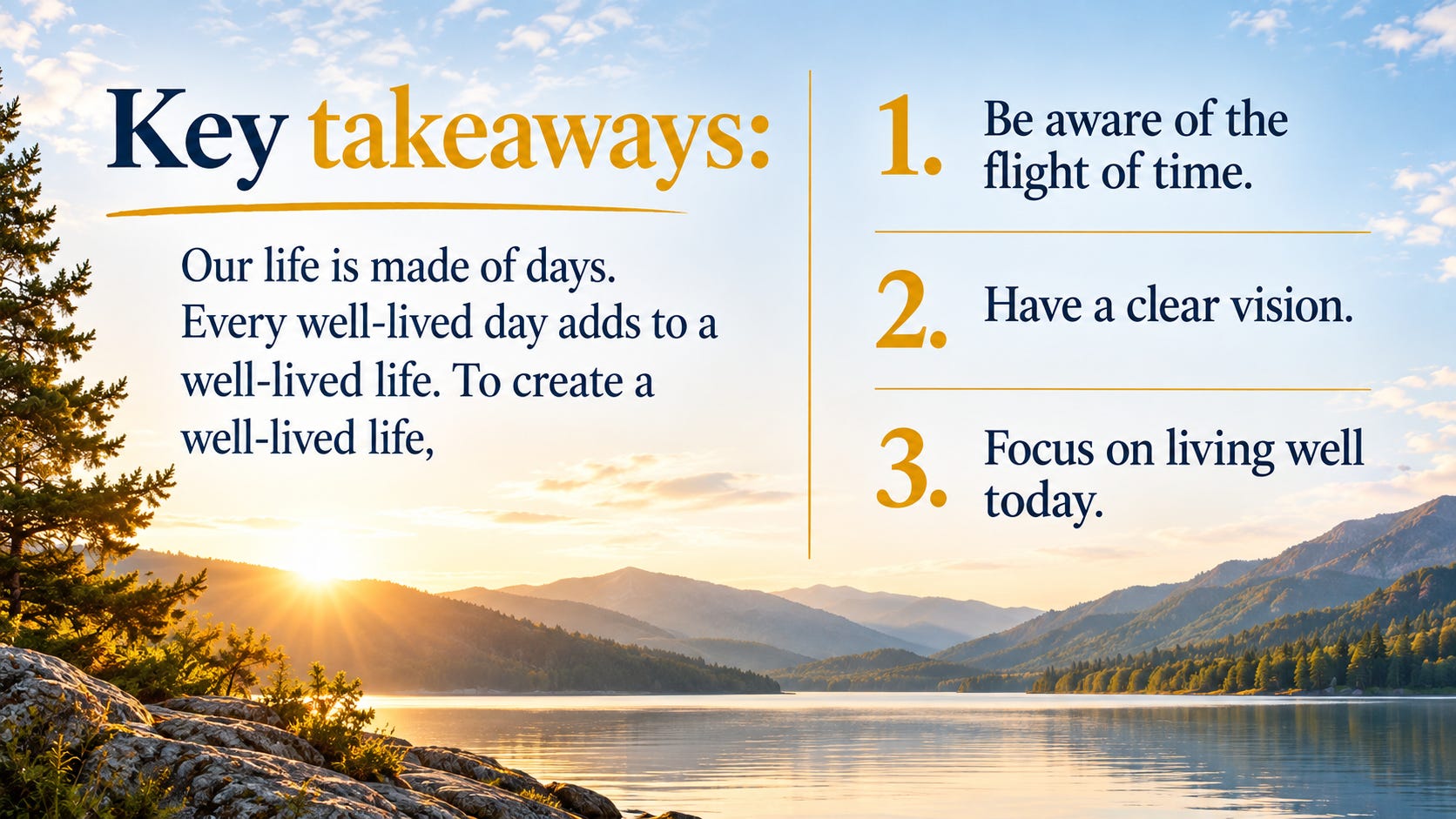
Our life is made of days. Every well-lived day adds to a well-lived life. To create a well-lived life,
Be aware of the flight of time
Have a clear vision
Focus on living well today
Take ten minutes and reflect on the following:
If you learned that your time was far shorter than you expected, what activities would immediately seem unimportant?
What people, pursuits, and commitments would still matter?
How much of your current week is spent on those things?
What are you postponing until “someday”?
What is one change you could make this week to bring your daily life into closer alignment with what you truly value?
150826