In 1995, Wag Dodge, a Montana firefighter, found himself trapped by a fast-moving wildfire. Flames were racing toward him. There was not enough time to outrun them, yet everyone started running anyway.
Dodge noticed something unusual. He stopped, lit the dry grass in front of him, and created a small burned patch of ground. Then he lay down in the ashes as the wildfire swept around him. Most of the other firefighters continued doing what instinct told them to do: run from the fire. Many died. Dodge survived because, in a moment of extreme danger, he stepped outside his automatic response and thought.
His survival depended on a rare human ability: not merely reacting, but examining a reaction before acting on it.
Most of us like to think we make conscious decisions throughout the day. Yet much of our lives are lived on autopilot. We are driven by habits, impulses, fears, prejudices, and assumptions that operate beneath our awareness. We react first and think later—if we think at all.
The strange thing is that we are masters at understanding the external world.
We know how to communicate instantly with someone on the other side of the globe by typing a few letters into an email address. We can place probes on distant planets. We build artificial intelligence systems, robotic assistants, and technologies that would have seemed magical a century ago.
Yet we remain surprisingly ignorant of our inner world.
Our judgments are distorted by biases. Our reasoning often serves as a lawyer defending beliefs we already hold. We start wars over ideology and identity. We accumulate resources long after our needs have been met. We compete for status, recognition, and honours that bring little lasting satisfaction. We worry endlessly about things that never happen.
Many of these problems will disappear once we pay full attention to what is in front of us rather than worrying about the past and the future.
Give your full attention to what is in front of you – an object, an action, a principle, or the meaning of what someone says. You will be disappointed, and rightly so. If you choose to become good tomorrow then be good today. — Marcus Aurelius,Meditations 8.22
Stoic mindfulness has many aspects. Here I essence of Stoic mindfulness is expressed through examining impressions. The Stoics advised us not to get carried away by our first impressions, but to examine them and accept them only when they accord with reality.
Consider road rage. A driver cuts us off in traffic. Within a fraction of a second, an entire story forms in our mind. We conclude that the driver is selfish, reckless, or disrespectful. Our heart rate rises. We become angry.
A few minutes later, we notice a sign on the back of the car: “Medical Emergency.”
Nothing about the event changed. Only our interpretation changed.
The Stoics would say that we did not react to reality itself, but to our impression of reality. We can begin by paying attention to how we form our judgments and how impressions distort them. This is Stoic mindfulness.
We are constantly bombarded by what the Stoics called impressions: the way things initially appear to us. Imagine that a close friend walks past you in a shopping mall without saying hello.
Several interpretations may arise immediately:
- My friend is angry with me.
- My friend is intentionally snubbing me.
- My friend is distracted and did not see me.
- My friend is dealing with a personal problem.
- My friend is in a hurry.
- My friend mistook me for someone else.
Each of these is an impression, not a fact. None is confirmed.
Yet most of us instantly accept one of these impressions as true and react accordingly. If we decide the other person is rude, irritation follows. If we decide they were distracted, we may simply move on. The event is the same; the response differs because it is based on interpretation. Psychologists call this tendency the “fundamental attribution error.”
Our minds make these judgments automatically, without asking whether they are true. Worry, anxiety, anger, selfishness, and similar reactions often stem from mistaken impressions.
We can avoid being carried away by an impression by pausing before judging and accepting it as true.
Hey impression, wait for me a while. Let me see what you are and what you represent. Let me test you before accepting you. — Epictetus, Discourses 2.18.24
The challenge, then, is to examine impressions before accepting them as valid.
Someone criticizes us, and we become angry. An investment falls in value, and we panic. A colleague receives praise, and we become envious. A small inconvenience ruins the entire day.
The event occurs. The impression appears. Then, without awareness, we assent to the impression and act. Stoic mindfulness consists of interrupting this process.
Instead of saying, “This must be true,” we learn to ask:
The pause may be brief, but it changes everything. When we pause, we suspend judgment, reevaluate the impression, and accept it only if it proves valid. With practice, our judgments become more dependent on reason than on emotion.
When we accept impressions as true without examining them, our judgments become distorted. This can diminish the four Stoic virtues: wisdom, justice, moderation, and courage.
Wisdom is the ability to distinguish appearance from reality.
A wise person recognizes that first impressions are hypotheses. They may be correct, but they may also be mistaken. Therefore, they must be tested.
Abraham Lincoln understood this. When he was furious with someone, he often wrote what he called a “hot letter,” expressing all his anger and criticizing the person in the strongest possible terms.
Then he put the letter away and never sent it.
The pause gave him time to examine his initial reaction. By the next day, what had seemed obvious in anger often seemed foolish in calm reflection.
Lincoln understood something the Stoics had taught centuries earlier: our first judgment is rarely our best judgment.
Much of what we call maturity is the gradual realization that our immediate judgments cannot always be trusted. When we stop reacting automatically and begin examining our impressions, we develop wisdom.
Justice is often understood simply as fairness toward others, but the Stoics saw it more broadly. It requires recognizing that we are not isolated individuals. We are members of families, communities, societies, and ultimately humanity itself.
We tend to interpret impressions personally. Our filter for judging them becomes: “What’s in it for me?” We forget that what benefits the community ultimately benefits us as well.
Many harmful actions begin with an unexamined impulse. We want more money, recognition, power, or control. Our desires convince us that grabbing whatever we can serves our interests.
But when we pause and examine these impulses, we often discover that selfishness damages trust, relationships, and communities. In harming the hive, we ultimately harm ourselves.
What is not good for the hive is not good for the bee. — Marcus Aurelius,Meditations 6.54
The Stoics would ask the question: Is this action good for me but harmful to others?
Mindfulness also helps us notice smaller acts of selfishness and distraction. Most people check their phones dozens or even hundreds of times a day. Few make a conscious decision each time they reach for the device.
A notification appears. The hand moves automatically. Five minutes later, we realize we have forgotten what we originally intended to do.
Stoic mindfulness begins by noticing the impulse before obeying it.
“Do I really need to check my phone right now?”
That single question can begin the practice of justice and moderation. It allows us to notice when greed, resentment, or selfish ambition is taking control and to ask whether those impulses deserve our assent.
Many of our habits survive because we never question them. We reach for another drink. We eat when we are not hungry. We continue scrolling after we are tired. The behaviour becomes automatic.
Moderation begins when we interrupt the habit loop and ask:
-
Why am I doing this?
-
Am I hungry, or merely bored?
-
Do I really want this, or am I acting from routine?
-
Do I need it, or is it simply familiar?
Often, the answer surprises us. A mindful examination of desire weakens its hold over us. What once felt irresistible begins to look optional.
This is how moderation develops: by examining our impressions before acting on them.
Our fears are another area in which autopilot dominates. We fear poverty, failure, rejection, illness, aging, and death. Yet many fears involve imagined futures rather than present realities.
When we examine these impressions, we may see that the mind is not disturbed by the event itself, but by the story it has created about the event. The future appears terrifying because we imagine facing it without our abilities, resilience, and judgment.
But whatever challenge arrives tomorrow, we will meet it with the same mind that has handled countless challenges before.
You will meet it—if you have to—with reason, the same resource you use now to deal with life. — Marcus Aurelius, Meditations 7.8
When we accept fearful impressions without examination, we fall into anxiety and worry. When we question them, we often discover that they rest on assumptions rather than realities.
Remember that for every challenge you face, you have the resources within you to cope with that challenge. — Epictetus,Enchiridion 10
Mindfulness does not eliminate fear. It reveals that fear is often arguing a weak case. In doing so, it gives rise to courage.
Much of our biases, prejudices, foolishness, selfishness, extremism, and fearfulness arise from hasty judgments. They can be reduced through Stoic mindfulness: examining impressions before accepting them as true.
An impression arrives.
Pause. Examine it. Test it. Then decide whether to accept it.
Most people spend their lives reacting. They follow impulses, prejudices, habits, and fears without noticing. In this sense, they are asleep while awake.
The Stoic seeks to wake up: to live consciously rather than automatically, to choose rather than merely react, and to replace autopilot with awareness. The primary tool for achieving this is to examine every impression that passes through the mind before accepting it as true.
The space between impression and response may be only a few seconds long. Yet within that space lie wisdom, justice, moderation, and courage—the four virtues upon which a good life is built.
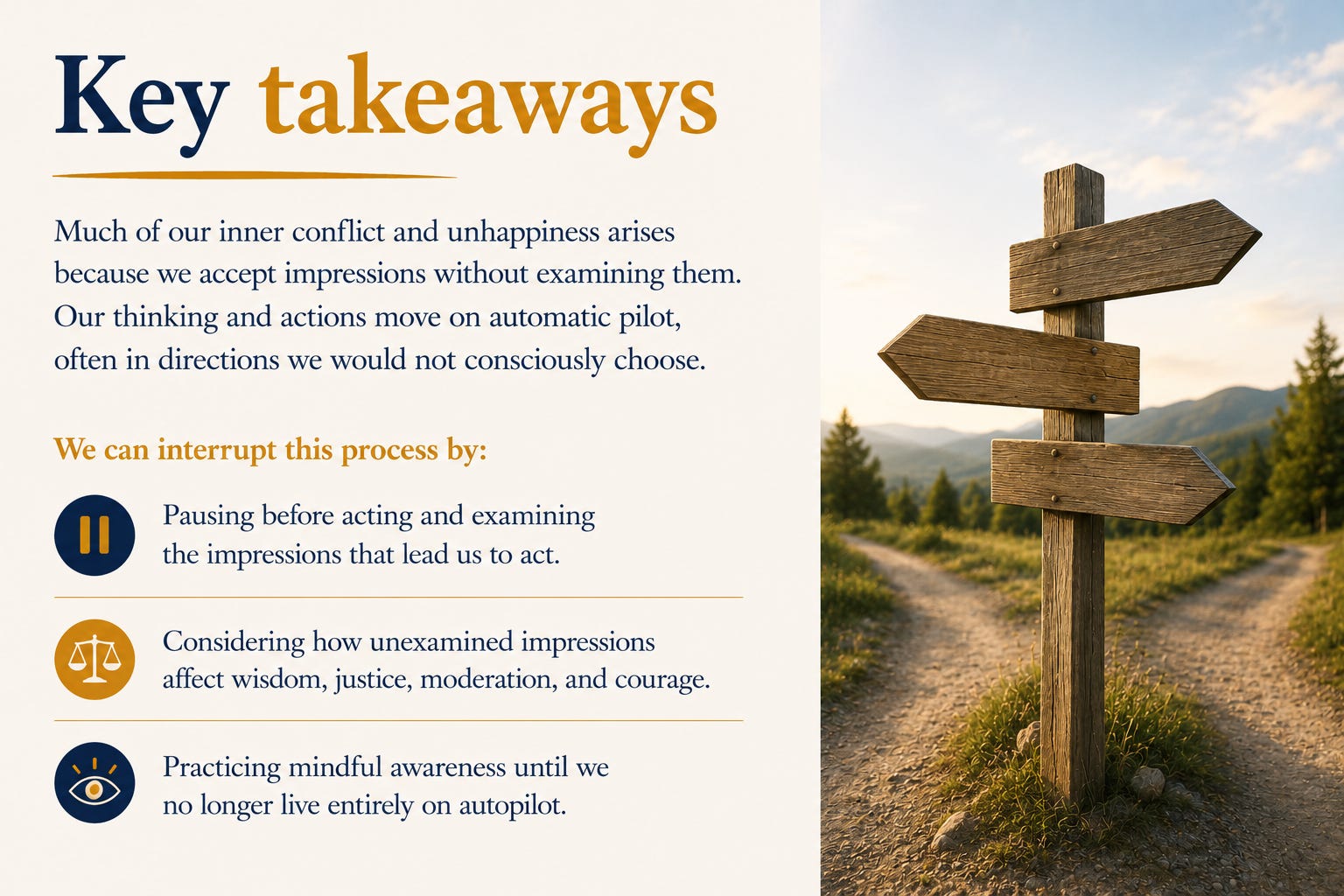
Much of our inner conflict and unhappiness arises because we accept impressions without examining them. Our thinking and actions move on automatic pilot, often in directions we would not consciously choose.
We can interrupt this process by:
Pausing before acting and examining the impressions that lead us to act.
Considering how unexamined impressions affect wisdom, justice, moderation, and courage.
Practicing mindful awareness until we no longer live entirely on autopilot.
For the next seven days, notice one moment each day when you experience a strong emotional reaction—anger, fear, irritation, jealousy, anxiety, or excitement.
Before responding, write down:
-
What happened?
-
What was my immediate interpretation?
-
What evidence supports that interpretation?
-
What alternative explanations exist?
-
What would a wise and fair response look like?
At the end of the week, review your notes.
You may discover that many of your strongest emotions were based not on reality itself, but on impressions you never thought to question. That realization may be the first step toward getting your mind off autopilot.
290826