The Friars Club, founded in New York in 1904, was one of the most famous private social clubs in entertainment. It was a gathering place for actors, comedians, musicians, and other show-business legends.
In the late 1940s, a friend persuaded Groucho Marx to join the club’s Beverly Hills chapter. Before long, however, he grew tired of its loud and boisterous atmosphere and decided to resign. The club president refused to accept Groucho’s explanation that he simply “didn’t have time” and demanded a better reason. Groucho responded with one of his most famous lines:
I don’t want to belong to any club that will accept me as a member.— Groucho Marx
The remark is funny, but it captures a surprisingly common human tendency.
We laugh at Groucho’s refusal to belong to a club that would accept him. If you can get it, how can it be worth much? Yet many of us do the same thing with our lives. We devalue the blessings that are already ours and spend our days longing for something else. Instead of appreciating what we have, we chase new experiences, possessions, and achievements, believing they will finally satisfy us.
Once something becomes familiar, we stop noticing its value. We assume happiness lies in the next achievement, the next purchase, or the next experience. Yet the good life is rarely found in what we are missing. More often, it is hidden in what we already possess but no longer see.
Most of us live with a low-grade sense of dissatisfaction. Perhaps it is the fault of the Prime Minister or the President. Perhaps it is our status in life. Perhaps people are against us. Perhaps we really need that promotion. We don’t have enough. We need a better car, a better house, a better job, a better neighbourhood, a better government, or even better weather. The reasons for our discontent are endless.
The irony is that this mild dissatisfaction often persists even when we already have everything we need to live well.
The good life begins when we want what we have. How do we exchange discontent for contentment?
The Stoics gave us several practical strategies.
The source of much of our dissatisfaction is not that we lack enough. It is that others seem to have more. Or that a newer, shinier version of what we already own exists somewhere.
No matter where we are in life, the mind creates a gap between what is and what should be. Unfortunately, closing one gap rarely helps. The moment we reach the target, the mind creates another.
Because the mind is constantly creating new gaps, happiness cannot come from filling them.
Instead of focusing on what is missing, we can change our perspective. We can look at everything we currently have and imagine how we would feel if it disappeared tomorrow.
Consider your home, your partner, your children, your health, your friends, your career, and the affection of people who care about you.
Many of the things we now take for granted were once things we desperately wanted.
Don’t dream about things you don’t have. Instead, think about the best things you now have and how much you would crave them if you didn’t have them.—Marcus Aurelius,Meditations 7.27
Do not spoil what you have by desiring what you have not; remember that what you now have was once among the things you only hoped for.— Epicurus
When we consciously focus on what we already possess, we will discover that we often have more than enough to be happy. The obstacle is usually not the absence of blessings but our failure to appreciate them.
We desire many things: food, water, shelter, money, reputation, and the comforts money can buy.
But not all desires are equal. Our desires are of two types: natural desires and opinion-based desires.
Desires for food, water, shelter, and safety are natural. Everyone experiences them.
Once satisfied, these desires diminish. After eating a meal, we do not immediately want another. After quenching our thirst, we stop looking for more water.
Natural desires are easy to understand, relatively easy to satisfy, and necessary for our well-being.
Wanting food when hungry is natural. Wanting gourmet food is a desire of opinion.
Ordinary food can satisfy hunger just as effectively as luxury food. Likewise, a modest chair can provide as much comfort as an expensive designer chair.
A person is admirable who uses earthenware as if it were silver, and equally admirable who uses silver as if it were earthenware.—Seneca, Moral Letters 5 (paraphrased)
The desire for luxury, prestige, and status is largely based on opinion.
Unlike natural desires, desires of opinion tend to grow when fulfilled.
The unemployed want jobs. Those with jobs want better jobs. Those with better jobs want even better jobs. People with hundreds of thousands want a million. Millionaires want tens of millions. Billionaires want more billions. There is no natural stopping point.
Natural desires are limited, but those which spring from false opinion can have no stopping point. The false has no limits. When you are travelling on a road, there must be an end; but when astray, your wanderings are limitless.—Seneca, Moral Letters 16
Is there anything wrong with pursuing a larger house, a better car, or greater wealth? Not necessarily. The danger comes when we confuse desires of opinion with necessities and begin believing that satisfying them is required for happiness.
Because desires of opinion expand when fulfilled, we should be careful when pursuing them. One way to avoid the trap is to limit such desires.
Suppose you want a larger house. Treat that goal as an endpoint, not the start of an endless series of upgrades.
The problem with opinion-based desires is that they appear highly attractive before we obtain them, then quickly lose their power once we have them.
By consciously limiting such pursuits, we prevent ourselves from creating a permanent gap between what we have and what we think we should have.
There is no harm in having more. But believing that more is necessary can be harmful.
Fix a limit which you will not even desire to pass, should you have the power. At last, then, away with all these treacherous goods! They look better to those who hope for them than to those who have attained them. If there were anything substantial in them, they would sooner or later satisfy you; as it is, they merely rouse the drinkers’ thirst.—Seneca, Moral Letters 15
How much do we actually need to be happy?
Probably far less than we imagine.
If our natural desires are satisfied, we already have most of what we need for a good life.
A bed performs its function whether it is simple or luxurious. Water quenches thirst whether it comes from a crystal bottle or a tap. The good life does not require endless additions.
Nature’s wealth is both limited and easy to procure; but the wealth required by vain ideals extends to infinity.—Epicurus, Principal Doctrines15
The problem is rarely that we have too little. More often, we fail to see how much we already possess. We keep looking beyond our lives for happiness while overlooking the people, possessions, opportunities, and experiences that once seemed worth wishing for. Contentment does not come from getting more. It comes from learning to value what is already ours.
The good life begins when we stop asking, “What am I missing?” and start asking, “What would I miss if it were gone?”
When we do that, we may discover that happiness has been closer than we thought all along.
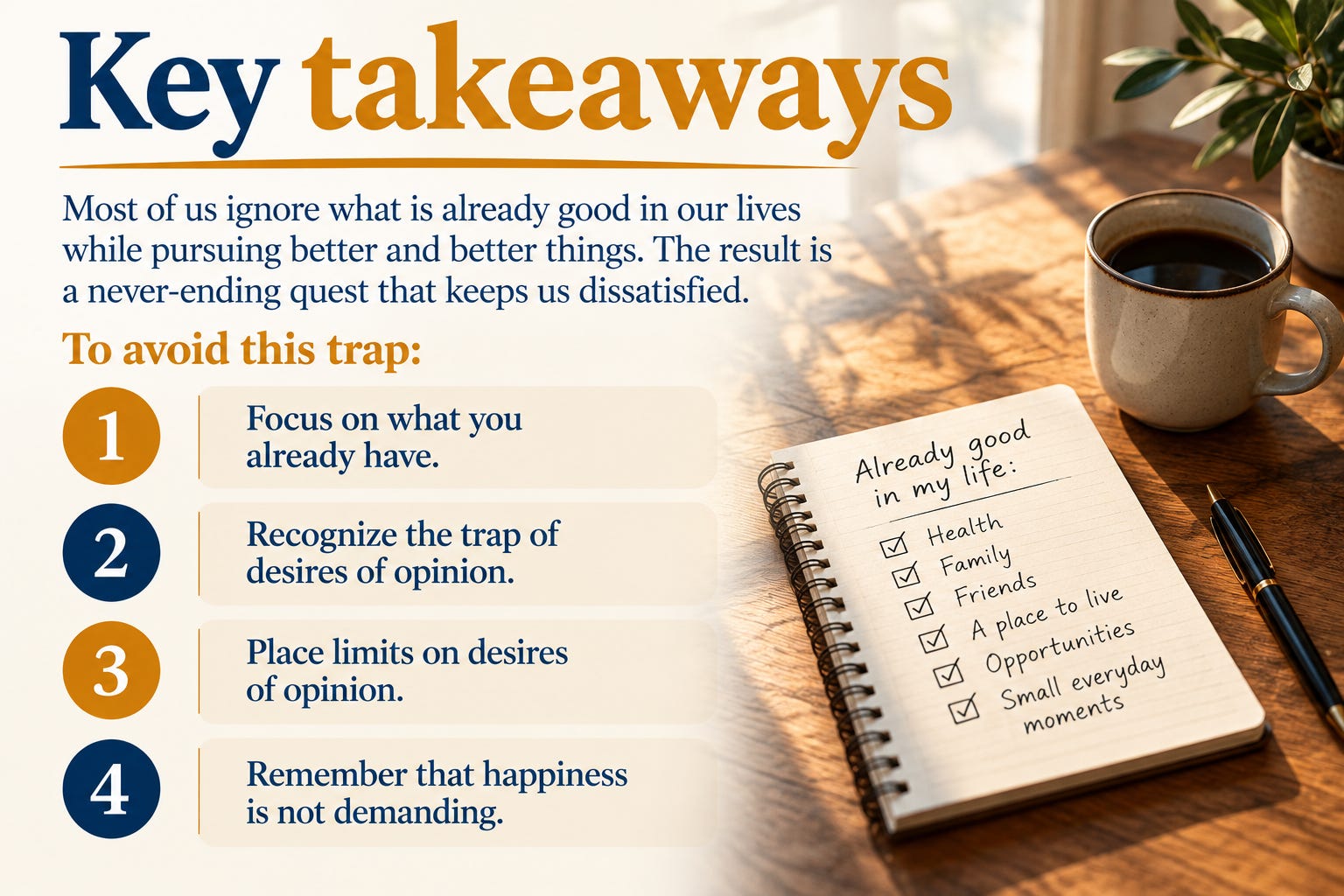
Most of us ignore what is already good in our lives while pursuing better and better things. The result is a never-ending quest that keeps us dissatisfied.
To avoid this trap:
Focus on what you already have.
Recognize the trap of desires of opinion.
Place limits on desires of opinion.
Remember that happiness is not demanding.
Take a sheet of paper and divide it into two columns.
In the first column, write down ten things that contribute to your life: your health, home, partner, children, close friends, meaningful work, financial security, treasured possessions, or anything else you value.
In the second column, imagine that each of these things has suddenly disappeared. Briefly describe how your life would change without them.
Then reflect on these questions:
Which of these blessings do I take for granted?
Which of them was once something I deeply wanted?
What am I currently pursuing because I believe it will make me happy?
Am I overlooking things that already have that power?
Repeat this exercise whenever your attention becomes fixed on what is missing from your life.
You may discover that it is difficult to feel grateful and dissatisfied at the same time.
031026