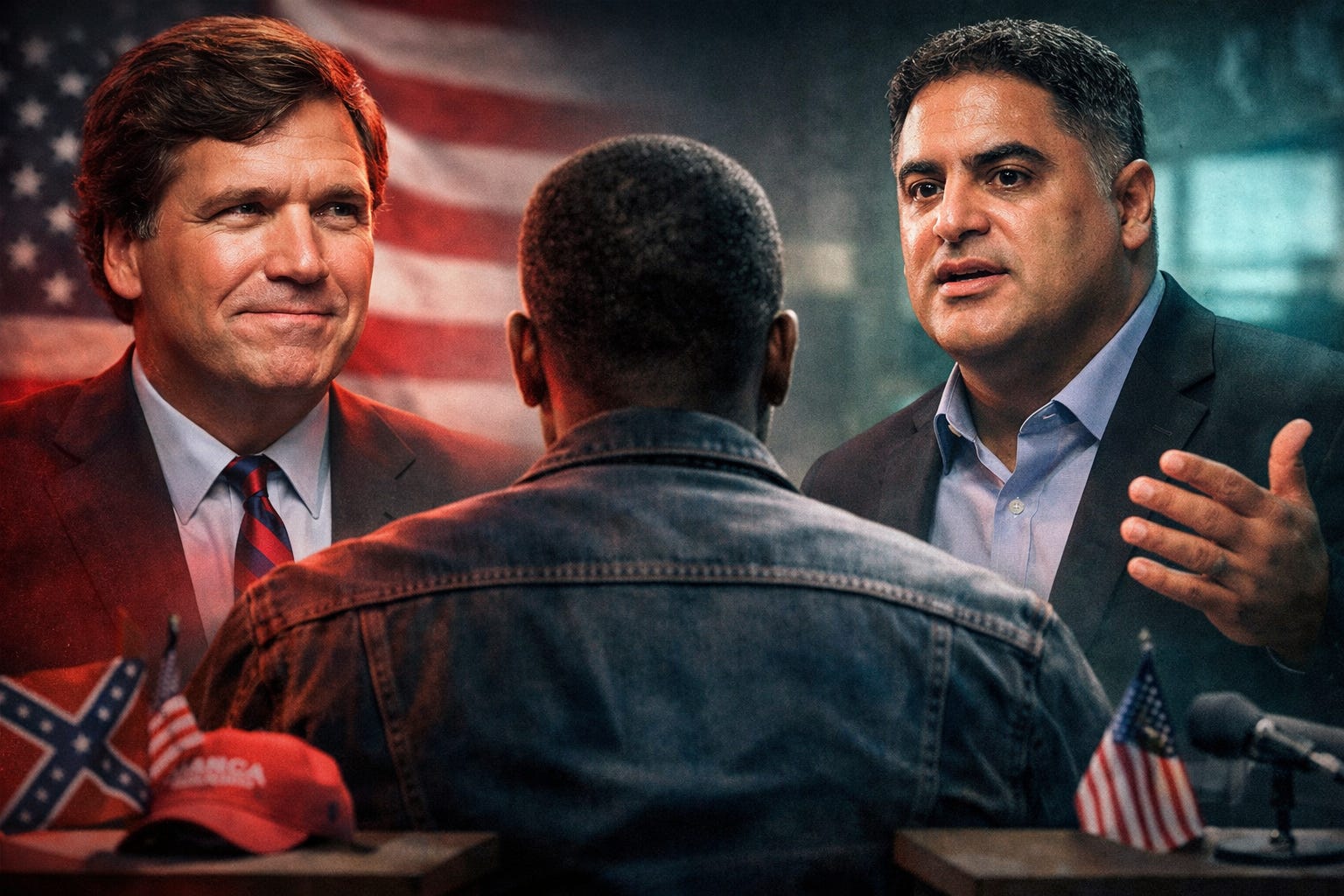
I want to be clear about something before we get into this. I don’t enjoy writing about Cenk Uygur. It’s not that I’m conflicted about the critique — I’m not. It’s that every time this man does something that demands a response, I have to sit down and spend energy on a person whose entire career is built on harvesting other people’s outrage and calling it journalism. But here we are. Again. Because Cenk recently went on his own show to discuss his appearance on Tucker Carlson’s program, and what followed was one of the more uncomfortable viewing experiences I’ve had that didn’t involve a medical procedure. Cenk was predicting that Tucker Carlson would become more popular than Donald Trump — and I need you to understand the energy with which he was delivering this prediction. This was not political analysis. This was not sober punditry. This was a man who sounded audibly aroused. I’m talking about the kind of vocal excitement that, in any other context, would require a cigarette and some privacy afterward. Cenk Uygur, founder of The Young Turks, progressive media institution, former congressional candidate, was out here talking about Tucker Carlson’s populist ascendancy like Tucker had just walked into the room in slow motion with the wind blowing through his hair. I watched it twice because I needed to make sure I wasn’t imagining things. I was not imagining things. Let’s get into it.
I’ve written about this moment coming for over a year. In April 2025, I published “I Don’t Negotiate with White Supremacists” — a piece that named TYT by name as a revolving door to the right, called horseshoe theory by its name, and drew a clear line between progressive credibility and progressive cosplay. Then in July I wrote “Everything You Shouldn’t Do in Progressive Politics, Taught by Cenk Uygur” and documented his Peter Thiel–adjacent funding, his logical fallacies, and his transformation from progressive firewall to what I called — and I stand by this term — a walking syllabus of argumentum ad blowhardium. Then in February 2026 I wrote “Zionism Isn’t a Moral Shield” about Ana Kasparian defending Tucker to the I’ve Had It ladies by claiming his Zionism cleared him of antisemitism charges — a piece of reasoning so intellectually empty that I had to take a moment just to process the audacity of it. I said then that Zionism is not a TSA PreCheck for bigotry. I’m saying it again now.
This piece is not a fourth swing at the same target. This is the closing argument. Because what Cenk has done in the last several months isn’t drift. It isn’t evolution. It isn’t brave independent media. What it is, with clinical precision, is the complete ideological collapse I documented in real time, three separate times, in three separate pieces. And I want to name every mechanism of that collapse before I’m done.
Let’s start with the stated justification. Cenk has explained, on camera and at length, why he keeps appearing on Tucker’s show. The argument goes like this: the Republican vs. Democrat divide is a mirage manufactured by elites to keep ordinary people fighting each other. Tucker has influence over Trump’s base that progressive professors and commentators don’t. Despite deep disagreements on immigration — which Cenk himself described as “racist and disgusting” — there is shared populist ground on anti-war positions, Gaza, the Epstein files, and credit card interest rates. Therefore the appearances are not only justified but strategically necessary. This is the argument. I want you to hold it in your mind while I tell you about Daniel Perry.
Daniel Perry is an Army sergeant who, in 2020, drove his car into a crowd of Black Lives Matter protesters in Austin, Texas, and killed Garrett Foster. His own text messages, retrieved before he even arrived at the scene, showed him talking about wanting to shoot protesters. A Texas jury — not a liberal coastal court, a Texas jury — looked at the evidence and convicted him of murder. The system that conservatives claim to revere — the jury of your peers, the verdict of twelve citizens, the rule of law — delivered its judgment. Tucker Carlson looked at that verdict and decided it was wrong. He ran a sustained media campaign to override a democratic legal process because the victim was on the wrong side of a culture war. And Greg Abbott, spineless as advertised, delivered the pardon. So when Cenk tells us he’s found common ground with Tucker on foreign policy and anti-war positions, Daniel Perry’s name is sitting right there in the room. Garrett Foster’s family is sitting right there in the room. Credit card interest rates are not sufficient moral currency to make that disappear.
And then there’s the record that Nicholas Confessore of the New York Times documented so thoroughly that NPR dedicated a Fresh Air episode to the question: has Tucker Carlson created the most racist show in the history of cable news? Confessore and his team went through years of transcripts and mapped exactly how Tucker mainstreamed white nationalist talking points — the Great Replacement rhetoric, the demographic panic, the dog whistles that didn’t require full sentences because the audience already knew what was being communicated. I’ve written about this directly in “From Tucker to Trump: How the Great (aka White) Replacement Theory Became Policy.” The Great Replacement isn’t a theory. It’s a confession. And Tucker Carlson spent years packaging that confession into primetime television and selling it to an audience that was hungry for permission to feel like victims of the people who actually are victims.
None of that gets erased because Tucker criticized Trump’s Iran war posture. Let me be direct about this: Tucker Carlson is correct about the Iran war. He is also correct that Easter Sunday is a strange occasion for a profanity-laden Truth Social post about bombing power plants. These are the easiest possible positions to hold right now. Millions of Americans who couldn’t identify Tucker Carlson in a lineup are correct about the Iran war. The anti-war position on an unpopular, constitutionally dubious military adventure is not a courageous intellectual stand. It’s the floor. You don’t get a character reference for clearing a hurdle that low. And you certainly don’t get your entire documented record of racial demagoguery laundered away because you and a former progressive media host agree that bombing Iran is bad, actually.
Let’s also talk about the Putin interview, since Tucker’s foreign policy bravery keeps getting invoked as evidence of his independent credibility. Tucker flew to Moscow, sat across from Vladimir Putin, and came back looking like a student who hadn’t done the reading. Putin ran circles around him historically, redirected every question into a prepared lecture about NATO expansion and Russian sovereignty, and Tucker sat there nodding like a man who was just grateful to be in the room. This wasn’t journalism. It wasn’t even good propaganda — it was Putin using Tucker as a delivery mechanism for Kremlin talking points to an American audience, and Tucker was so flattered by the access that he couldn’t see he was the product being sold, not the journalist doing the selling. That’s the foreign policy courage Cenk is celebrating as the basis for their populist alliance.
Then there’s the Ice Cube interview, which Tucker has apparently filed under “street credibility.” Tucker had Ice Cube on his show, where Cube held forth about nothing changing in the hood, called out The View and Oprah, touched on transgenderism, and generally gave Tucker’s audience the Black authenticity cosign Tucker had been looking for. I want to be precise about the psychology operating here. What Ice Cube suffers from is experiential distance bias — a condition where someone uses a past identity or experience as permanent authority on a current reality they are no longer living. The supporting mechanism is nostalgic credentialism — cashing an authenticity check that your current net worth and your son’s acting career have long since voided. Ice Cube was twenty years old when Straight Outta Compton dropped in 1988. He has been wealthy, famous, and materially insulated from the conditions of South Central for over thirty years. His son O’Shea Jackson Jr. grew up in a completely different tax bracket, got his film debut playing his own father in a studio biopic, and has established himself as a working actor on his own terms. Outside of racism — which is a real and persistent variable that no amount of generational wealth fully eliminates — O’Shea Jackson Jr. is not navigating the material conditions that produced the music his father made when Ronald Reagan was president.
I want to be fair to myself here. I’m not Ice Cube rich. I’ve been upper middle class for a little over a decade and I already have to actively catch myself before assuming everyone has an accountant, or knows what a housekeeper costs, or has stocks and bonds as a line item in their monthly budget. I have the kind of money where one bad night in Vegas and I could go right back to being poor. That precarity keeps me honest. Ice Cube has the kind of money that expands generations. And in 2022, he was giving Tucker Carlson a tutorial on the inner workings of communities his family tree has been departing since the early 1990s. Tucker didn’t need Ice Cube to be accurate. He needed Ice Cube to be Black and famous and willing to sit in that chair. The content was beside the point.
The same dynamic operated when Cenk showed up at a Turning Point USA event, got interviewed by the late Charlie Kirk, and asked the crowd whether they liked Dick Cheney. The crowd booed. And Cenk turned to the left and said, essentially: you win, take the W. I want to be charitable and assume Cenk is smarter than that moment suggested. I’m going to be charitable and assume he knew exactly what he was doing — which is actually worse. That TPUSA crowd didn’t boo Dick Cheney because he lied about weapons of mass destruction to start a war that killed hundreds of thousands of people. They didn’t boo him over Abu Ghraib, or warrantless surveillance, or Halliburton. They booed him because his daughter voted to impeach Donald Trump and Dick Cheney said January 6th was wrong. That’s a loyalty test. That’s MAGA enforcing its ideological purity. And Cenk looked at that boo and called it common ground. That’s not naivety. That’s opportunism with a populist bumper sticker slapped over it.
And I keep coming back to Kamala Harris and Liz Cheney, because the double standard here is so grotesque it deserves its own paragraph. Harris courts Cheney — a Republican who openly despises Trump, voted for impeachment, and was willing to say January 6th was wrong on the national record — as a strategic move in a razor-thin election. TYT loses their minds. Purity violation. Unforgivable. Cenk and Ana practically write her political obituary. Meanwhile Cenk is spending two and a half hours on Tucker Carlson’s couch calling him a visionary populist figure, and that’s brave independent journalism. As I documented in “She Deserved Better,” Harris wasn’t trying to win an argument on YouTube. She was trying to survive a broken electorate and she nearly pulled it off. The people who torched her for the Cheney endorsement are the same people now hosting the man who lobbied a governor to pardon someone convicted of murder by a jury of his peers. The asymmetry isn’t a contradiction. It’s the tell.
Let’s name what this is with the precision it deserves. What Cenk runs is what communications researchers Jeffrey Berry and Sarah Sobieraj identified as outrage media — a business model structurally dependent on there always being an enemy, always being a betrayal, always being a reason the audience needs to stay angry and keep clicking. The product isn’t analysis. The product is the anger itself. A Republican will never be conservative enough to be beyond critique. A Democrat will never be pure enough to deserve defense. The machine requires enemies on both sides to keep running, which means the machine is never actually in the business of building anything. It’s in the business of harvesting grievance.
The more specific diagnosis for Cenk in particular is asymmetric outrage entrepreneurship — where the outrage isn’t applied evenly or consistently, but deployed strategically based on what serves the brand. Kamala Harris courting Liz Cheney: moral catastrophe. Tucker Carlson lobbying for a convicted killer’s pardon: a conversation partner with shared populist values. Ana Kasparian appearing with Glenn Beck: necessary bridge-building. Progressive voters choosing Harris over abstention: selling out. The outrage is real but the targeting is entirely opportunistic. That’s the asymmetric part. The entrepreneurship part is that Cenk gets paid either way. In this respect, his media ecosystem is not structurally different from Alex Jones’s. Different aesthetics, different nominal politics, same engine. Outrage as infrastructure. Enemies as inventory.
And here’s the logical framework underneath all of it — the motte and bailey fallacy. The motte is the defensible position: “we just agree on foreign policy and anti-war stances.” The bailey is what he actually lives in: the full rehabilitation project, the enthusiastic Tucker cheerleading, the populist alliance building, the sounding like a man who has found his political soulmate and can’t stop talking about it. When challenged, Cenk retreats to the motte. When unchallenged, he’s deep in the bailey predicting Tucker’s historic ascendancy over Trump. The halo effect does the rest of the work — Tucker’s correct position on Iran casting a retroactive glow over a decade of demographic panic rhetoric that the New York Times documented, that NPR amplified, and that I have now cited in four consecutive pieces because Cenk keeps making it necessary.
I want to say something about populism broadly before I close, because the Tucker alliance isn’t just a Cenk problem — it’s the logical destination of a political framework I have come to deeply distrust. I don’t like left-wing populism. I really don’t like right-wing populism. What populism does, in both its forms, is reduce the genuine complexity of how power operates in this country to a political boogeyman simple enough to monetize. For the right, Trump tells his base their problems were caused by immigrants, the woke, and DEI initiatives. For the left, Bernie Sanders tells his base their problems were caused by billionaires, full stop. Not even saying the billionaire class doesn’t do damage — it does. But a Black kid getting his ass beaten by a racist police officer is not worried about a billionaire. His problem has a face and a badge and a legal system that keeps finding ways to explain it away. Populism’s economic framing doesn’t have room for that. It requires a villain that everyone can theoretically unite against, which means it consistently papers over the specific, targeted, racialized nature of how power actually operates on the bodies of actual people.
Bernie Sanders went on CNN and told Dana Bash that Kamala Harris lost because her campaign was vague and disconnected from the working class. This was a provable lie delivered on national television to protect his brand. Harris said “working class” until she was blue in the face. PBS published […