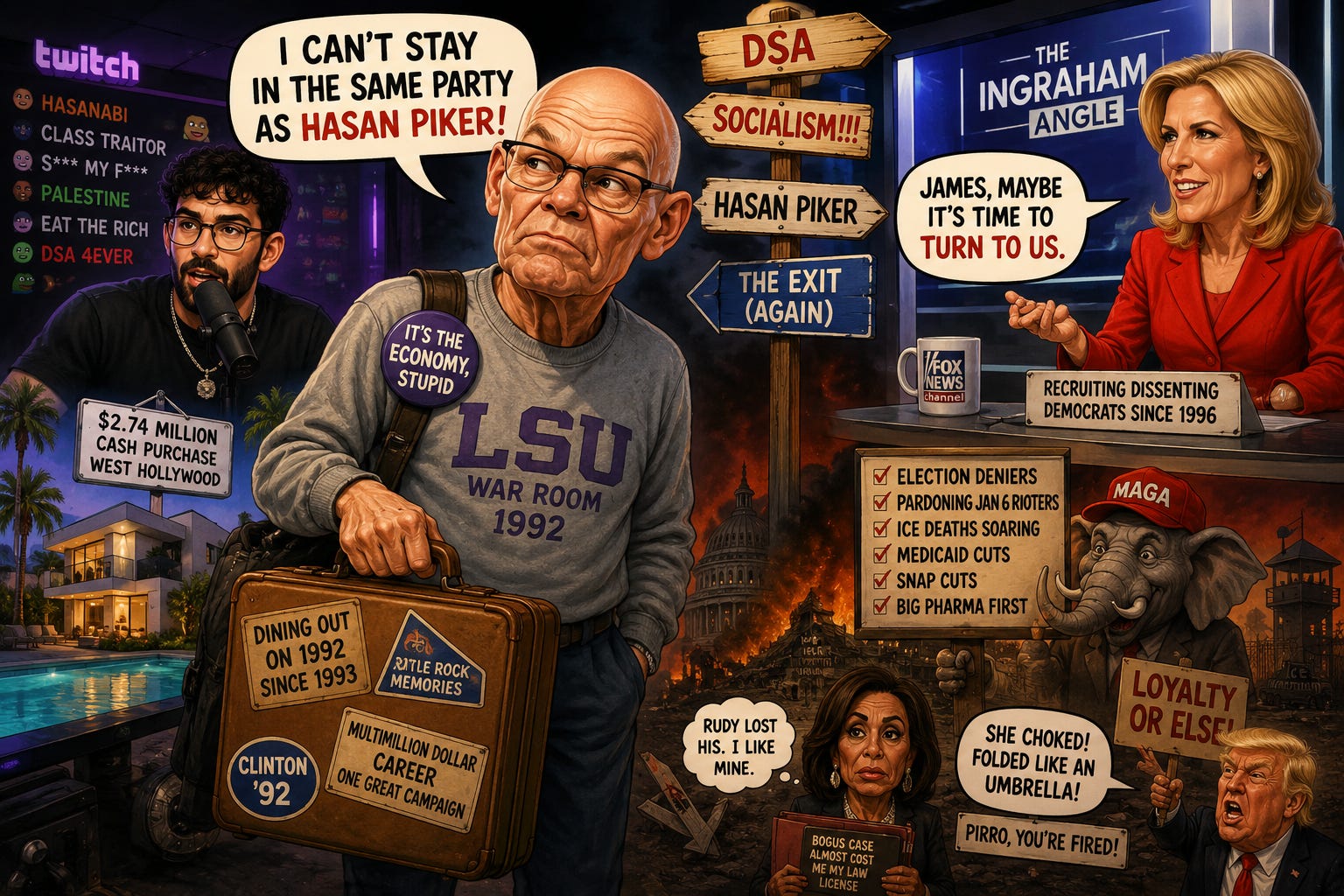
If you have been reading me on Substack or Lincoln Square for any length of time, you already know I am not exactly the president of the Hasan Piker fan club. I have my reasons, and I have listed more than a few of them already: the breathtaking wealth hypocrisy of a man broadcasting the revolution from a $2.74 million, cash-purchased West Hollywood mansion; the tortured logic that had him screaming at a Black viewer to “suck my fucking cock” for daring to ask why he covered Sudan with nowhere near the same urgency or intensity that he brought to Palestine; and the amplification of Jasmine Crockett’s claim that later turned out to be false. I do not hate him quite as much as I hate his uncle—Cenk has managed to become so consistently wrong that he deserves his own branch of political science—but Hasan has always been his own special kind of exhausting. He is a professional left-wing troll, cut from the same cloth, except Hasan repackaged the family business as revolutionary livestreaming and somehow convinced millions of people that screaming obscenities at anyone who questions him is a substitute for having a defensible answer. The pattern with him is almost comforting in its consistency. Every now and then he says something that makes me think, Well, okay, he has a point there, and then, almost as if a shock collar goes off whenever he approaches intellectual responsibility, he follows it with something racist, breathtakingly stupid, or so detached from observable reality that the agreement dies before it has time to unpack its bags.
Here is the thing, though. As much as I do not care for Piker, or anybody else making a living in that particular sewer grate of the political internet, none of them are going to run me out of the Democratic Party. It is simply not happening. Barring some genuine political realignment, this is my party. I have been registered blue longer than some of these commentators have been old enough to vote, and I am not surrendering my place in a national political coalition because a millionaire Twitch streamer threw another tantrum in front of an audience that communicates primarily through emotes. Nobody with a subscriber count and a chat scrolling faster than the human brain can process gets to evict me from a party I have spent my entire adult life supporting.
And Hasan Piker is not even a Democrat, which makes James Carville’s performance this week even more ridiculous. Carville is standing at the front door with his suitcase packed because a man who does not live in the house, does not pay rent in the house, and regularly announces that he hates the house might occasionally be invited inside for dinner. If one loud political streamer operating from the party’s outer parking lot can send you reaching for the emergency exit, maybe your commitment was never as sturdy as you advertised. Real loyalty to a coalition does not come with a trapdoor that opens every time somebody annoying wanders near the tent. If it did, the Democratic Party would have been abandoned sometime during the second hour of its first meeting.
On Fox News’s “Sunday Briefing” this past weekend, Carville said he was not going to remain in the same party as Hasan Piker and had no intention of ever sharing a political party with him. He claimed an overwhelming majority of Democrats share his alarm and pointed to the DSA platform as though merely reading it aloud should trigger an evacuation order at DNC headquarters.
Carville’s latest panic attack was prompted by the Michigan Senate primary, where Piker has been loudly campaigning for Abdul El-Sayed against Rep. Haley Stevens. I do not agree with El-Sayed on everything, but he is actually one of the more reasonable members of DSA. I did not love his attachment to the Uncommitted movement, particularly during an election in which the alternative was Donald Trump, but when Kamala Harris became the nominee, he got on board and supported her. Like plenty of other Democrats, El-Sayed has positions I disagree with. He does not have differences that make cooperation impossible. That is what a political coalition is: people who argue, negotiate, occasionally irritate the shit out of one another, and still understand that losing the country to MAGA would be considerably worse than losing an intraparty argument.
Piker responded on CNN by arguing that Democratic defeats have been so public and spectacular that voters are looking for alternatives, pointing to Hillary Clinton’s loss in 2016 and Kamala Harris’s loss in 2024 as evidence against the establishment track record he believes El-Sayed is challenging. Elizabeth Warren has also rejected Carville’s broader portrayal of a Democratic Party being swallowed whole by its left flank.
Carville certainly has the résumé to make people listen. An LSU law graduate, he spent the 1980s helping engineer underdog victories for Robert Casey in Pennsylvania, Zell Miller in Georgia, and Harris Wofford in the 1991 Pennsylvania Senate race, where Wofford erased a roughly 40-point deficit before Bill Clinton brought Carville into his presidential campaign. Carville went on to run Clinton’s Little Rock “War Room,” win Campaign Manager of the Year, meet his future wife Mary Matalin while she was working for the opposing campaign, and help inject “It’s the economy, stupid” into the American political bloodstream. Those are real accomplishments. Nobody has to pretend otherwise to recognize that he has been dining out on 1992 for more than three decades.
Carville’s role in Clinton’s 1992 victory has always felt a little inflated to me. George H.W. Bush was hardly storming into reelection like an electoral juggernaut. He had promised, “Read my lips, no new taxes,” then raised taxes anyway, presided over a sluggish economy, and arrived at the end of twelve straight years of Reagan-Bush rule with the country looking ready to change the channel. By the time Carville reached for a whiteboard in Little Rock, Bush had already spent years laying banana peels across his own path.
Clinton also had something no campaign consultant could manufacture: charisma. He was cool, undisciplined, talented, reckless, and capable of making voters feel like he was speaking directly to them even when half the country knew there was probably another scandal warming up backstage. Carville helped organize the operation, sure, but he did not invent Bill Clinton, he did not wreck the economy, and he did not make George Bush break his most famous promise.
What Carville unquestionably mastered was turning one great campaign into a thirty-year multimedia pension plan. He caught lightning in a bottle in 1992, slapped his name on the bottle, and has been charging appearance fees to explain electricity ever since. That is not nothing. It is just not the same thing as proving, decade after decade, that you still understand where the party is going.
And naturally, Carville chose Fox News as the place to deliver this urgent message to Democrats. Because apparently, when you desperately want your own party to listen, the smartest move is to march into Laura Ingraham’s house, borrow her microphone, and explain to an audience that hates Democrats why the Democratic Party is allegedly falling apart. Nothing says constructive intraparty intervention quite like providing free programming for people whose business model depends on convincing viewers that every Democrat is either a communist, a criminal, or using the wrong bathroom.
If Carville genuinely wanted Democratic leaders and voters to hear him, there were approximately nine million places he could have gone before Fox News. He could have written an op-ed, spoken to Democratic officials, appeared on a liberal network, called a meeting, started a podcast, sent an email, released a carrier pigeon, or simply yelled into a storm drain outside DNC headquarters. Any of those would have been more plausibly aimed at Democrats than sitting across from people who treat Democratic dysfunction like pornography. Going on Fox to complain about your own party is not sending Democrats a message. It is handing Republicans a prewritten attack ad and volunteering to perform the voice-over.
Carville has been carrying on like the Democratic Party’s permanently aggrieved homeowner for years now, forever peeking through the blinds and calling the association because somebody under forty parked too close to the curb. He is old guard in the most literal and spiritual sense: deeply convinced that the party peaked sometime around the first season of Martin and that every development since then has been an administrative error.
Take his feud with David Hogg last year. When Hogg, then a DNC vice chair, announced that his PAC, Leaders We Deserve, would spend $20 million primarying older Democratic incumbents in safe blue seats, Carville called it “the most insane thing” he had ever heard, “abominable,” “jackassery of the highest level,” and dismissed Hogg as a “contemptible little twerp.” Carville reacted as though Hogg had proposed replacing the entire Democratic caucus with TikTok influencers selected by raffle.
The irritating part is that Carville was not completely wrong. I understand the argument for keeping Democratic incumbents sharp and clearing out people who have become furniture, but randomly throwing millions of dollars at popular members in safe districts is not automatically a strategy. Sometimes it is just an expensive way to generate group-chat discourse. Democratic resources are finite, Republicans remain the actual opposition, and “this person is old” is not, by itself, a governing philosophy.
But no elected office comes with a lifetime warranty, either. If an incumbent wants to keep a seat, that incumbent should be prepared to defend it every cycle rather than treating a primary challenge like someone violated the terms of a reverse mortgage. Carville had a legitimate strategic concern buried somewhere beneath the name-calling and the theatrical clutching of his campaign memorabilia.
His endless panic over DSA is something else entirely. At this point, he does not discuss the organization so much as react to it like a dog hearing fireworks. Somebody says “democratic socialist,” and Carville starts barking at the television, knocking over furniture, and demanding to know what happened to Bill Clinton. It is no longer useful criticism. It is a recurring cable-news condition.
Carville’s Fox News field trip went exactly the way any sentient person should have expected. By marching onto a Republican network to announce that the Democratic Party was becoming intolerable, he told Fox’s audience that Democrats were dysfunctional and then seemed surprised when Laura Ingraham treated his complaint like a Groupon for defectors.
On Monday’s “Ingraham Angle,” she portrayed Carville as a man “threatening a breakup” after sixty years of loyalty, then graciously extended the warm and completely sincere hand of the modern Republican Party. Carville and other Democrats who oppose socialism, she said, should “turn to us” and help “defeat this scourge,” before wondering aloud how many more people like him might be willing to join. Yes, Laura Ingraham—famed curator of ideological tolerance—would now like to welcome all the sensible Democrats into MAGA, a movement known for calmly embracing dissent and never questioning anyone’s patriotism, masculinity, religion, birthplace, or commitment to Donald Trump.
What an irresistible offer. Leave a party because Hasan Piker gets on your nerves and join one where disagreeing with Trump on a single Tuesday can get you labeled a traitor by Wednesday morning. I am sure Carville would fit right in. They would probably let him speak for almost eleven minutes before someone called him a communist because he once worked for Bill Clinton.
Ingraham did not hear Carville’s appearance as a thoughtful warning meant to strengthen Democrats. Why would she? She heard a recruitment opportunity. Carville walked into Fox News carrying a grievance against his own party, and Ingraham immediately tried to slap a red hat on it. That is what Fox does. You do not go into a shark tank covered in tuna salad and then act offended when something takes a bite.
I do not like Hasan Piker even a little, and Carville becomes almost unbearable whenever he starts performing this wounded-elder-statesman routine. But for the Democratic Party to function, there has to be room for DSA, just as there apparently has to be room for crotchety old fossils who believe every political problem can be solved by locating the nearest television camera and complaining about young people.
That is coalition politics. It means sharing a party with people who annoy you, challenge you, occasionally embarrass you, and sometimes say things so stupid that you have to walk around the block before responding. Demographics shift. Movements evolve. New factions emerge, and older ones remain long after they have exhausted everyone’s patience. The Democratic Party has to represent Democrats across that entire spectrum, not merely whichever faction is currently screaming loudest on cable news or Twitch. If ideological irritation were grounds for expulsion, the party would have about seven members left, and at least four of them would still be arguing in the parking lot.
I have met with and listened to DSA members from all over the country, and despite what cable news would have you believe, they are not produced in a warehouse from the same mold. Some are thoughtful, some are practical, some are deeply irritating, and some can turn a three-minute answer into a hostage situation. In other words, they are exactly like every other faction in the Democratic Party. There are people in DSA who get on my nerves, just as there are people in the Congressional Black Caucus, the Senate Democratic caucus, and the Congressional Hispanic Caucus who make me wonder whether the mute button was humanity’s greatest invention. That is not evidence of party collapse. That is Tuesday.
I recently wrote about DSA co-chair Megan Romer’s appearance on “Fox News Sunday”, where Shannon Bream ran through a rapid-fire list of things DSA supposedly wants to abolish and Romer answered like someone had handed her the final exam in a class she had only attended twice. She sounded a sandwich short of a picnic, and unfortunately the picnic had already left without her. Was it painful to watch DSA represented that way on national television? Absolutely. Somewhere, a Fox producer probably had to be treated for a four-hour erection. But one bad interview does not define an entire organization, any more than one unhinged senator defines every Senate Democrat or one CBC member with a bad take somehow speaks for every Black Democrat in America. Coalitions do not require uniformity. They require enough discipline to keep the dumbest clip of the week from becoming everybody’s permanent biography.
Carville, meanwhile, sounds like he is flirting with the idea that the two-party system might simply pack its bags, dissolve its assets, and leave politics forever because Hasan Piker annoyed him. He knows better than almost anyone that this is not happening. So what exactly is the plan here? Become a MAGA Republican? Join a third party whose national convention is held in the private room of a Cheesecake Factory? Start an independent moveme…