In 2009, tennis star Serena Williams lost her temper with a line judge during the U.S. Open semifinal. What might have been remembered as a great match became known largely for the outburst, which led to penalties and controversy that overshadowed her performance. This illustrates a timeless truth: a moment of anger can cause more damage than the event that provoked it. Long after the cause is forgotten, anger's consequences can remain.
We all recognize anger as * a* destructive emotion. It may be
No plague has cost the human race more. — Seneca,On Anger 1.2
Yet we all get angry because anger can seem empowering. There are immediate payoffs. The first flush of anger can even feel good. Some people go a step further and label their anger “righteous anger,” which allows them to feel morally superior to the other person. We feel as though we are in control when, in fact, the opposite is true. Anger is in control of us.
We seldom realize what anger does to us, both mentally and physically. An angry person is rarely pleasant to look at. Most of us don’t enjoy becoming angry, and we generally don’t enjoy being around angry people either. More often than not, anger makes a bad situation worse, not better. It hurts us more than it does the other person.
Holding on to anger is like drinking poison expecting the other person to die. — Buddha
So, how do we avoid being angry? Here are some suggestions from the Stoics.
When we vent our anger, we often feel elated and righteous. We tell ourselves that we have taught the other person a lesson. We fail to recognize that anger has consequences. It can damage our reputation and lead to legal, moral, or material costs. Before expressing your anger, take a moment to consider those consequences.
Contrary to what we may believe, the other person is unlikely to become a better person because we “taught them a lesson.” More often, our anger provokes retaliation, which can harm us far more than whatever made us angry in the first place.
How much more grievous are the consequences of anger than the causes of it.—Marcus Aurelius, Meditations 11.18
We tend not to care about the consequences because our judgments become clouded. We focus only on the harm we were subjected to, whether real or imagined. We fail to count the costs of being angry. When we do, we may realize that the cost of being angry is far higher than the cost of being calm, even when we think we have reason to be angry. Anger adds far more damage than the act that made us angry. Anger usually costs far more than the injury itself.
If we don't restrain it, anger is often more hurtful to us than the injury that provokes it. — Seneca, On Anger 3.5
Before you express your anger, take a moment to understand its consequences. Many of them can be avoided if we learn to pause, reflect, and keep our anger in check.
We become angry because we believe we have been injured. It is just our opinion. It is not necessarily true. We can simply choose not to be offended. Some people are quick to take offence and others much less so because they don’t believe they have been injured. You can choose not to be offended, no matter what the other person says and does.
We often think the other person’s actions are making us angry. But, in fact, our opinion of their actions makes us angry. Suppose someone calls you an idiot. Instead of becoming angry, you can just ignore him: “After all, it is his opinion. I am not an idiot because he thinks I am one. If he thinks I am an elephant, I am not going to be an elephant, and I am not going to be upset. Why should I get upset because he thinks I am an idiot?” If you are angry because you were stood up, remember that your opinion, that you shouldn’t be stood up, is what’s making you angry. You can get rid of your anger by changing your mind: “It’s no big deal if I am stood up.”
Take away the complaint, ‘I have been harmed,’ and the harm is taken away. — Marcus Aurelius, Meditations 4.7
Even though you may feel powerful when you express your anger without restraint, anger’s real victim is the person who is angry. The other person may not care how you feel. They may even retaliate and harm you further. But anger affects you both physically and mentally. Your bodily functions change, your expression becomes unpleasant, your blood pressure may rise, and you may ruminate over the incident all day. If you become habitually angry, your friends may even start avoiding you.
“The outward appearance of angry persons is no less hideous and terrifying than that of the insane. Their eyes blaze and sparkle; there is a deep flush from all the blood that boils up from the breast; their lips quiver; their teeth are clenched; their hair stands on end and bristles; their breathing is laboured and forced...”—Seneca, On Anger 1.1
When you finally cool down, you may wonder why you reacted so angrily.
The target of your anger may be the other person, who may or may not care. But anger's negative effects on you are inescapable. You cannot be angry without being affected by it yourself.
Remember that the first victim of anger is the person who is angry. Even if you think your anger is justified, why harm yourself by being angry? Leave the other person alone to face the consequences of their actions. On the other hand, if you become angry, you have to face the consequences of your anger.
When we are angry about something, we often fail to recognize that we have done similar things ourselves. If we pause and think back, we will usually find occasions when we acted in much the same way. We excuse our own behaviour because we know our reasons, yet we fail to extend the same understanding to others. We justify ourselves but do not see ourselves in the actions of others.
When we are angry with someone, it helps to remember that we are not as different from one another as we imagine. As human beings, we all act for reasons that seem good to us. Two people may both seek happiness, but one may believe it comes from hoarding wealth while another believes it comes from helping others. Why be angry with someone trying to achieve the same end as you, just by a different route?
When we are angry, we rarely have all the facts. We react to our impressions without first examining them. A colleague who ignores your greeting may have just received troubling news. Someone who seems unfriendly may not be hostile at all, but simply shy or preoccupied. Before giving way to anger, it is worth asking whether we truly understand what has happened.
Often, anger arises from a sense of entitlement. We are angry when someone disrespects us because we feel entitled to respect. We are angry at the government because we think we are entitled to lower taxes. We become less prone to anger when we recognize that externals are not ours by right. What is truly ours is how we respond.
If someone deliberately wrongs you, they are acting out of ignorance. No one willingly chooses what they believe to be bad. Such a person may deserve correction, but not anger. Ignorance calls for understanding, perhaps even pity.
All these things happen to them because they are ignorant of what is good and evil... I can be neither injured by any of them, for no one can fix on me what is ugly, nor can I be angry with my kinsman or hate him. For we are made for co-operation. — Marcus Aurelius, Meditations2.1
We are like different organs of the same body, designed to work together rather than against one another. If you have a headache, you do not become angry with your head because it is part of you. Similarly, when another person causes you pain, anger is not the only possible response. We are all part of the same human community, and it is contrary to Nature for one part to work against another.
For we are made for co-operation, like feet, like hands, like eyelids, like the rows of the upper and lower teeth. — Marcus Aurelius,Meditations 2.1
Our anger often arises from a sense of entitlement. We become angry when someone disrespects us because we feel entitled to respect. We become angry at a corporation because it is not acting in a way we see as ethical. Yet much of our anger fades when we realize we are not entitled to anything outside ourselves.
The things we feel entitled to, such as others' respect, approval, or good opinion, are externals. Externals are not under our control. What someone says or does to provoke us is not up to us. Whether we choose to become angry about it is up to us. Whenever we treat what is not under our control as if it were, we inevitably suffer.
We are far better off focusing on what we can control: our own response.
If you regard things that are naturally enslaved as free, and things that are not your own as your own, you will be hindered, you will lament, you will be disturbed, and you will find fault both with gods and men. — Epictetus,Enchiridion 1
What we think we are entitled to is not up to us and therefore is not truly ours. But controlling our anger is up to us; it is ours. When we focus on what belongs to us—our judgments and responses—and stop worrying about what doesn’t, like our imagined entitlements, we become free.
We often become angry because we feel we can’t stand a situation any longer. But we already possess the resources needed to cope without anger. Think of your inner resources, such as patience, endurance, and self-control. Use them. You don't have to act helpless or let other people’s actions, or your own emotions, push you around.
When we are angry, we tend to believe that anger is the only way to deal with the situation. But it never is. There is always another way to approach it. Suppose a friend says something that hurts you. One response is anger. But you can take a different approach. You might remind yourself: “She has been a good friend for many years. What she said hurts. But if I am honest, I can see that I have hurt others too.” Holding on to that thought can soften, and even dissolve, your anger.
Everything has two handles, the one by which it may be carried, the other by which it cannot be carried. If your brother acts unjustly, do not lay hold of the act by the handle of his injustice, for by that handle it cannot be carried; but by the opposite, that he is your brother, that he was brought up with you; and thus you will lay hold of it by the handle by which it can be carried. — Epictetus,Enchiridion 43
Everything has two handles. When anger arises, look for the handle that calms and clarifies, not the one that inflames and intensifies. Choose the handle that helps you carry the situation, not the one that makes it heavier.
Both you and the person you are angry with will be dead soon enough. Put things in perspective. Do you really want to spend even a minute of your brief life being angry? Do you want to feed your anger and turn it into a habit?
The danger is that anger becomes easier each time we give in to it. Every outburst strengthens the habit, making the next one more likely. So how do we break the habit of anger, or prevent it from taking root in the first place?
Epictetus offers a simple solution: cultivate a contrary habit. Laughter, for example, is a contrary habit because you cannot laugh and be angry at the same time. When anger arises, look for something amusing in the situation and smile. Or laugh at your own self-importance, which often lies behind anger. Another useful technique is to count slowly to ten, then count backward from ten to one. By shifting your attention elsewhere, you give your anger time to cool and lose its grip on you.
Habit is first weakened, then destroyed. If then you do not wish to be of an angry temper, do not feed the habit; throw nothing on it which will increase it. — Epictetus,Discourses 3.12
Every time you refuse to indulge your anger, you weaken it. Every time you respond with a contrary habit, you loosen its hold a little more. Eventually, what was once a habit of anger can become a habit of calm.
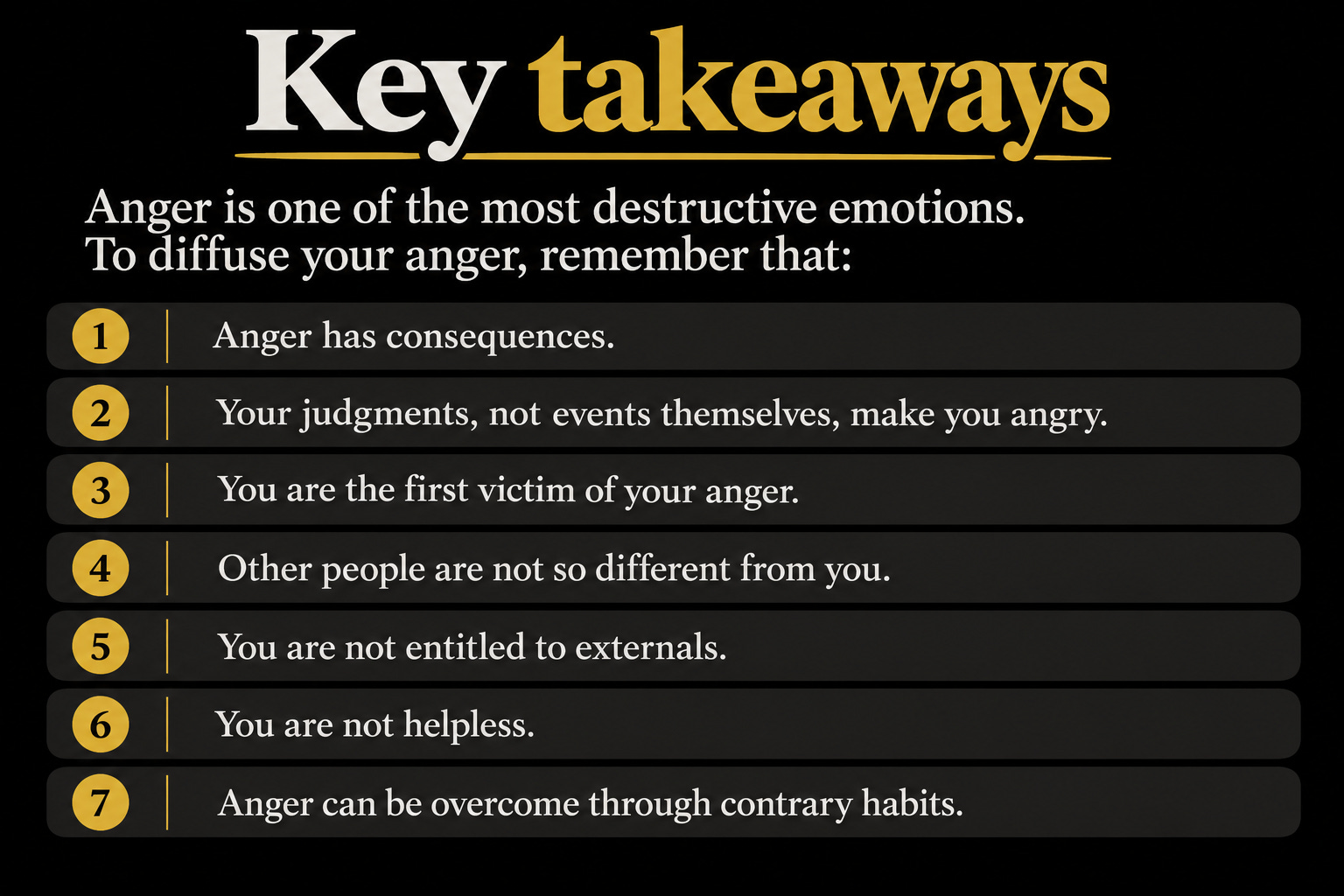
Anger is one of the most destructive emotions. To diffuse your anger, remember that:
Anger has consequences.
Your judgments, not events themselves, make you angry.
You are the first victim of your anger.
Other people are not so different from you.
You are not entitled to externals.
You are not helpless.
Anger can be overcome through contrary habits.
The next time you feel anger arising, pause before responding and ask yourself these seven questions:
What are the likely consequences of expressing my anger?
Am I angry because of what happened, or because of my judgment about what happened?
Who is suffering from this anger right now?
Have I ever acted similarly or made a similar mistake?
Am I angry because I feel entitled to something that is not under my control?
What inner resources can I use instead of anger: patience, endurance, understanding, or self-control?
What contrary habit can I practice right now: humour, silence, counting to ten, taking a walk, or simply smiling?
At the end of the day, reflect on any moments of anger. Did you pause? Which question helped most?
Get your copy here.
171026