For thirty-three years, Steve Jobs began each morning by asking himself:
If today were the last day of my life, would I want to do what I am about to do today?
When the answer was “No” for too many days in a row, he knew something had to change. Later, after a cancer diagnosis forced him to confront his mortality, he told Stanford graduates:
Your time is limited, so don’t waste it living someone else’s life.
Our lives are made of time. How we use our time determines how we use the life entrusted to us. Wasted days accumulate into wasted weeks, wasted weeks into wasted months, wasted months into wasted years, and wasted years into a wasted life. Yet the reverse is just as true. A life well lived is not built all at once. It is built one well-lived day at a time.
We tend to postpone living until some time in the future. Better yourself? I’ll start on New Year’s Day. Finish this piece of work? I’ll do it tomorrow. Exercise? I’ll start next month. Often we don’t even have a specific time in mind. “I’ll do it when I get around to it.” But we never do. Saying we will do something someday is often the same as saying, “I don’t think I’ll ever do it.”
We let anyone, even a stranger, take our time. We spend hours on trivial things that add little value to our lives or to those around us. Social media, television, gossip, endless distractions; anything can steal our time if we let it. Often, we freely surrender it. We let other people dccide what we should do with our life. Meanwhile, our lives pass us by. Wasted days do not add up to a well-lived life.
This does not mean we must be productive all the time. There is nothing wrong with entertainment, rest, or leisure. An idle Sunday afternoon will not result in a wasted life. It can be a pleasure to spend time with strangers. However, there is a difference between watching television because you choose to and watching it mindlessly because you cannot think of anything better to do. We waste our time only when we lose it unconsciously or allow others to take it from us.
We waste our lives because we do not pay attention to what we are doing. If we look closely, we will see that much of our life slips away when we do nothing meaningful or do something half-heartedly. When we fail to pay attention, we lose the very thing life is made of: time.
Do we truly understand the value of our time? Do we appreciate what it is worth, knowing that life is short and that each day brings us closer to death?
From time to time, ask yourself a simple question:
“Is this how I want to spend my time?”
You may discover that many of your activities are driven by habit rather than choice. Because our time is limited, there is no reason to spend it unconsciously. We can choose how we use each moment, even if that choice is simply to relax and watch television. Wasted time, however, is gone forever. It never comes back.
Time is a sort of river of passing events, and strong is its current; no sooner is a thing brought to sight than it is swept by and another takes its place.—Marcus Aurelius,Meditations 4.43
We procrastinate, putting things off to some vague future date. We imagine a future in which we will finally have uninterrupted time to do what we could not do today. But that time never comes.
Often, we postpone things because we don’t really want to do them. The deadline keeps moving farther into the future. We don’t notice because we keep putting it off. Then one day, when it is too late, we wake up and wonder, “Where did my life go?”
Many things we postpone, especially those with no specific date attached, are things we do not really want to do, now or ever. We simply do not want to admit it to ourselves or others. Most plans assigned to an indefinite future never get done.
“There is a limit to the time assigned to you, and if you don’t use it to free yourself, it will be gone and never return.”—Marcus Aurelius, Meditations 2.4
If something is worth doing, it is worth doing today, unless something better or more urgent deserves your attention.
“You are no longer a child, but a full-grown person. If you are careless and lazy now and keep putting things off ... you will live and die as someone quite ordinary.”—Epictetus, Discourses 1.2
We do not have to wait for better times to begin. Things get better when we begin.
“It is now, therefore, high time for us to begin to live if we intend ever to live according to reason.”—Musonius Rufus, Lectures
We all know that if we have $100 and have already spent $80, we can spend only $20 more. Time works the same way.
When we waste a day, that day is gone forever. You now have one less day to live the life you want. Time is a dwindling resource. As we age, we are left with less and less of it, yet we often behave as though we have an endless supply.
We do not.
Much of our life is already behind us.—Seneca, Moral Letters 1
We cannot keep postponing what matters.
Be not as one that has ten thousand years to live; death is nigh at hand: while you live, while you have time, be good.— Marcus Aurelius,Meditations4.17
If you want to learn something, start today. If you want to achieve something, start today. If you want to become better, start today.
“Remember how often you have postponed minding your interest ... it will quickly run off with you, and be lost beyond recovery.”—Marcus Aurelius, Meditations 2.4
We often shape our lives to fit someone else’s expectations. In doing so, we surrender our judgment and our freedom.
There is nothing wrong with considering other people’s advice when it is rational and useful. The problem arises when we seek approval rather than wisdom. You do not have to go to the opera if you would rather spend a quiet evening at home. You do not have to attend a party simply because important people will be there.
When we spend our time pleasing or impressing others rather than doing what is genuinely good for us, we waste our lives.
How much time we gain when we do not look to see what our neighbour says or does or thinks, but only at what we do ourselves!—Marcus Aurelius, Meditations 4.18
Or, as Steve Jobs put it “Your time is limited, so don’t waste it living someone else’s life."”
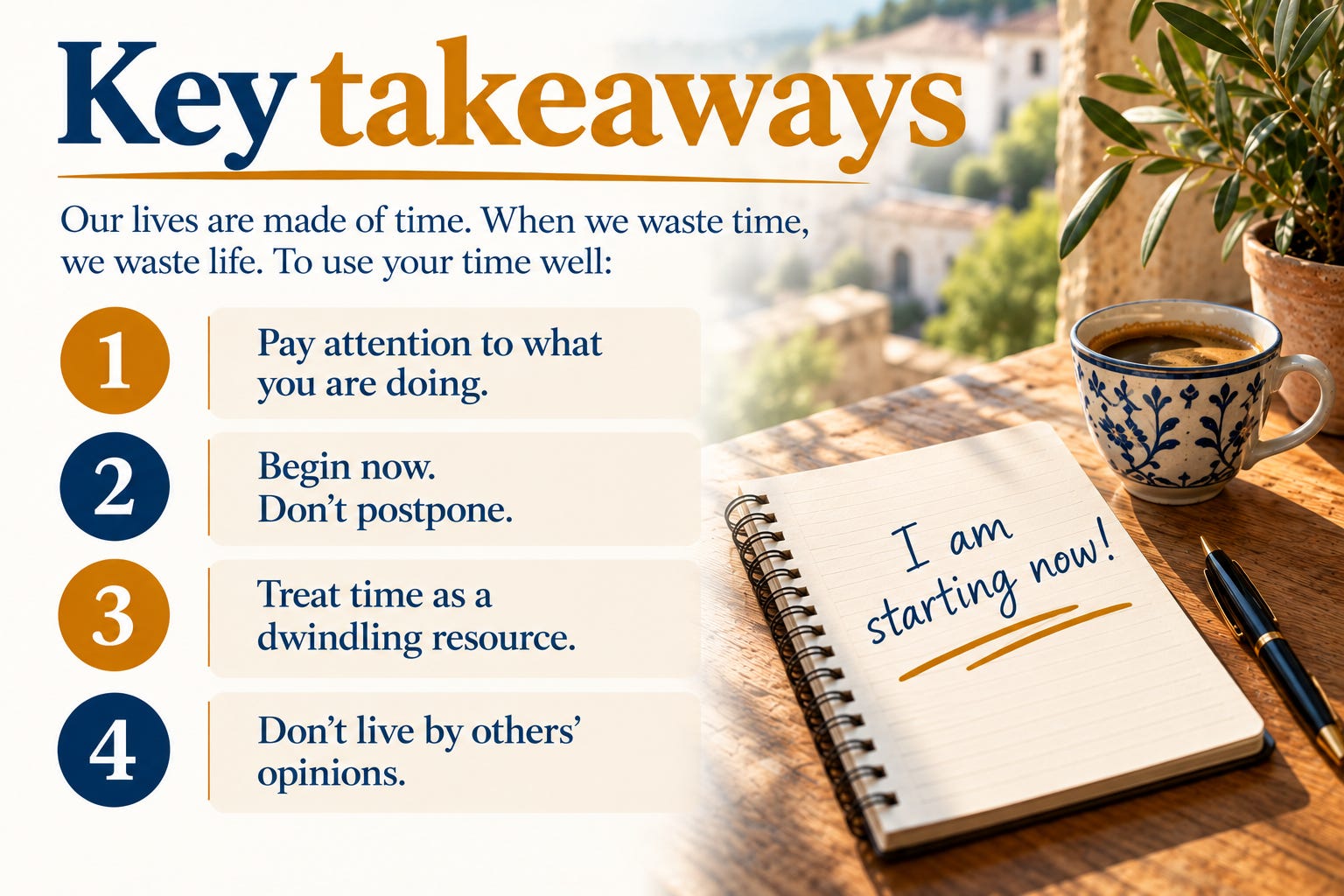
Our lives are made of time. When we waste time, we waste life. To use your time well:
Pay attention to what you are doing.
Begin now. Don’t postpone.
Treat time as a dwindling resource.
Don’t live by others’ opinions.
For the next twenty-four hours, carry one question with you:
“Is this how I want to spend my time?”
Ask it several times during the day — before opening social media, turning on the television, saying yes to a request, or postponing a task.
Do not judge your answers. Simply notice them.
At the end of the day, write down:
One thing you spent time on that was genuinely worthwhile.
One thing that consumed time without adding value.
One thing you have been postponing that you can begin today.
Then spend five minutes taking the first small step on that postponed task. Not tomorrow. Not next week. Today.
101026