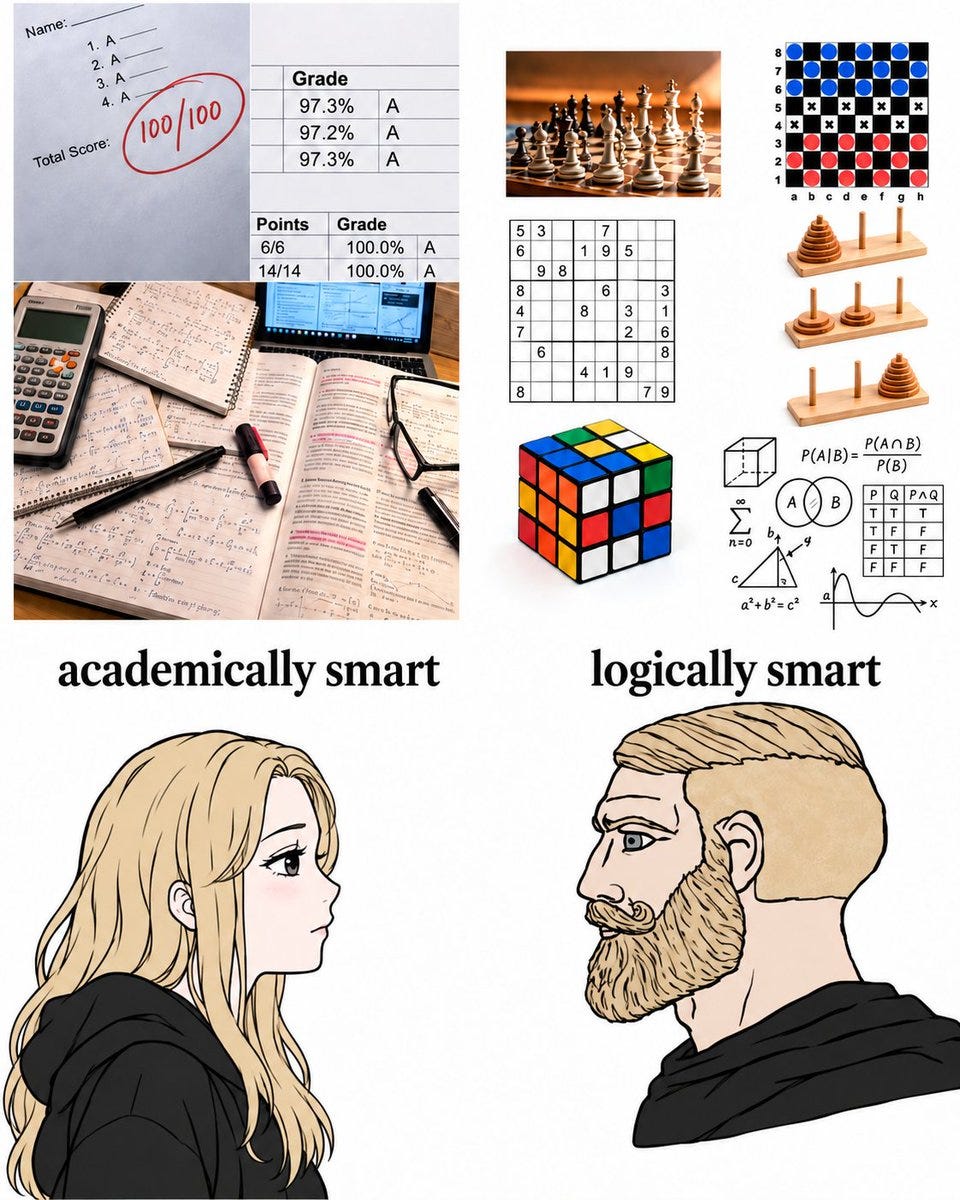
Somewhere upstream of the hatred of “HR ladies” is the hatred of “highlighter girls,” or Type-A overachieving girls who do really well in school but are only smart insofar as it refers to useless organization skills and rote memorization.
As the legend has it, highlighter girls grow up to be, you guessed it, HR ladies, or perhaps even marketing executives and other species of girlboss, while not actually having any original ideas or true intelligence. Now, the world is run by highlighter girls, everything is pink and organized, and everyone is miserable. The true geniuses—the pyromaniac boys who couldn’t sit still for five minutes, who kept turning their eyelids inside out and drawing that S—should be running the world, but because education is so feminized, it cannot illuminate the full extent of their elusive erudite. (Because, of course, no boy was ever expected to sit still, follow rules or obey his teacher until the rise of insipid female teachers in Ms. Rachel overalls.)
I’ve seen this idea parroted online a bunch of times, but this isn’t one of those wacky Internet ideas that you can avoid by logging off. At one of my earliest jobs at an advertising startup, I had a boss named Vince who didn’t go to college. Given that all the roles in the company required a college degree, I was a little surprised, but he informed me he went to the “school of hard knocks,” and that he had “street smarts,” so he was actually smarter than anyone who went to college because he could “really think.” He was giving big “Michael Scott rips textbooks up at business school” energy.
Unfortunately, Vince’s superior street smarts stopped short of the ability to use Powerpoint—he would frequently ask me to show him how to use basic software programs “just to see if I knew how to do it” when he clearly didn’t know and was unwilling to learn because learning was for squares. He would send emails with incorrect capitalization and punctuation. He was a decent salesman, but frequently relied on lying to close deals (he called it “telling the truth very well.”) Vince’s company also went out of business because he was selling a fraudulent product. All the while, Vince would pull me aside and chuckle with me about the “choirboys” at our company who thought they were smart because they studied in school.
Now, I actually did not perform very well in school, which might be why Vince sought me out as a companion at our company. I had been hiding my low college GPA until I realized it would earn me some street cred with Vince, and it did. Throughout my youth, school felt like going to work, except I wasn’t paid, I wasn’t good at it, and everything was boring. Memorably, I was once reprimanded for writing a play during a math lesson in third grade. At the beginning of every school year, I would rush to Staples with my mom to find some perfect, color-coordinated school supplies, and I would promise myself that this was the year I would become the right type of girl at school. A highlighter girl. I wanted to have tiny, neat, bubbly handwriting. I wanted to win awards. I wanted to be the girl who raised her hand and elicited a response of, “Anyone else, for a change?”
But I wasn’t that girl. And I understand why other people who weren’t that girl might be keen to rebrand her as “not really that smart” and undeserving of her success, while the true geniuses (the slackers, me, Vince, the inside-out eyelid boys) got the short end of the stick. But organizing, attention to detail, social skills, and the ability to remember things are actually important skills. Being able to focus on things you don’t find innately interesting is a skill I wish I could acquire. And even if we don’t want the world run by highlighter girls, I’m not sure I want the world run by Vince (or me, quite frankly) either. Because sometimes the kid who can’t learn in school isn’t a misunderstood genius—just a kid of average intelligence who also can’t follow instructions and doesn’t listen.