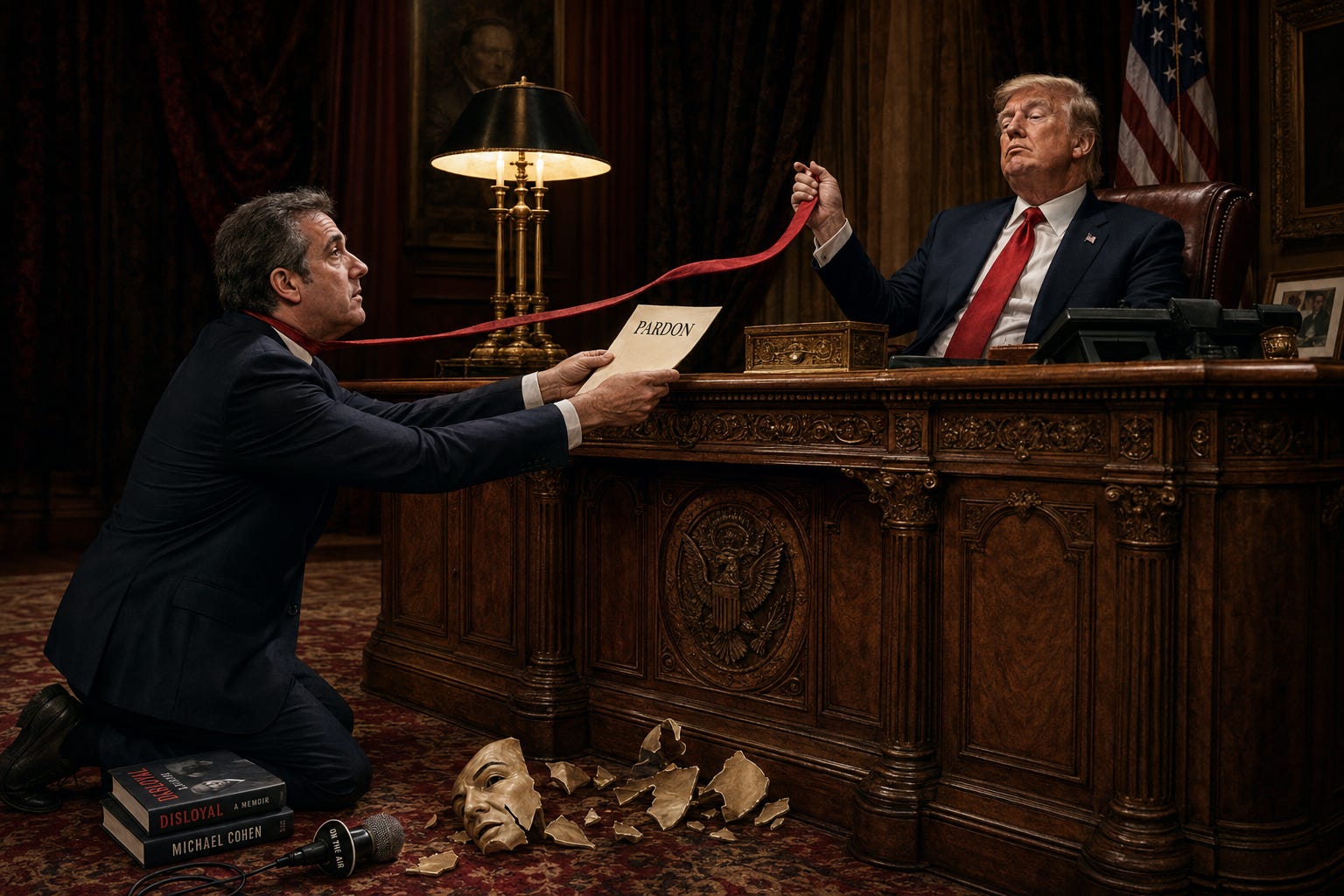
Michael Cohen did not interview Donald Trump. He conducted a parole hearing for his own dignity, with Donald Trump serving as the only member of the board.
The proceeding lasted a little more than thirty-eight minutes. Cohen arrived prepared to demonstrate that he had changed, reflected, forgiven, healed, and found some higher spiritual understanding of the human condition. Then Trump said hello, and within minutes Cohen was calling him “Boss” again.
Not “Mr. President.” Not “Donald.” Not even “the man I once described as a racist, a con man, a cheat, a predator, and a danger to democracy.” Boss.
I have watched dogs show more restraint when their owners return from checking the mailbox.
That one word told us more about Michael Cohen than two books, hundreds of cable-news appearances, years of podcasts, and every overwrought monologue he has delivered about redemption. Cohen spent the better part of six years insisting that he had escaped Donald Trump’s orbit, reconstructed his identity, and finally understood the psychological machinery that had kept him loyal to a man who discarded him the moment loyalty became inconvenient.
Then Trump joined Cohen’s radio show, and Cohen snapped back into position so quickly I am surprised nobody heard his knees hit the floor through the microphone.
The episode was called “Burying the Hatchet,” which turned out to be appropriate because somebody’s remaining self-respect was absolutely murdered during the broadcast. Trump did not apologize for abandoning Cohen. He did not acknowledge that Cohen went to prison for crimes committed partly in service of him. He did not retract the years of insults, denials, and public degradation. He did not offer Cohen anything resembling accountability.
He simply allowed Cohen to speak to him again.
And Michael Cohen treated that access like a papal audience.
This is now the fourth time I have written about Michael Cohen, something I did not intend to make a franchise out of when I published The Mea Culpa of His Mea Culpa in March. That piece became the most-read article I had ever published on Substack, which taught me two things: readers are fascinated by Michael Cohen, and nobody involved in media actually knows what the hell people are going to read.
I returned to him in The Fixer Always Comes Home, when it became clear that Cohen was moving back toward Trump while apparently angling for a pardon. Then I wrote Mama Mea Culpa after Cohen became furious with callers who recognized that he was using the same Trumpian reconciliation techniques he had spent years teaching his audience to identify.
At this point, I am not writing a Michael Cohen series so much as documenting one man’s prolonged attempt to reverse his own character development.
Every time I think Cohen has reached the bottom, he finds a basement with studio space.
Cohen opened the interview by taking Trump back to 2016 and reminding him of the infamous CNN appearance during which Cohen responded to an unfavorable poll by asking, “Says who?” It became a meme because Cohen looked less like a political surrogate than a man who had wandered into an argument without bringing access to Google.
That is the memory Cohen chose for their public reunion. Not the eleven years they spent working together. Not any meaningful personal moment from their supposed friendship. He reached for the clip in which he had most famously humiliated himself defending Trump and presented it like a beloved photograph from the family album.
Trump remembered it fondly, naturally. Why wouldn’t he? The entire moment had been designed to demonstrate that Michael Cohen would dispute observable reality on command. Other people might remember a wedding, a vacation, or the birth of a child. Trump and Cohen apparently reminisce about the first time Cohen made himself look stupid on national television for him.
The interview did not improve from there.
Cohen repeatedly addressed Trump as “sir,” which was already deferential enough for a man hosting the person he had spent years describing as uniquely dangerous. Then the muscle memory took over.
“So maybe what we should do is then have a press conference and literally put out all of the accomplishments,” Cohen suggested. “Because what’s happening, Boss, you remember when I was by your side, I literally used to analyze the polls.”
There it was. Boss.
Not only had Cohen reassumed the title; he was volunteering for his old job during the interview. Trump had called into Cohen’s radio program, and within minutes Cohen was pitching communications strategy, proposing a press conference, analyzing hostile polling, and reminding Trump how useful he used to be “by your side.” Most people interviewing a president prepare questions. Michael Cohen apparently prepared a résumé.
Later, Cohen did it again: “People still, Boss, don’t you remember they did that? They did that to us from the beginning.”
At that point, he might as well have called the man Daddy and asked whether he had been a good boy.
The second “Boss” was worse than the first because it arrived with “us.” Cohen was no longer talking about Trump as the subject of an interview. He was speaking from inside the old partnership again. They did that to us. Not Trump and his former employee. Not a president and the witness who helped convict him. Us: the old team, reunited against the people who had supposedly driven them apart.
That tiny pronoun carried an enormous amount of psychological freight. Cohen spent years constructing a public identity around being the man who escaped Trump, understood Trump, and could translate Trump for the rest of us. But the moment Trump addressed him directly, Cohen stopped speaking as an independent person and returned to the collective identity that had governed him for fifteen years.
Michael Cohen did not merely work for Donald Trump. He organized himself around Donald Trump. Even during the anti-Trump years, Trump remained the center of Cohen’s professional universe. Cohen’s books were about Trump. His podcast was about Trump. His cable appearances were about Trump. His value to MeidasTouch was his ability to explain Trump. Cohen left the building, but he never developed another address.
The interview demonstrated how little distance he had actually traveled. The old hierarchy was still intact. Trump was Boss. Cohen was the fixer. The outside world was the enemy. All Trump had to do was answer the phone.
The speed of that regression would have been humiliating enough by itself. What makes it substantially more pathetic is that Michael Cohen personally taught us how Donald Trump’s forgiveness works.
For years, Cohen explained that Trump does not forgive in any ordinary human sense. He does not sit with the harm, accept responsibility, offer an apology, and attempt to rebuild trust. Trump’s version of forgiveness is transactional. You flatter him. You affirm his grievances. You attack the people he hates. You publicly revise whatever truth offended him. You make yourself useful again, and if the performance is sufficiently degrading, Trump may allow you to return to his presence.
Michael Cohen taught that lesson repeatedly. He drew diagrams. He distributed the syllabus. He practically held office hours.
Then he performed the lesson himself and apparently expected nobody to recognize the material.
Brother, we have ears. We have eyes. More importantly, we have several years of Michael Cohen television appearances, podcasts, congressional testimony, two books, and enough archived footage to reconstruct the man in three dimensions. Cohen cannot teach the country that Trump rewards flattery and manufactured grievance, then call Trump “Boss,” propose a press conference celebrating his accomplishments, blame prosecutors for turning them against each other, and pretend we are witnessing an organic flowering of forgiveness.
We know what this is because Michael Cohen told us what it is.
He told us Trump wants to be flattered, so Cohen praised his accomplishments. He told us Trump wants to be treated as the victim, so Cohen declared that Trump had suffered “possibly the most egregious weaponization of any politician in history.” He told us Trump rewards people who adopt his enemies, so Cohen dismissed critics as “crazy leftists” and said they were “out of their minds.” He told us Trump values usefulness, so Cohen offered him a press conference and reminded him about the poll analysis he used to provide.
This was not subtle. Cohen did everything short of sliding a laminated loyalty card across the table and asking Trump to validate his parking.
That is the staggering insult embedded in the performance. Cohen apparently believes either that his audience was not listening all those years or that Trump’s approval is now worth more to him than the audience knowing he is full of shit. Neither possibility reflects particularly well on him.
He is not merely running the Trump reconciliation playbook. He is running the exact playbook he sold us, annotated for us, and spent years assuring us only pathetic opportunists would ever use.
Cohen did not get caught hiding the ball. He handed us the ball, explained where people usually hide it, demonstrated the hiding technique in slow motion, and then became furious when we noticed the suspiciously ball-shaped lump underneath his shirt.
Once Cohen had demonstrated his loyalty, he still needed to give Trump a version of their history that made reconciliation possible. The central lie of the interview was that Cohen and Trump were two old friends driven apart by the “weaponization” of the justice system. Cohen described Trump as the politician who had suffered the most egregious weaponization in history and himself as the citizen who had suffered the most. This allowed them to recast the entire relationship around shared victimhood.
It was a beautiful little arrangement. Trump did not exploit Cohen. Cohen did not commit crimes while serving Trump. Trump did not abandon him, call him a rat, minimize his role, and spend years attacking his credibility. Cohen did not testify under oath that Trump was a racist, a con man, and a cheat. Prosecutors simply wandered into a perfectly healthy friendship and tore two innocent men apart for sport.
Hallmark should have it ready by Christmas: The Fixer Who Came Home for a Pardon.
This reframing is not incidental to the reconciliation. It is the price of admission. Trump could not welcome Cohen back while allowing Cohen’s previous account to remain intact, because the previous account identifies Trump as the author of the harm. Cohen therefore had to supply a new story in which neither man betrayed the other. They were both betrayed by the same villains.
That is how Trumpian reconciliation works. The returning apostate does not merely apologize. He must help falsify the history of why he left.
Trump rewarded the performance immediately. He told Cohen that he would “go down as a man with courage“ because he had supposedly told the truth. He said people hated Cohen because of that courage and assured him that his family probably respected what he had done.
It was an extraordinary moment. Cohen spent years telling the public that Trump’s approval was cheap, manipulative, and conditional. Then Trump tossed him a single pellet of praise, and Cohen practically wagged through the commercial break.
Trump’s compliment also completed the moral inversion. Cohen’s courage was no longer the decision to testify truthfully about the man he had served. His courage was walking that testimony backward. The truth was no longer what Cohen told Congress, prosecutors, jurors, readers, podcast listeners, and cable-news audiences over six years. The truth was whatever version made his return to Trump possible.
Cohen once described Trump as a mobster who called him a rat for cooperating with the government. Now Cohen is helping the alleged mobster revise the witness statement and calling the process forgiveness.
Martin Scorsese would reject that ending for being too obvious.
Cohen also brought Christianity into this, because apparently ordinary groveling did not provide enough moral camouflage.
Responding to critics with crosses in their profile pictures, Cohen invoked Colossians: “Bear with each other and forgive one another.” He then continued with the instruction to forgive as the Lord forgave you. This was a clever move because it transformed public skepticism into a spiritual defect. If you questioned why Cohen was rehabilitating a man he had called dangerous, perhaps the problem was not Cohen’s contradiction. Perhaps you simply lacked grace.
I believe in forgiveness. I believe people can change. I believe human beings should not be permanently imprisoned inside the worst thing they have ever done. But forgiveness ordinarily requires the parties to confront what happened. What Cohen staged was not forgiveness because Trump conceded nothing, regretted nothing, and apologized for nothing. Trump did not meet Cohen halfway. He remained exactly where he was and watched Cohen crawl the entire distance.
That is not reconciliation. That is submission with a spiritual soundtrack.
The Bible citation becomes even more insulting when placed beside the pardon application. Cohen wants us to believe that this is about healing while pursuing an official act of clemency from the man whose favor he is publicly rebuilding. Apparently the road to Damascus now runs directly through the White House Office of the Pardon Attorney.
Michael Cohen once testified under oath that he had “never asked for, nor would I accept, a pardon from President Trump.”
That sentence has aged like shrimp in a glove compartment.
Cohen now admits that he submitted a pardon application to President Biden, received no action, and then repackaged essentially the same application for Donald Trump. According to Cohen, he changed the cover letter by removing Biden’s name and inserting Trump’s, which is an almost perfect metaphor for the man’s entire political identity. Change the name at the top, adjust the moral explanation underneath, and Michael Cohen is ready to serve whoever might clear his record.
Even immediately before the Trump interview, Cohen was still pretending the question remained unresolved. Asked whether he would request a pardon, Cohen answered, “Maybe, maybe not.”
My brother in selective disclosure, you had already submitted the application.
Cohen appears to be relying on the distinction between personally asking Trump for a pardon and formally submitting paperwork asking the Trump administration for a pardon. That is the kind of semantic maneuver lawyers attempt when the truth has become inconvenient but perjury remains unfashionable. It is like mailing someone a marriage proposal and later insisting you never technically asked because you did not get down on one knee.
The contradiction could not be cleaner. Cohen once presented his refusal to accept Trump’s pardon as proof that he had finally escaped Trump’s control. Now he has returned to calling Trump “Boss,” r…