For the month of September, we are reprising one of Chuck’s most popular Prokopton Letter series, The Backseat Drivers. This is the second of four.
We saw how our first backseat driver can persuade us to make foolish decisions that can destroy our happiness and lead us to anxiety and worry. Now, let us see how our second backseat driver, excess, can lead us to turn a good thing to do into something that is not good. Our backseat driver’s screams are like this:
This feels good. Drive faster!
That car just overtook us. Let’s overtake that car!
Don’t bother about the speed limit. It’s fun to go at high speed.
If we keep listening to our backseat driver, we will likely get into an accident or be pulled over by a police officer.
Many of us believe that some things are good and some things are bad. We think in binary terms. For example, health is good, and disease is bad. Killing someone is bad, and saving someone is good. Being angry is bad, and being tranquil is good. We simply assume that if something is good, more of it should be better. We seldom stop to think that what is good at one level can also be bad at another.
We eat a piece of chocolate. It feels good. We eat another piece of chocolate. That feels good, too.
“Let’s have more!” screams the backseat driver. “Why not?” you reply. Before you know it, you have eaten the whole chocolate bar. Now, you are looking for the second one.
We have a glass of wine. It feels good. We drink another glass of wine. That feels good, too.
“This fun. How about another glass?” says the backseat driver. “Yes, why not!” you say. Before you know it, you have managed to drink the whole bottle of wine.
We make money to buy the necessities of life, such as food and shelter, which makes us feel secure. We make more money to buy things that make our lives even more secure.
*“*Let’s get on with this. Let’s make a lot of money so we can feel totally secure,” says the backseat driver. “That makes sense to me!” you reply and start making more money. Before you know it, you are consumed with acquiring things without having any idea why you are so desperate to acquire more and more things.
In each of these cases, we start with something that is either good or harmless and turn it into something that is less than desirable. Anything carried to an extreme, even if it is good to begin with, can harm us.
This is the problem with our second backseat driver: Excess.
Excess is our inability to choose wisely. It is not knowing
…what things must be selected and what should be rejected and what is neither. — Stobaeus450, Book 2, 5b1
When we don’t know what to select or what to leave out, we tend to choose things that weigh us down. Excess is related to our wanting more, consuming more, and striving after more. It arises out of our desires.
Desires, in general, are external-oriented—things we cannot give ourselves. We crave things like money, power, prestige, drugs, and alcohol.
Not all our desires lead to excess. In fact, Seneca (*Moral Letters 16) *distinguished between two kinds of desires: natural desires (desires of needs) and desires of opinions (desires of wants). It is the desires of wants that lead to excess.
All of us have some basic desires, such as the desire for food when hungry, the desire for water when thirsty, and so on. These are desires of needs. When we are thirsty and drink water, thirst goes away; when we are hungry and eat, our hunger goes away. These desires of needs don’t lead to excess. They are common, natural, and easy to satisfy. Then there are desires of wants, what Seneca calls desires of opinion. They include the desire for wealth, fame, adulation, and luxury. The problem with the desire of wants is that these desires can be fulfilled only temporarily. There are several reasons for this (what follows below applies to desires of wants).
Even when we get what we want, our desires are not satisfied. Instead, they are fuelled. When we have wealth, we want even more of it. When we have power, we want even more of it. The desires are moving targets. There is no natural limit to desire. As Seneca put it
Suppose that the property of many millionaires is heaped up in your possession. Assume that fortune carries you far beyond the limits of a private income, decks you with gold, clothes you in purple […] you will only learn from such things to crave still greater.Moral Letters—Seneca,16
That is the nature of these desires. They cannot be satisfied by feeding them.
However much you pile up, it will not end desire but only advance it. — Seneca,Consolation to Helvia
So every time you listen to the backseat driver telling you to get more and more, acting on it will only make the backseat driver scream louder and louder.
We may be perfectly happy with what we have, but if we come across someone who has more, our desire is fuelled once again. Since we can always find someone who has more, desires of wants can never be fulfilled. To quote Seneca again,
No one who views the lot of others is content with their own. — Seneca,On Anger31
When the backseat driver asks you to get more because someone else has more, remember someone else will *always *have more. Listening to your backseat driver is a loser’s game.
When we desire something deeply, anyone who controls the object of our desire becomes our master. As Epictetus says, we become slaves to those who have the power to grant or thwart our wish. We may become sycophantic and lose our moral compass.
When we desire something, the person who can grant us that becomes our master., Discourses 4.1—Epictetus
Again, there is no reason not to enjoy whatever comes our way. A desire becomes a burden only when we believe we need it to be happy.
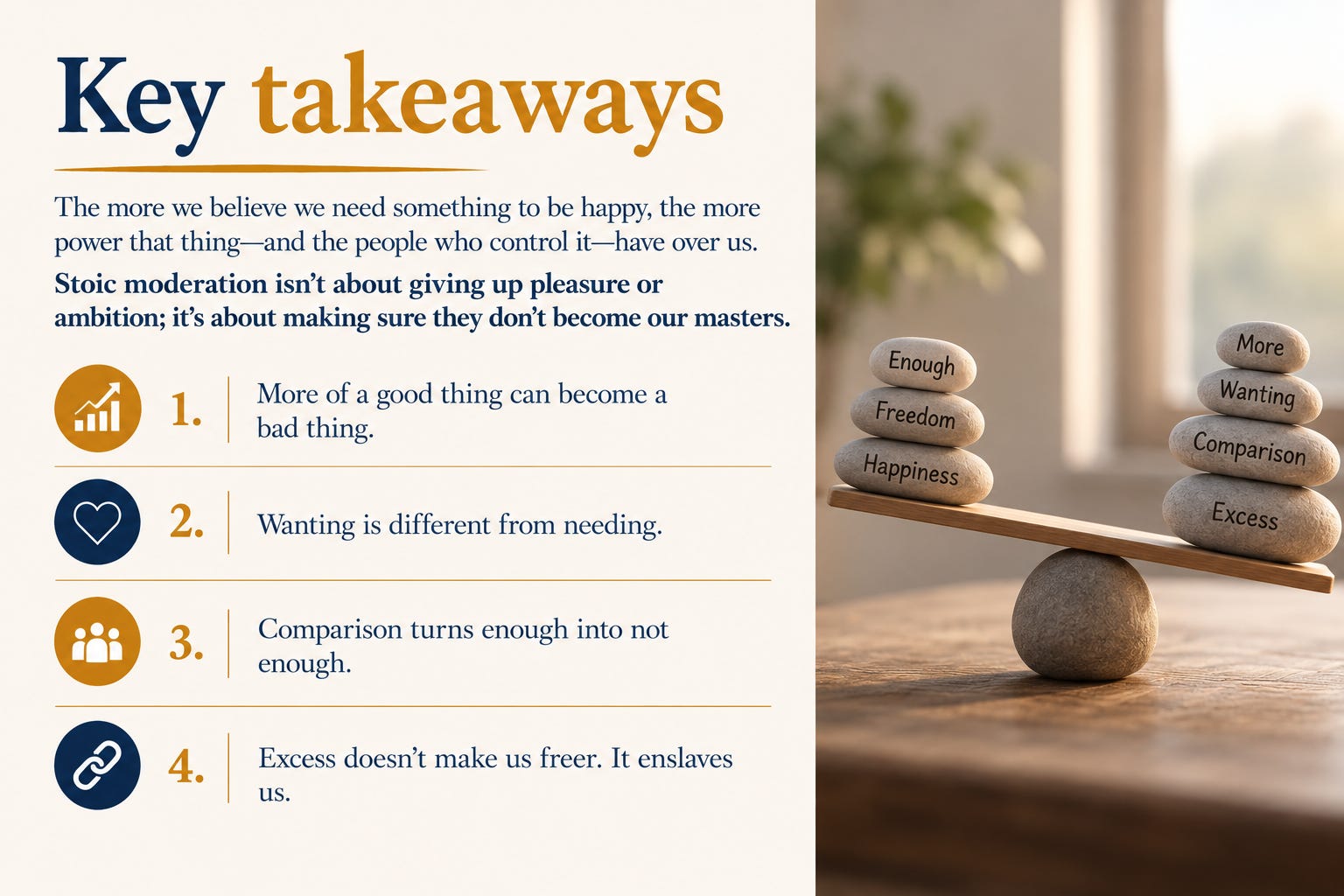
When you follow the instructions of your backseat driver, remember it won’t set you free; it will enslave you.
As we saw, we cannot get rid of our desires by fulfilling them because the more we feed them, the more they grow. We will be better off if we stop listening to our backseat driver and instead listen to Epictetus:
You cannot achieve freedom by fulfilling your desires, but only by eliminating them., Discourses 4.1—Epictetus
When our backseat driver pushes us to get more, consume more, and ‘enjoy’ more, doing so makes us feel good at first. We fail to realize how we are gradually dragged into a life of always wanting and always trying to get more. The life of excess slowly takes over our lives, and we need all this stuff to be happy. However, the truth is that the desire for excess is standing in the way of our living a productive and enjoyable life.
The most important step in understanding excess is to become aware of how what seems normal and harmless can lead to excess. To become gradually aware of the excess we indulge in without realizing it, do the exercises at the end. Keep repeating these exercises over several days.
It is not just the Stoics who taught us to be wary of excess. It is also a basic teaching in several other traditions. Aristotle emphasized the golden mean; Buddha taught the middle way to his followers. It is exciting to go to the extremes. But eventually, excess leads to a life of dissatisfaction and enslavement.
Stoicism does not say ‘don’t enjoy your meal, drink or the wealth you may have’; it does not ask us not to make money or enjoy it; it does not ask us to ignore our bodies. Stoicism is not against health, wealth, or other good things in life. We can enjoy all the ‘good things’ in life, even if they are externals, as long as they don’t compromise our virtues and as long as we don’t start believing that they are essential for our happiness. So let’s stop listening to our backseat driver—excess—and be moderate in what we seek in life.
Next time you are about to buy something—such as a new dress or an electronic gadget—stop and think. When was the last time you bought something like that? Do you feel the same way about it now as you did then? Will you be as excited about what you are buying now six months from now? If your answer is ‘no’, then you don’t really need this. You are just obeying your backseat screamer.
When you are indulging in something that can be potentially harmful—such as overeating or drinking—and tell yourself, “One more will not harm me,” try telling yourself, “One less will not harm me either.” If you find it difficult to stop, you are just giving in to your backseat driver.
When you go after something (such as promotions or favours), ask yourself how far you are willing to compromise your principles to get what you want. Is it really worth listening to your backseat driver?
When you give up your work-life balance to make more money, ask yourself what your motive is. If making money is a goal in itself, ask yourself, “Is the desire for excess money preventing me from leading the life I want?”
120926