For the month of September, we are reprising one of Chuck’s most popular Prokopton Letter series, The Backseat Drivers. This is the last installment.
Acting in a just way is a part of living skillfully. But our backseat driver would tell us otherwise.
What is the big deal? Everyone does that.
I don’t think I need to care what happens to others as long as I am alright.
Why should I be thankful? I have done so much for her already.
If I don’t grab what doesn’t belong to me first, someone else will.
I know this doesn’t belong to me, but I took it only to help someone else.
It is a “kill or be killed” world out there.
Sure, it is not mine, but no one will miss it.
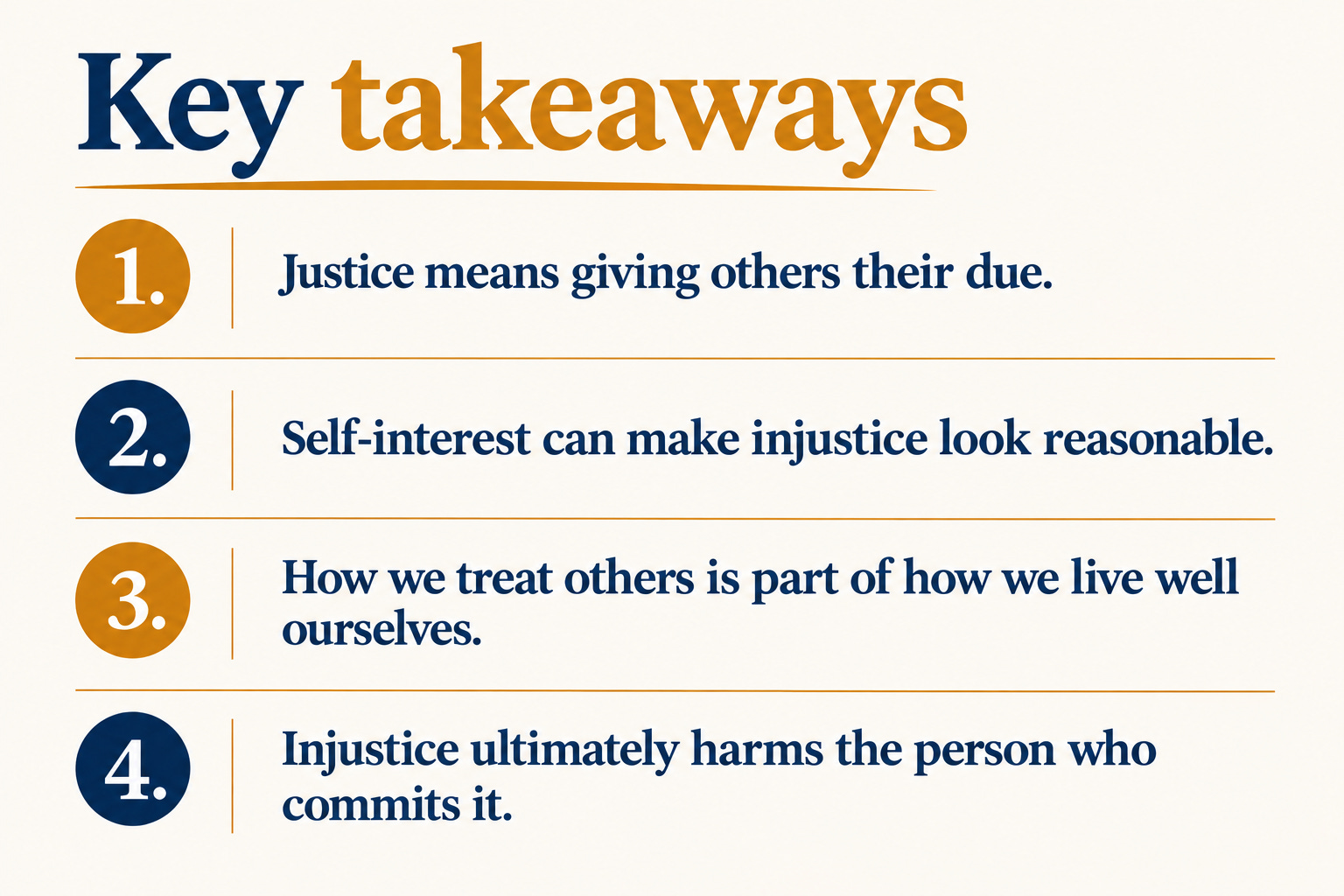
There are all forms of injustice. Because acting selfishly results in immediate gratification, our backseat drivers keep encouraging us to act unjustly. And our rewards are immediate. We convince ourselves that if we are clever, we can escape all the negative consequences of injustice. But injustice is a destructive force in our lives. Let’s look at it more closely.
Injustice, the last of our backseat drivers, is ignorance of what belongs to whom. More specifically,
Injustice is the ignorance of how things are to be assigned or distributed.(based on Stobaeus, 450, Book 2, 5b2).
It is not knowing how to give everyone their due, not knowing what should rightly belong to whom. The concept of Stoic justice is broad. It includes our relationship with our family, friends, country, the world, and even the universe. It includes caring, friendship, compassion, duty to the country, and our place in the world and the universe. Thus, when we pollute the planet, we are unjust because we do not assign to future generations their due. When we lack compassion, we are unjust because we fail to appreciate that we are a part of a larger whole. We fail to see that what is good for others is also good for us.
Stoic injustice includes many things, such as:
When someone does an act of kindness or does us a favour, they deserve our gratitude. When we don’t “assign or distribute” gratitude to them, we are being unjust.
Whenever we act in a way that benefits us at the expense of others, we are unjust because we fail to give what is due to others. When we take what belongs to others, we are being dishonest. This is dishonest and unjust.
Injustice is a kind of blasphemy. Nature designed rational beings for each other’s sake: to help—not harm—one another, as they deserve. To transgress its will, then, is to blaspheme against the oldest of the gods. — Marcus Aurelius,Meditations 9.1
We are connected to everything in the universe. Our connection starts with us, our family, society, and the world and extends to the entire universe (Hierocles). We need to do what benefits us and what benefits others. Since we are a part of the universe, our well-being is tied to the well-being of others. When we are solely focused on ourselves without any concern for others, we are being unjust.
What is not good for the beehive is not good for the bee. — Marcus Aurelius,Meditations 6.54
Because injustice is not knowing how things are to be assigned, we are also being foolish when we are unjust. Depending on the context, being unjust can also mean being excessive or cowardly. Our backseat drivers sometimes demand different things and sometimes cry in unison.
Epicurus also considered justice as a virtue. However, he saw justice as a social contract. He saw no meaning in justice unless it is reciprocal: I won’t harm you so that you won’t harm me.
Justice is a social contract: We don’t harm others, so others don’t harm us. Justice is nothing in itself without such understanding. — Epicurus, Principal Beliefs31-35 (Paraphrased)
But this is not Stoic reasoning. A Stoic would be just if the entire world is not. For a Stoic, justice is not a social contract but a social reconciliation.
The Stoic sense of justice is independent of the person or object towards which it is directed. Epictetus is quite explicit on this. A student who is estranged from his brother asks for Epictetus’s (Discourses 1.12) help with this question,
“How about my brother’s life?”
“It is his art of living. But as far as you are concerned, it is as external to you as land, health, and reputation.”
Just in case we are left with any doubt on this, Epictetus adds this later in the same discourse:
“You are released from all accountability to your parents, brothers, property, life, and death.”
In Stoicism, we do nothing specifically designed to make others happy. At first, this may sound paradoxical. But not so. Stoicism is very clear on this. As Epictetus clarifies,
No one has the power to hurt us. Only we can hurt ourselves.
By the same logic, we cannot hurt others. Others hurt themselves.
So the question arises*—*if our injustice does not harm others, why should we be just? Why not listen to our backseat driver and take what belongs to others? Why not stop caring for others and do only what benefits us?
Injustice is a burden because it hurts us. When we deny what is due to others, we believe an external will benefit us. But believing an external will benefit us is foolishness. A Stoic is just because the virtue of justice is an attribute of the Stoic. All virtues in Stoicism have this purpose: to live life skillfully. (In fact, Chris Gill describes Stoic virtues as ‘special skills.’ [Christopher Gill, in *Introduction to The Discourses, *Tr. Robin Hard]). This is the reason why injustice should be avoided.
The second reason why injustice hurts us is that, because we are a part of the whole, when we hurt anyone, we indirectly hurt ourselves.
In Stoicism, others cannot hurt us; only we can. So, revenge does not make sense to a Stoic. Yet unjust deeds sometimes call for punishment. The Stoic punishment has only one goal: to educate the attacker about their folly.
Suppose someone physically attacks a person. Then, the attacker has done an inappropriate thing by causing the other bodily harm. So, the Stoic punishment would be meted out so that the attacker would not attack again. What about the mental pain of the victim? A Stoic does not recognize mental pain because it is under the victim’s control. If you feel mental pain, it is because you choose to do so. You have the power to stop it. Stoic justice would not punish the attacker for any mental distress on the part of the victim. It would only assign a punishment to educate the attacker for acting inappropriately.
Recall a time when you could express your gratitude to someone but didn’t; recall the times when you were less than honest in your dealings with others; recall the times when you failed to do what was expected of you because it only benefitted others and not you; and recall the times when you had the opportunity help others, the community, or the planet and did not because you couldn’t care enough. Realize all these are forms of injustice. Resolve to be more just in your dealings.
260926