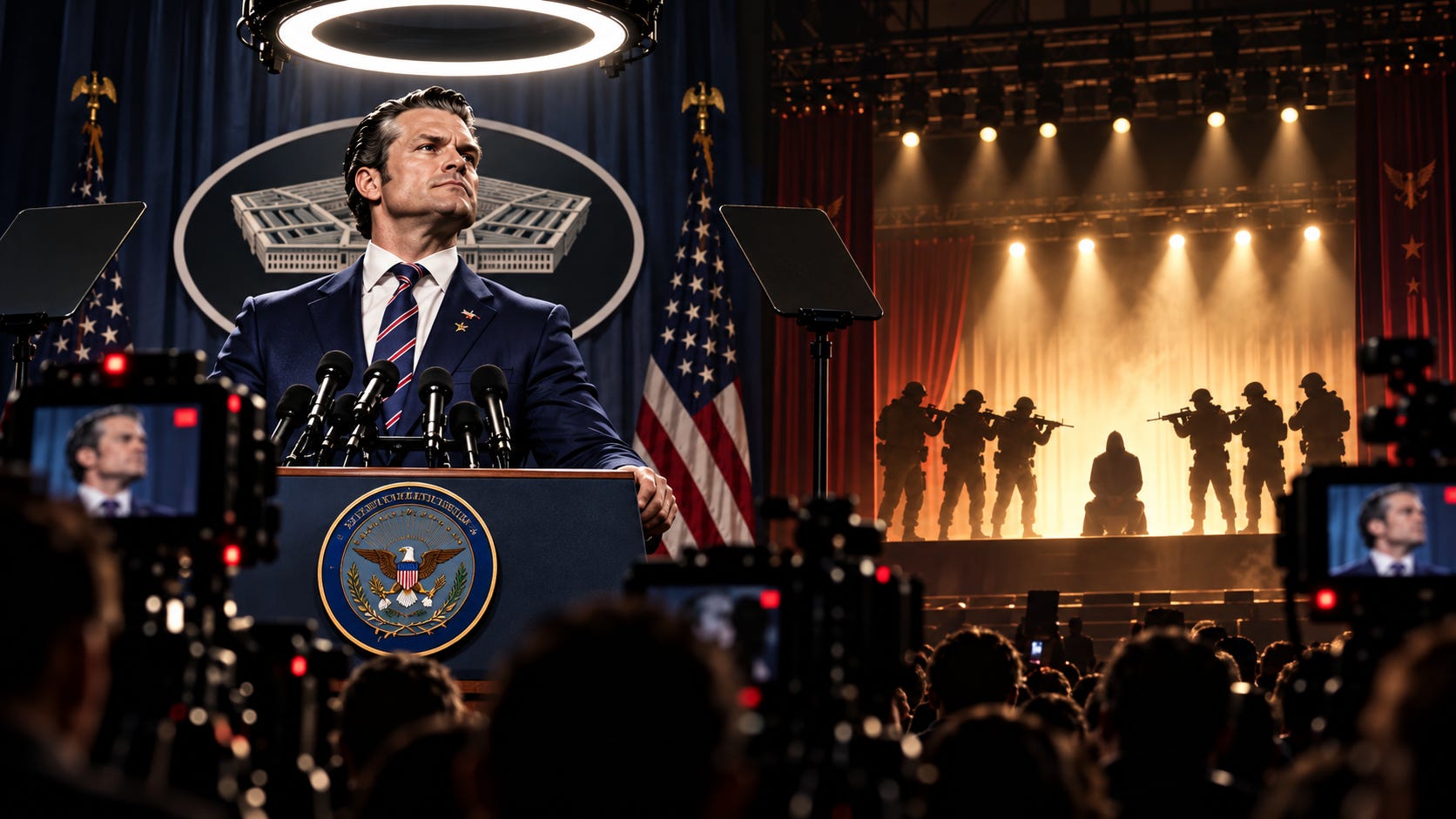
The Secretary of Daddy Thinks I’m Tough
Pete Hegseth has apparently decided that what American democracy needs right now is a government-sponsored snuff film. Not better military readiness, not improved veterans’ services, not a coherent national security strategy. No, the man entrusted with overseeing the most powerful military on Earth has been busy figuring out how to turn an execution into a livestreaming event. Somewhere between managing the Pentagon and auditioning to become Donald Trump’s favorite action figure, Hegseth concluded that the administration’s next contribution to American civilization should be a firing squad with a broadcast schedule. Apparently, the Roman Colosseum was unavailable, and the Department of Defense couldn’t secure the rights to The Hunger Games.
Now, before we examine the latest episode of Pete Hegseth’s ongoing war against human intelligence, it’s worth remembering that this man did not have to be a dumbass. Nobody forced this on him. This is a lifestyle he has actively chosen, the way some people choose veganism, CrossFit, or believing that drinking raw milk makes them intellectually superior to epidemiologists. Hegseth earned a bachelor’s degree from Princeton University and a master’s in public policy from Harvard’s Kennedy School. That is an extraordinary amount of educational privilege for a man whose governing philosophy appears to have been assembled from rejected Rambo scripts and the comments section of a testosterone supplement advertisement. Somewhere along the way, two of the world’s most prestigious universities taught him about public policy, international relations, institutional leadership, and probably the ethical obligations of state power. He somehow absorbed all of that information and concluded that what government really needed was more executions with better production values. Princeton and Harvard each handed this man a diploma, and apparently neither institution offered an extended warranty. Somewhere in Cambridge, a former professor is quietly deleting Hegseth’s name from an alumni success story and reconsidering the effectiveness of graduate admissions.
There is actually a serious political science problem underneath this remarkable display of intellectual malpractice. Hegseth operates within a political environment that rewards what psychologists call identity signaling: the performance of attitudes and behaviors designed to demonstrate loyalty to a particular group. In Trump’s political universe, masculinity is measured by public displays of aggression, intelligence is routinely treated as elitist contamination, and restraint is interpreted as weakness. Hegseth doesn’t simply have to demonstrate loyalty to Donald Trump. He has to perform it so extravagantly that nobody could possibly mistake him for a functioning adult with an independent thought. This is what happens when political advancement depends less on administrative competence than on competitive displays of ideological obedience. The Secretary of Defense becomes the Secretary of Daddy Thinks I’m Tough, and the Pentagon starts resembling a fraternity house where everyone has access to classified information and nobody has access to adult supervision.
Which brings us to the latest production from the Department of Dumbfuckery, formerly known as the Department of Defense and now operating under the administration’s preferred Department of War branding. The Pentagon plans to carry out the firing-squad execution of Nidal Malik Hasan, the Fort Hood shooter convicted of murdering 13 people and wounding 32 others in 2009, on December 3 in Texas. It would be the first military execution since 1961. But simply carrying out the sentence wasn’t sufficiently theatrical for Hegseth, who announced that the execution would be made available for public viewing. “We’ll make sure that people are able to watch it, that it’s public,” he told Real America’s Voice. Asked about Hasan’s final requests, Hegseth responded, “Don’t care. We’ll see him on December 3rd.” What an extraordinary display of courage from a man who will presumably be watching from a safe distance while other people do the shooting. Nothing communicates masculine strength quite like using the machinery of the federal government to arrange a televised killing and then congratulating yourself for being the toughest guy in the production meeting. Somebody get Pete a ring light, a protein shake, and a little military-themed TikTok intro. Turns out America’s national defense strategy now includes making sure the execution gets enough engagement.
And before someone inevitably mistakes criticism of this grotesque spectacle for sympathy toward Hasan, allow me to explain a distinction that should be comprehensible to anyone who survived an introductory civics course. Hasan murdered American service members and inflicted unimaginable suffering on their families. His crimes were horrific, and condemning Hegseth’s proposed spectacle does not diminish them. The issue is not whether Hasan is a sympathetic figure. He isn’t. The issue is whether the United States government should transform the deliberate taking of a human life into entertainment for a politically energized audience. Political theorists have spent centuries examining the relationship between punishment, sovereign authority, and public displays of violence. Michel Foucault devoted much of Discipline and Punish to explaining how public executions historically functioned as demonstrations of state power rather than merely instruments of criminal justice. Pete Hegseth appears to have encountered the same historical tradition and mistaken it for a programming opportunity. Hasan is the condemned man. The government controls the machinery of death. But the person most interested in becoming the center of attention appears to be Pete himself.
And if anyone thinks this latest episode represents some sudden departure from Hegseth’s otherwise distinguished record of sober leadership, I regret to inform you that the evidence suggests the exact opposite. This man has spent his tenure turning the Pentagon into an extended audition for the role of America’s Most Aggressively Unqualified Tough Guy. His leadership style combines institutional vandalism, performative masculinity, contempt for accountability, and the remarkable ability to make a terrible decision look even worse by explaining it into a microphone. In organizational psychology, researchers examine how dysfunctional leadership can spread through institutions when loyalty is rewarded more consistently than competence. In the Trump administration, that isn’t a dysfunction. It’s practically the employee handbook. And Hegseth has been working overtime to earn Employee of the Month.
Consider the following timeline of dumbfuckery.
The Timeline of Dumbfuckery
Early 2025 — The Great Military Competence Purge: Hegseth’s tenure opens with a purge of the top brass. In January, Coast Guard Commandant Adm. Linda Fagan is fired. In February, Trump fires Joint Chiefs Chairman Gen. Charles Q. Brown Jr., and minutes later Hegseth fires Navy chief Adm. Lisa Franchetti. The administration cites an “excessive focus” on diversity in Fagan’s case, because apparently having women and Black people in senior military positions constitutes a national security emergency. Brown was a decorated fighter pilot with decades of experience. Franchetti was the first woman to lead the Navy. Fagan was the first woman to lead an American armed service branch. But Pete, whose most recent experience with military command involved giving political opinions to a Fox News camera, decided these people were insufficiently qualified to serve in his testosterone-themed fraternity. This is a textbook example of ideological purification, a process in which institutions systematically remove individuals whose identities or perceived loyalties conflict with the ruling leadership’s preferred political culture. In ordinary organizations, you evaluate employees based on performance. In the Department of War, you check whether their existence makes somebody in the White House uncomfortable. Nothing says military readiness quite like firing experienced leadership because the organizational chart contains too much melanin and estrogen.
March 2025 — Signalgate, or How to Fail Operational Security While Holding a Master’s in Public Policy: In perhaps the most spectacular demonstration of technological idiocy since somebody tried to charge a cellphone in the microwave, the editor-in-chief of The Atlantic, Jeffrey Goldberg, finds himself included in a Signal group chat where senior Trump officials are discussing military strikes against Yemen. Hegseth shares operational details, including the timing of aircraft launches and attacks, over a commercial messaging application. Seriously, how fucking dumb do you have to be? You are the secretary of defense of the United States of America. You have access to secure communications infrastructure that costs taxpayers billions of dollars, and somehow your approach to discussing an imminent military operation resembles a group text organized by somebody’s drunk uncle planning a bachelor party in Miami. And the editor of The Atlantic is sitting there watching the conversation unfold like he accidentally wandered into the world’s most expensive episode of Punk’d. Hegseth insists that no “war plans” were shared, which is like telling the police you didn’t disclose the bank robbery, only the address, the getaway route, the precise time, and which employee has the vault combination. I have seen undergraduate students demonstrate better information security while organizing surprise birthday parties. At some point, two Ivy League institutions should be allowed to request their degrees back on the grounds that the recipient has been using them in a manner inconsistent with the manufacturer’s instructions.
April 2025 — Signalgate: The Family Plan: Because one catastrophic group-chat scandal was evidently insufficient, reports reveal another Signal conversation involving sensitive military information, this time with Hegseth’s wife, brother, and personal lawyer among the participants. Yes, his wife, his brother, and his personal lawyer. What in the Thanksgiving dinner hell is going on at the Pentagon? The man was discussing details of military operations like he was sending out the family itinerary for a cruise to the Bahamas. Did Grandma get the strike schedule too? Was somebody’s cousin asked to bring potato salad and intelligence assessments? At this point, the only person missing from Pete’s national security apparatus was the family dog, and frankly, the dog might have exercised better judgment. In organizational behavior, this resembles the collapse of professional boundaries, where personal relationships become entangled with responsibilities that demand institutional discipline. In plain English, the Pentagon is not supposed to operate like a family WhatsApp group where everyone gets to know when the missiles are leaving.