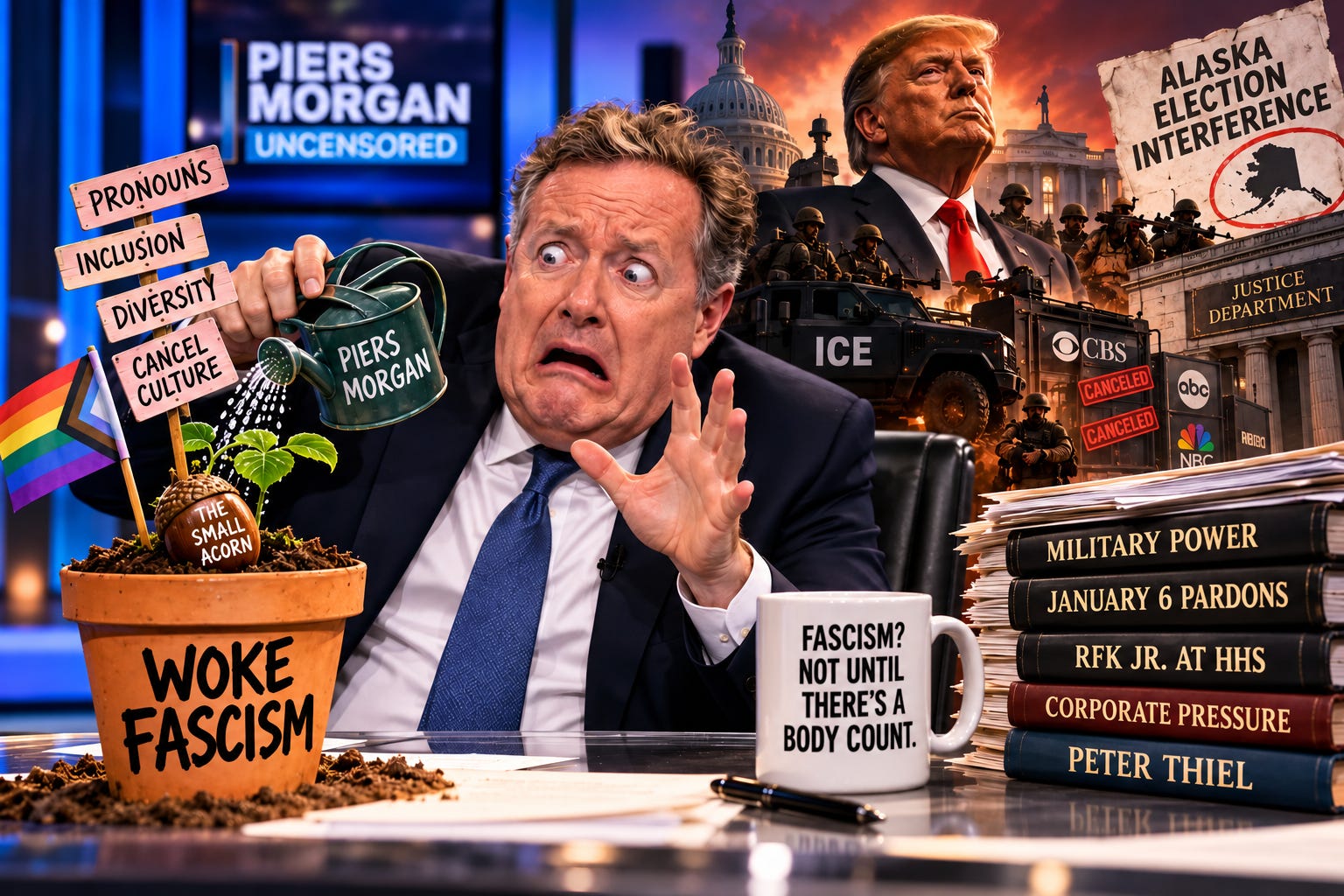
Piers Morgan strikes me as the kind of man who could watch Donald Trump set the Constitution on fire, interview the arsonist afterward, and conclude that both sides made some interesting points about fire safety. I put him in the same medical ward as Bill Maher and Stephen A. Smith, all suffering from an advanced case of what I call Asymmetric Neutrality Syndrome. Symptoms include selective outrage, delusions of intellectual independence, and the remarkable ability to discover fascism in a transgender person’s pronouns while demanding millions of corpses before considering whether Donald Trump might qualify. There is no known cure, although prolonged exposure to intellectual consistency has shown promise in laboratory settings.
Normally, I would leave Piers alone. America has ICE agents roaming neighborhoods, a war in the Middle East, and an election on November 3. I have enough to worry about without adding a British television personality whose ego requires its own broadcasting license. But then I watched his ▶interview with Naomi Klein, co-author of End Times Fascism, and realized that somebody needed to explain a few things before this man injured himself attempting another intellectual somersault. Klein arrived with historical scholarship, political analysis, and evidence. Piers arrived with interruptions, facial expressions, and the confidence of a student who skipped every reading but still believes the professor should reconsider the textbook. So welcome to class, Piers. Today’s lesson is fascism. Try not to confuse it with somebody asking you to respect their pronouns.
Piers is not a dumb man. He is, however, an extraordinarily comfortable one, and comfort can make intellectual laziness feel like objective reasoning. Political psychologist John Jost’s work on system justification theory helps explain why people sometimes defend social arrangements that benefit them. Individuals can become invested in viewing existing institutions as legitimate, particularly when those institutions have treated them generously. Piers has spent decades enjoying the privileges of a predominantly white, male-dominated media establishment. From that comfortable perch, he can look at a transgender activist with an Instagram account and a billionaire with government contracts and somehow conclude that both represent comparable threats to civilization. It is difficult to smell smoke when you own the house, the fire insurance, and the marshmallows.
Then there is his relationship with Trump. Piers won The Celebrity Apprentice in 2008, with Trump presiding over the boardroom, and their relationship has continued in various forms ever since. In psychology, affinity bias describes our tendency to evaluate people with whom we have favorable associations more generously. Familiarity does not establish what Piers privately believes, but it raises an obvious question about his public reasoning. Is he examining Trump through the same analytical framework he applies to everybody else, or is his former television buddy receiving the intellectual equivalent of a family discount? Watching Piers strain to avoid an uncomfortable description of Trump, I am beginning to suspect the dictionary is being asked to honor an expired Celebrity Apprentice coupon.
During the interview, Piers complained that calling Trump a fascist or comparing him to Hitler diminishes the suffering of historical victims. He then asked Klein whether she genuinely believed Trump, Elon Musk, or Peter Thiel would end up killing millions of people. Ladies and gentlemen, welcome to the Piers Morgan School of Comparative Politics, where the final examination consists of one question: Has the suspect murdered enough people yet? If the answer is no, congratulations! Your authoritarianism application has been denied. Please return when the casualty figures become sufficiently horrifying.
This is a textbook example of the representativeness heuristic, developed in the work of psychologists Amos Tversky and Daniel Kahneman. People sometimes evaluate whether something belongs to a category by comparing it to a familiar prototype rather than examining its defining characteristics. Piers’s prototype of fascism is Adolf Hitler, complete with the mustache, goose-stepping soldiers, and extermination camps. If the subject does not resemble that particular historical example closely enough, Piers starts questioning the classification. By that logic, nothing is a dog unless it looks like Lassie, and nobody qualifies as a corrupt politician until investigators discover a suitcase full of cash. I would hate to see this man teach biology. Half the animal kingdom would be disqualified for failing to resemble the pictures in his childhood encyclopedia.
There is also motivated reasoning, the tendency to evaluate evidence in ways that support conclusions we already favor. Rather than begin with an established definition of fascism and evaluate Trump’s conduct, Piers begins with the most catastrophic historical outcome imaginable and treats it as the minimum qualification. The result is a definition tailored so precisely around Trump that I suspect Piers took it to a Savile Row clothier. The fitting must have been magnificent. Every inconvenient historical characteristic was carefully removed until his old friend could slip comfortably out of the accusation.
And here is where we encounter something that should be familiar to anyone who has taken one of my political science courses: words have definitions. I realize this must come as devastating news to a television personality accustomed to treating his personal opinions as the final authority on everything from constitutional government to somebody else’s gender identity. But political science is an academic discipline, not a customer-service counter where Piers Morgan can demand to speak to the manager because a definition has inconvenienced him. If one of my students submitted an examination arguing that fascism could only exist after millions of people had been murdered, I would return that paper with enough red ink to qualify as a minor environmental incident. At least the student would have the excuse of being new to the material.
Robert Paxton, the Columbia University historian and author of The Anatomy of Fascism, identifies fascism through obsessive national grievance, militant nationalism, political mobilization, collaboration with traditional elites, abandonment of democratic liberties, and violence justified through promises of national restoration or purification. His definition examines ideology, political organization, institutional relationships, and governing behavior. Notice what it does not require: an operational extermination camp, a minimum body count, or a notarized affidavit from Adolf Hitler confirming that the applicant meets the qualifications. Piers has essentially invented a fascism rewards program in which the membership card arrives only after the atrocities accumulate enough points.
The historical problem with his argument is equally ridiculous. Hitler’s Nazi movement was fascist long before the Holocaust. The Nazi Party adopted its political program in 1920. Hitler published Mein Kampf in the 1920s. After becoming chancellor in 1933, he dismantled democratic institutions, persecuted political opponents, established concentration camps, and institutionalized antisemitic persecution. The Nuremberg Laws of 1935 stripped German Jews of citizenship rights and formalized racial discrimination. The genocide that became the Holocaust developed through subsequent escalation, particularly during the Second World War.
Now imagine Piers Morgan broadcasting from Germany in 1935. The Nazis have destroyed parliamentary democracy, criminalized opposition, and established a dictatorship built around racial supremacy and political violence. But Piers wants everybody to calm down because Hitler has not yet murdered six million Jews. I can practically hear him interrupting a critic: “But do you seriously believe this man is going to kill millions? Isn’t that rather inflammatory?” Yes, Piers. That is why historians study the development of fascism instead of waiting until the catastrophe is complete. You do not need to watch a building collapse before identifying the man removing its load-bearing walls.
Or consider Benito Mussolini, the man who gave fascism its name. Mussolini founded the Fascist movement, destroyed Italian democracy, and presided over a dictatorship responsible for horrific colonial atrocities, including mass killings and chemical warfare in Africa. His regime did not reproduce the Holocaust’s particular system of industrialized genocide. Under Piers’s standards, even the founder of fascism might fail to qualify as a fascist. Imagine inventing an entire political ideology only to have a smug British television host inform you that your membership application has been rejected. Mussolini would need three references, proof of residence, and six to eight business weeks for Piers to determine whether his dictatorship was sufficiently unpleasant.
I have written before that simply declaring Trump to be Hitler is intellectually lazy. The better question concerns what Trump would do with the same degree of unchecked political authority Hitler eventually consolidated. What institutional restraints would remain? How would he use the machinery of the state? Those are questions about authoritarian capacity, political ideology, and democratic safeguards. Piers instead invokes Holocaust victims to discourage the very historical inquiry their experiences should encourage. Bill Maher performed a similar maneuver when Larry David satirized him. It fascinates me how men who make their living offending people suddenly become guardians of historical sensitivity whenever an uncomfortable comparison involves somebody they happen to like.
Now let’s discuss the people Piers is comfortable calling fascists, because this is where his intellectual standards abandon the studio and leave a particularly agitated garden gnome in charge. Around the forty-seventh minute of the full episode, Piers asks Klein whether she is equally concerned about “woke fascism.” Excuse me? Woke fascism? What in the freshly manufactured Fox News vocabulary is that supposed to mean? I have watched this man throw the word “woke” around for years, and I cannot recall him providing a coherent definition. In political science, we call this a failure of conceptual clarity. Piers appears to believe he can attach “woke” to anything he dislikes, add “fascism” for dramatic effect, and call the resulting nonsense political analysis. By that standard, I could describe him as a chronically constipated authoritarian waffle and demand that Columbia University establish a research center to investigate the condition.
His understanding of “woke fascism” seems especially inseparable from his almost cartoonish transphobia. This is a grown man who once announced on Good Morning Britain that he identified as a “two-spirit penguin” while mocking a classroom video about gender identity. A two-spirit penguin. Imagine waking up, getting dressed, traveling to work, sitting under professional studio lighting, and deciding that pretending to be a penguin is how you are going to defeat gender diversity. Somewhere, an actual penguin was probably wondering why this loud British asshole was dragging its species into a culture war. Penguins already have enough problems with climate change. They do not need Piers Morgan filing an unsolicited membership application.
And the penguin routine was only the beginning. Piers has described nonbinary children as a “contagion” and a “massive new fad,” questioned a nonbinary guest about their genitals, and asked whether he could refer to the guest’s child as “it.” This is a man whose fascination with other people’s gender identities has become so obsessive that I am surprised he has time to interview anyone about international affairs. Someone says they are nonbinary, and Piers reacts like a missile has been launched at Buckingham Palace. I half expect him to appear on television wearing a helmet and announcing that civilization has forty-eight hours to survive because somebody requested a gender-neutral restroom at Starbucks.
In social psychology, othering describes the process of portraying people outside a perceived social norm as alien, threatening, or illegitimate. Piers’s repeated treatment of gender diversity as a contagion or social menace fits that rhetorical pattern. He behaves as though his personal discomfort constitutes scientific evidence, and his television audience has somehow awarded him honorary degrees in endocrinology, developmental psychology, and everybody else’s genital anatomy. I would love to know which medical school granted those qualifications. Perhaps the same institution that taught him fascism requires a Holocaust-sized death toll.
Then comes his method of argumentation. When discussing Trump, Piers demands completed historical catastrophe. When discussing the left, he suddenly becomes a prophet of hypothetical disaster. A university introduces a pronoun policy, and before you know it, according to Piers’s imaginary political trajectory, somebody is constructing a gulag behind the student union. He told Klein that left-wing cancel culture was the “small acorn” that could grow into real-world violence.
Excuse me, the fucking what? The small acorn? What in the horticultural hell is this man talking about? Are we conducting political analysis or hosting a gardening program? Are we supposed to water the pronouns until they grow into a dictatorship? Does the fascism tree bloom in spring? Somebody call the Royal Horticultural Society. Piers Morgan has discovered a dangerous shrub behind the gender studies department.
What makes this especially absurd is that Klein had just explained how fascism develops through identifiable political stages. Piers resisted that argument when the subject was Trump, only to borrow the same logic when the subject became left-wing activism. Suddenly early warning signs mattered. Suddenly hypothetical escalation deserved serious consideration. Suddenly nobody needed to wait for millions of deaths. The acorn became a matter of national security the moment Piers imagined it being planted by somebody with pronouns in their biography. This is selective reasoning dressed up as intellectual consistency, with a slippery-slope argument thrown in for good measure. Piers can identify the theoretical beginnings of totalitarianism in a campus diversity seminar but somehow misses the authoritarian warning signs coming from the Oval Office.