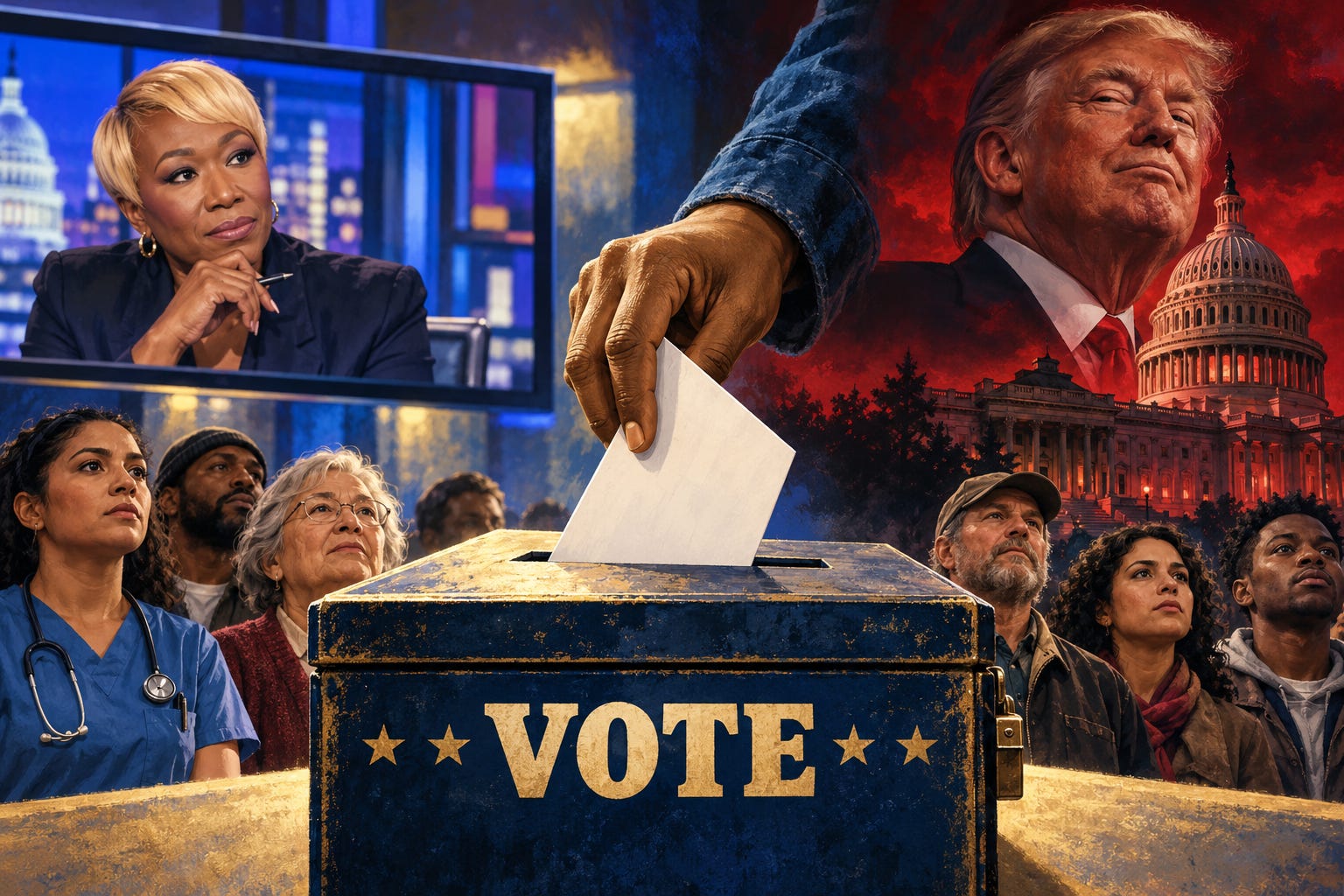
If you have followed my writing for any length of time, you know I take voting seriously. I also consider it the minimum requirement of democratic citizenship. Casting a ballot does not relieve us of the responsibility to understand what the people on that ballot actually do. That requires following the news, paying attention to local government, and knowing who sits on your school board, who serves on the bench, and who makes decisions at city hall, the statehouse, and in Washington. If you can explain the Lakers’ salary cap but cannot name the people deciding your school district’s budget, your research skills are fine. We just need to redistribute some of that intellectual labor.
Elections are exercises in comparative judgment. Depending on where you live and how your elections are structured, your final choice might be between two Democrats or two Republicans. The relevant question is which available candidate will produce better outcomes, or at least do less damage. I have deliberately made my home in a blue city, in a blue county, in a blue state. Apparently, I like my political geography the way MAGA likes its merchandise: aggressively color coordinated. But if I lived in a red county and had to choose between two Republicans, I would grit my teeth, examine their records, and vote for one. One of them is going to exercise power over my life. My disgust does not cancel the election.
I know some of you live in counties where Republican campaigns have become competitive auditions for who can kiss Donald Trump’s ass with the greatest anatomical precision. You have my sympathy. That ballot reads like a talent show where every contestant brought the same kneepads. Even there, however, differences in competence, policy, and willingness to abuse power can matter. A candidate does not have to earn your admiration to be the better electoral choice. Voting gives you a say in who receives the authority to make decisions you will have to live with, whether you participated or stayed home congratulating yourself on having higher standards.
Now we are a month away from the election. Primary season has come and gone. The votes were counted, the nominees were chosen, and your preferred candidate’s yard sign is now a historical artifact. We cannot keep conducting imaginary primaries in October because the actual one failed to produce our desired result. The task now is to stop the bleeding from the Trump administration and decide who will have the power to help it—or obstruct it. Those are the choices on the ballot, however many strongly worded posts we write requesting a different menu.
Here in California, Xavier Becerra is not my cup of tea. But now that he is the Democratic nominee, my choice is between him and Steve Hilton, the MAGA Englishman formerly of Fox News. Apparently, California needed its own imported Trump tribute act. Hilton is a British immigrant backing Trump’s politics and advocating tougher immigration enforcement, which makes the whole performance especially rich: he crossed an ocean and found a political home complaining about other people crossing borders. Immigration brought us Steve Hilton, and somehow immigrants are still the ones being asked to explain themselves. I can have reservations about Becerra without needing a semester to figure out which candidate gets my vote.
The same reasoning applies when the Democrat has taken AIPAC money. That financial relationship deserves scrutiny, criticism, and organized pressure. But does anyone honestly believe handing the office to a MAGA Republican is an effective way to challenge it? What changes for the people whose suffering supposedly motivated that decision? Political accountability requires examining consequences, including the consequences of withholding your vote. If Joy Reid, Ta-Nehisi Coates, or anyone else is proposing abstention in those circumstances, they need to explain how the resulting Republican victory advances their stated goals. “The Democrat disappointed me” explains the grievance. It does not explain the strategy.
Look at New Hampshire. Chris Pappas, the Democrat running for the state’s open Senate seat, has AIPAC’s endorsement, and his primary challenger attacked his position on Israel. His Republican opponent, former senator John E. Sununu, has Trump’s endorsement but would like voters to appreciate his independence. What a convenient arrangement: collect Daddy’s endorsement, then tell the neighbors you barely know the man. Sununu is running on a family name that has already supplied New Hampshire with two governors and a senator. Apparently, the Republican commitment to competition ends when somebody suggests putting a different surname on the stationery.
The electoral question is what either candidate would do with a Senate seat. That means examining legislation, judicial confirmations, executive oversight, and control of the chamber. Your ballot does not contain a box labeled “Please interpret my absence as a sophisticated critique of campaign finance.” It contains candidates, and one of them will win. Helping Sununu win to punish Pappas would require an explanation of how a Trump-endorsed Republican advances the policies you wanted from the Democrat. I would love to see that argument worked out. Preferably before we hand him six years in office and discover that the protest came with a confirmation vote.
Maine produced the kind of nominee Reid wanted. After Platner withdrew, Democrats selected Troy Jackson, who opposes U.S. military aid to Israel. But even if Democrats had selected an AIPAC-endorsed candidate, I would still tell voters to choose that Democrat over Susan Collins. Collins helped confirm Brett Kavanaugh, whose vote helped overturn Roe v. Wade. Her political brand is reassurance; the consequences arrive later, after everyone has been assured there is nothing to worry about. At this point, her assurances ought to come with the pharmaceutical disclaimer: may cause loss of constitutional rights.
Any time I suggest voting for an AIPAC-endorsed Democrat over a MAGA Republican, somebody calls me a shill, an establishment Democrat, or an AIPAC plant. Apparently, comparing two candidates and considering the consequences constitutes a suspicious financial transaction. If I am on AIPAC’s payroll, somebody needs to contact accounting, because this alleged conspiracy has a serious wage-theft problem. And if they think a check would purchase my approval, they have confused a political science professor with a Republican senator.
My job is to evaluate power: who will exercise it, whose interests they will serve, and what their decisions will mean for people who cannot afford the consequences. Recommending a vote for someone does not absolve that candidate of scrutiny. It establishes a comparative judgment about the available alternatives. You can oppose AIPAC’s influence, demand better Democratic candidates, and still recognize that electing a Trump-endorsed Republican is a spectacularly ineffective way to accomplish either objective.
Truth be told, I would prefer a political system where candidates spent more time answering to voters and less time auditioning for people who can purchase a congressional district’s entire commercial break. But we need to distinguish contributions accepted by a campaign from independent spending on its behalf. Refusing corporate PAC contributions does not prevent a super PAC from buying advertisements supporting you. El-Sayed had Fighting for Michigan’s backing in the primary; Senate Majority PAC’s Michigan spending reached $30 million in September. Apparently, the Democratic establishment can locate a progressive’s address when it needs him to win a Senate seat. The broader point is institutional: candidates can reject particular sources of money without escaping an electoral system organized around expensive campaigns and outside spending. You can decline the invitation and still have a super PAC show up outside your house with a marching band.
There is no difference between an interest group and a special interest group. “Special” is a rhetorical label, not a separate category of political organization. Every interest group has an interest that is special to it. Nobody forms Americans for Whatever, We’re Honestly Fine Either Way. Politicians generally use “special interests” to describe somebody else’s supporters; their own are concerned citizens who just happen to have a government affairs department. The meaningful distinctions concern whose interests a group represents, what policies it pursues, and how much influence its resources purchase. A nurses’ union and a corporate lobbying organization are both interest groups, but that does not make their goals, power, or effects equivalent. Calling them “special” tells us considerably less than examining what they actually want government to do.
I understand that “the world is a crazy place right now” barely begins to describe the stakes. The war in Iran, the suffering in Palestine, and the devastation in Sudan concern human beings whose lives cannot be reduced to material for our domestic political arguments. Their suffering deserves sustained attention and serious policy demands. It also makes evaluating consequences more urgent. We need to ask which available electoral outcome offers a better chance of reducing harm, protecting civilians, and changing American policy. The gravity of those questions demands more than a declaration that every candidate has disappointed us. Unfortunately, American elections do not offer a “none of the above, please reconvene with better people” button. Believe me, I would have worn that motherfucker out.
My argument has never been that Democrats should escape accountability. Democratic accountability requires monitoring what officeholders do, organizing around specific demands, and imposing electoral consequences when they fail. Examine the promises they kept, the ones they abandoned, the votes they cast, and the interests they served. Organize between elections, recruit challengers, and contest nominations while the choice of nominee is still open. A vote gives someone temporary authority; it does not grant them diplomatic immunity from your criticism. These people work for us, however often they behave like we are interrupting their donor luncheon. But accountability also requires choosing a remedy that advances your goals. Replacing a disappointing Democrat with a MAGA Republican can leave the people you wanted to protect facing even greater harm. The punishment has to reach the officeholder without making everyone else serve the sentence
If you do not like your candidates taking AIPAC money, organize enough people to make refusing it a political necessity. Demand commitments, examine campaign finance disclosures, recruit challengers, and build a constituency they cannot afford to ignore. Collective action turns an individual objection into political leverage. A furious comment can express your position; an organized voting bloc can change a politician’s calculation. By all means, call somebody a sellout if the evidence supports it. Just have a plan beyond posting it seventeen times and waiting for campaign finance reform to emerge from the replies.
Electoral outcomes determine who writes legislation, who controls public spending, who confirms judges, and who can investigate or enable executive abuses. Those decisions distribute benefits, impose costs, and establish whose rights government will protect. A Senate seat comes with actual governing authority. It does not arrive with a customer satisfaction survey where you can explain that you helped elect the Republican to teach the Democrat a valuable lesson. The Republican gets the seat, the committee assignments, and the vote. Everybody else gets to live with what he does with them.
Consider who actually bears the punishment when an electoral protest helps produce a government more hostile to the protesters’ demands. Kamala Harris lost the presidency, but she did not lose every resource, relationship, or professional opportunity she had accumulated. Losing an election is a profound personal defeat; it does not make a successful former vice president economically vulnerable in the same way as someone living paycheck to paycheck. If your intention was to punish Harris, ask how much of that punishment reached her and how much reached people with far less protection from the consequences of Trump’s decisions. She lost an election. Other people have to worry about what the resulting administration can take from their lives. That is a hell of a way to discipline a politician: send the bill to somebody who cannot afford it.
It is also easier for wealthy commentators with television shows and substantial platforms to make abstention feel principled. They have resources that can cushion the consequences of the political strategies they endorse. Their viewers may not. In political terms, the costs are distributed unequally: the person recommending the protest can be better protected than the person living with its outcome. That does not invalidate the commentator’s argument, but it raises the standard of justification. Explain how the strategy helps the people exposed to the greatest harm. A stirring monologue about withholding your vote needs a second segment explaining who gets stuck with the deductible.
Voting is not a favor to the person seeking office. It is an exercise of your authority over the government that will exercise authority over you. The candidate gets a temporary job; you get to live with the decisions made from it. That is why I vote with expectations, not gratitude. These people are applying to manage public power, not asking me to sponsor their personal journey. They should expect scrutiny, pressure, and demands for results. Supporting a candidate does not require pretending their failures are imaginary. It requires deciding which available outcome gives us more room to organize, more opportunities to improve policy, and fewer threats to the people we are trying to protect.
November 3 is our opportunity to stop the bleeding and change who holds the power to govern. Then comes the pressure: public meetings, constituent organizing, legislative demands, primary challenges, and sustained scrutiny of the people we helped elect. Democrats should expect our votes to come with expectations and our support to come with supervision. I am voting to put people in office whom we can pressure to deliver better outcomes, and I intend to remain a pain in their asses afterwa…