Leo Tolstoy had almost everything most people spend their lives chasing. As one of the world’s most famous writers, his novels were celebrated across Europe. He was wealthy, owned a large estate, had a family, and enjoyed the respect and admiration of countless readers. Many other famous people of his time admired him. He had fame, fortune, and an enviable reputation.
When he was in his fifties, a strange question began to haunt him: “What is the meaning of my life?” Whatever answer he came up with seemed inadequate. Wealth could not answer it. Fame could not answer it. Success could not answer it.
He became so troubled that he feared for his own safety. He hid ropes so he wouldn’t hang himself. He avoided carrying a gun because he feared what he might do. And yet nothing disastrous had happened to him. He had not lost his fortune. He was not an obscure writer struggling to make a living. He was not alone. Outwardly, his life looked enviable. He was not in conflict with others, but with himself.
Most of us may never experience anguish on Tolstoy’s scale. But all of us know what it is like to be in conflict with ourselves.
We are fully aware when we are in conflict with others. Conflict isn’t pleasant, so we try to resolve it, even though we don’t always succeed. But we often ignore the relentless conflict in our own minds, from the moment we wake up until we go to bed, and sometimes even after that.
Every upset is a sign that we are not at peace with ourselves. We get upset with other people when we think they have wronged us, mistreated us, insulted us, cheated us, taken something from us, or behaved in ways they should not have. When we think this way, we are not at peace with ourselves. And when we are not at peace with ourselves, we become angry, seek revenge, lose ourselves in distractions, throw ourselves into work, entertainment, or travel, or turn to drink to escape our troubles.
None of these things really works. Even when they seem to help in the short term, they often leave us unhappier in the long term. In this way, almost any interaction with other people can disturb our peace of mind. But most often, we trouble ourselves. We feel we said something we shouldn’t have said, did something we shouldn’t have done, or failed to do something we ought to have done. Such conflicts arise when we try to control what is not under our control and manipulate externals in an attempt to get what we want.
We live with this mildly disturbed state of mind much of the time. We have become so accustomed to it that it seems perfectly normal. We rarely question it. We think we are in conflict with people and things outside of us. We accept it as natural and don’t look for a way out.
We seldom realize that there is another way to live. It is simple, but first we need to think about the reasons we have inner conflicts.
We tend to think that external factors, such as other people, our circumstances, or what happens to us, create our problems. But, in reality, the biggest source of our problems is not other people, circumstances, or what happens to us. Most of our problems come from us, and we can end them.
Your greatest difficulty is in yourself. You are your own biggest obstacle. You don’t know what you want. You are approving the right course rather than following it. You see where true happiness lies, but you don’t have the courage to attain it. — Seneca, Moral Letters 21
Our thinking creates our inner conflicts. Reckless politicians, bad drivers, terrible weather may bother you, but not someone else. If the situation that bothers you does not bother someone else, then that circumstance cannot be the source of your inner conflict. Your judgment about what happened creates the conflict.
People are disturbed not by things, but by the views they take of them.—Epictetus,Enchiridion 5
If your view of things creates the conflict, you can view it differently and eliminate it. If we are the source of our problems, we are also the source of their resolution.
When we are upset by an erratic driver on the highway, annoyed by inclement weather, angry about a politician, or disappointed by our misfortune, we try to control what we cannot. We can protest, but the erratic driver will still drive erratically, inclement weather will still be inclement, the politician will continue to do as he pleases, and our misfortunes will remain our misfortunes.
If we are mentally choosing good drivers on the highway, pleasant weather every day, reasonable politicians, and better luck, and things of that nature…
… who was it that gave you the choice? Shouldn’t you practice being satisffied with what has been given to you? — Epictetus, Discourses 1.1
When we try to control things we can’t control, we create conflict with ourselves because externals don’t care to align with how we think things should be. We may believe that we are looking at things rationally, but what we are really doing is agitating our mind and setting up a conflict with ourselves. This is a major source of our inner conflicts.
Other people’s behaviour is not up to us. What “happens to us,” whether it is the weather, a stock market movement, or a natural disaster, is not up to us. What is up to us is what we can do about it. When it rains, we can choose to be miserable or get on with the day’s work with an umbrella. When the stock market collapses, we can either feel shattered or plan how best to move forward under the changed conditions. When a natural disaster strikes, we can choose to feel helpless or look for the best way to improve things. Once we choose to focus on what we can control, our inner conflict ends.
The basic rule for avoiding conflict with ourselves is to stop struggling with external problems we cannot control and focus on internal solutions we can apply to them.
Whenever life leaves us upset, discouraged, or unsettled, we tend to seek comfort in distractions, such as entertainment, busyness, or the company of others, to regain our balance. Such distractions may work for a while, but not for long. Soon enough, our mental conflict comes to the surface and shows up as general unease.
We cannot escape this unease by distracting ourselves. We cannot escape it by going on holiday or travelling to a different place. Our inner conflicts stay with us because we take ourselves with us wherever we go. An external solution to an internal conflict can only work temporarily.
And yet, a sanctuary within you remains untouched by external events. You can withdraw there whenever you wish. It is your inner citadel.
People try to retreat to the country, to the beach, or the mountains. You wish you could do it too, but such fantasies are not worthy of a philosopher. Any moment you choose, you can retire within yourself. Nowhere can you go which is more peaceful and more untroubled than your soul. —Marcus Aurelius, Meditations, 4.3
We can retreat from the outer world and go into our inner citadel. Here we can contemplate the source of our inner conflict. We can reflect on what is and isn't under our control. We can observe our thinking. Are we trying to control what is not under our control while neglecting to act on what is? For example, what someone else has done is not under our control. But forgiving them is. Choosing not to be worried about other people’s opinions is under our control.
Make the rules of life brief but profound. Practising them often will get rid of all aggravations, and you will return to your duties as you should, without complaining. —Marcus Aurelius, Meditations, 4.3
Retreating into our inner citadel and reflecting on our behaviour will help us rid ourselves of inner conflicts. Our inner citadel is always available to renew us, but we fail to use it.
An inner citadel is always available to us. By going into it and contemplating, we can renew ourselves and rid ourselves of inner conflicts.
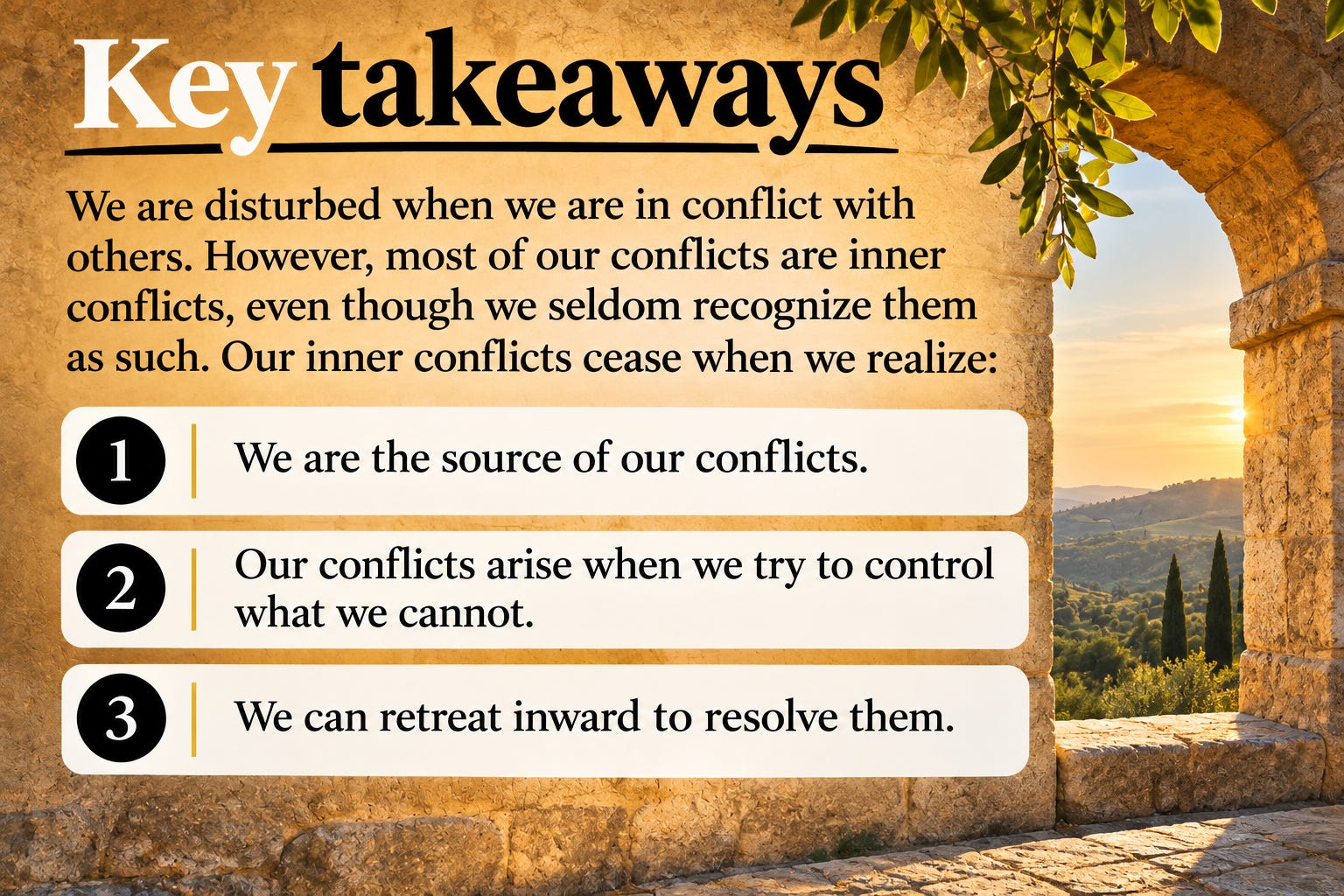
We are disturbed when we are in conflict with others. However, most of our conflicts are inner conflicts, even though we seldom recognize them as such. Our inner conflicts cease when we realize:
We are the source of our conflicts.
Our conflicts arise when we try to control what we cannot.
We can retreat inward to resolve them.
Think of something that happened recently that upset you.
Write down exactly what happened.
Write down the judgment you made about it.
Ask yourself: “Is the event disturbing me, or is my interpretation of it disturbing me?”
Identify what is under your control and what is not.
Let go of what is not under your control.
Decide on one constructive action within your control, and take it.
Observe the effect of letting go of what you cannot control and focusing only on what you can control to resolve the internal conflict.
071126