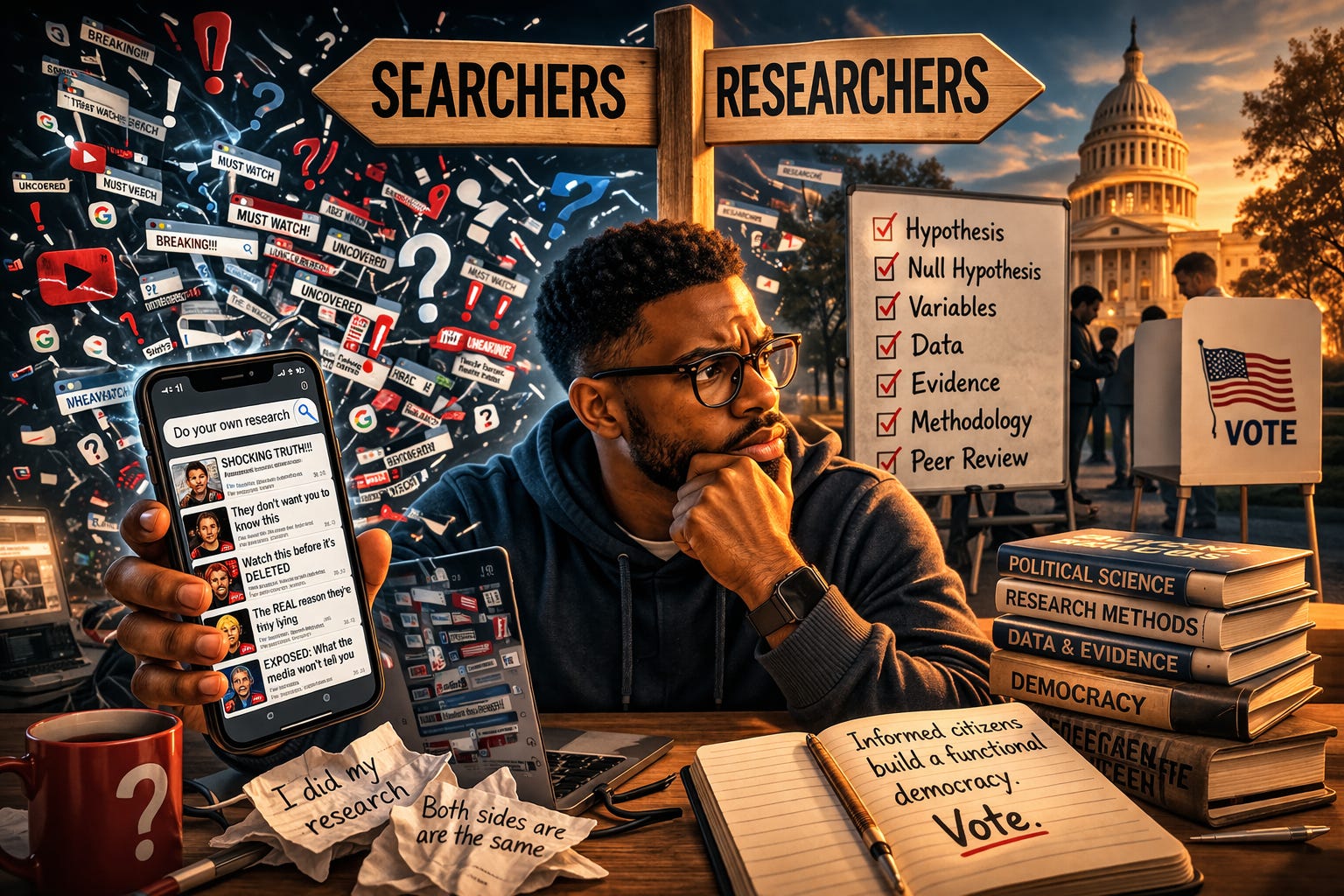
I am writing a book about political illiteracy. Not the kind where people don’t know the three branches of government — though God knows that’s real — but the deeper kind, where intelligent people absorb completely wrong lessons from correct observations and then defend those wrong lessons with the confidence of someone who just discovered fire. I’ve been sitting with this manuscript for months, watching the world hand me free material faster than I can write chapters. Since the book isn’t coming out this year and we are exactly seven months away from midterm elections, consider this a preview. No charge. Think of it as a public service.
I should tell you upfront that I used to be one of these people. In 2000, I cast a protest vote for Ralph Nader because I had decided, with the full conviction of someone who had absolutely no idea what he was talking about, that the two parties were essentially the same and that my vote would send a message. It sent a message alright. The message was delivered to the Supreme Court, then to Iraq, then to about 4,500 American military families who got a folded flag instead of their kid back. I’m not saying my single vote did all of that. I’m saying the thinking that produced my vote, multiplied across enough people, absolutely did. I know what this particular brand of political nonsense smells like because I used to marinate in it. That’s my qualification for everything that follows. Consider it a confession before the sermon.
The sixth sense I’ve developed over years of teaching political science, completing doctoral work in organizational psychology, and watching American politics up close is this: when someone tells you they “did their own research,” they almost certainly did not do any research. What they did was search. And searching is not researching, no matter how many tabs you have open, no matter how many rabbit holes you fell into at 2 a.m., and no matter how confident you sound at Thanksgiving dinner.
I want to be precise about this because it matters. I didn’t have a real understanding of what research actually was until I entered my master’s program. I didn’t get the full picture until my doctoral program, where the methodology requirements forced me to confront exactly what the word means in a rigorous context. Research has a structure. It begins with a hypothesis — a specific, testable claim about the world. It requires a null hypothesis — the version of your claim that you’re trying to disprove. It requires you to identify your independent variable, the thing you’re manipulating or observing, and your dependent variable, the outcome you’re measuring. It requires controls, sample sizes, peer review, and a methodology section that another scholar could replicate independently and arrive at the same result.
So the next time someone hits you with “I did my own research,” I want you to ask them, calmly and without malice: what was your hypothesis? What was your null hypothesis? What were your independent and dependent variables? What was your sample size and how did you control for confounding variables? If they cannot answer any of those questions — and they cannot, because they Googled something and watched a YouTube video from a guy with a ring light and a vendetta — they are not a researcher. They are a searcher. Those are not the same activity any more than pressing buttons on a controller is the same as finishing medical school. One of them has consequences.
Nowhere was this more catastrophically on display than during the COVID-19 vaccine debate, and I want to pause here because this is where the “do your own research” crowd really showed their whole hand. Let me be clear about what the development of those vaccines actually involved: decades of prior mRNA research — we’re talking foundational work going back to the 1960s — clinical trials involving tens of thousands of participants across multiple phases, independent safety monitoring boards, and a regulatory approval process at the FDA that, even in its accelerated emergency authorization form, was reviewed by teams of scientists whose combined credentials would fill a phone book the size of a Cheesecake Factory menu. The people who opposed the vaccine on the grounds that they had “done their research” were, in virtually every documented case, people who had read Substack posts written by chiropractors, watched videos from discredited physicians who had lost their medical licenses, and mistaken the feeling of confirmation for the process of verification.
And here’s the thing about science that the “do your own research” crowd consistently misunderstands: when scientific guidance changes as new information emerges, that is not evidence of a conspiracy. That is the methodology working correctly. Science is a self-correcting process by design. When guidance is updated, it means the system caught something and responded to it — the same way a GPS recalculates when you make a wrong turn instead of just driving you into a lake. Confusing intellectual honesty with institutional deception is not skepticism. It’s a category error dressed up as courage.
Now let me bring this home to the specific political nonsense that pushed me to write this piece in the first place, because this same “do your own research” energy has metastasized from public health into electoral politics, and the results are just as predictable and just as damaging.
▶Swae Lee — yes, the rapper, and yes, he’s from my city — recently sat down on The Breakfast Club with Charlamagne Tha God and DJ Envy and explained his political non-position to an audience that deserved better. To their discredit, Charlamagne and Envy let him cook for the entire interview without a single serious pushback, which is its own problem we’ll come back to. He doesn’t hate Kamala Harris, he clarified. He just wanted people to “have their eyes open” and research candidates instead of assuming they’re “sweet.” He’s not MAGA. In fact, when the Trump administration came to him with $90,000 to perform at an event and post in support on social media, he turned it down — not because of what Trump’s policies were doing to people who look like him, but because he didn’t want to appear as a supporter. He just has concerns. He liked certain tax policies. He doesn’t perform “Up Like Trump” anymore because it’s gotten too political. He delivered all of this with the sincerity of someone who genuinely believes that being confused qualifies as being enlightened.
Let me take all of that seriously for exactly one paragraph, because that’s all it warrants. Swae Lee is from Inglewood, California. Kamala Harris was the San Francisco District Attorney, then the California Attorney General, then a United States Senator from California before she became Vice President and the 2024 Democratic presidential nominee. Her entire career of public service was built in the state he is from and operates in. The information about who she is and what she has done is not hidden. It is not behind a paywall. It does not require a research methodology. It requires about twenty minutes of basic attention and the ability to type into a search bar — which, to be clear, is the floor, not the ceiling, of civic engagement. The fact that he encouraged his audience to “do their research” on a candidate from their shared home state, while demonstrating no apparent familiarity with her actual record himself, is not independence. It is the performance of independence in the absence of the work that would justify it.
The $90,000 story is, unintentionally, the most revealing moment of the whole interview. He turned the money down, he says, because he didn’t want to appear as a supporter. Not because of what the Trump administration’s policies meant to his community. Not because of family separation, or the gutting of healthcare access, or the removal of Black history from school curricula — which he does mention disliking, to his credit — but because of how it would look. Every political calculation he makes runs through the filter of personal brand management and exits the other side dressed as conscience. That’s not political independence. That’s just sophisticated self-interest with a civic vocabulary bolted on. He fatality’d himself and didn’t even know it.
And then there is the matter of not voting as a flex. This posture only works if you are sufficiently insulated from political outcomes that the results don’t reach you personally. For a wealthy entertainer, that insulation is real. For the people Swae Lee grew up around in Inglewood — people navigating Medicaid, housing instability, criminal justice, and underfunded schools — that insulation does not exist. Choosing not to engage with a binary electoral system and framing that choice as enlightenment is a luxury position. It is available to people for whom the stakes are abstract. For everyone else, it is an abdication decorated as philosophy. The game was on and he put the controller down.
A word on Charlamagne and Envy, because they don’t get a pass here either. The Breakfast Club has the kind of reach that comes with responsibility, and sitting across from someone who is actively telling a predominantly Black audience that civic non-participation is a form of wisdom — while nodding along — is a failure of the platform. Charlamagne in particular has shown he knows how to press a guest when he wants to. He just didn’t want to here. The question isn’t only why Swae Lee said what he said. It’s why nobody in that room with a microphone asked him a single hard follow-up.
Marc Lamont Hill is a more complicated case, and I say that as someone who respects his work and has actually told him this to his face — though I doubt he remembers the conversation. Hill is a genuine intellectual. He has written seriously about power, race, and political economy with real clarity and analytical precision. Which is exactly why his third-party vote logic in 2016 was so frustrating — not because it was ignorant, but because he knew better and did it anyway. When someone this smart steps on a rake this obvious, you want to ask them to pull up their notes from their own class.
The structural argument against third-party presidential voting in the American system is not a matter of political opinion. It is a function of Duverger’s Law, which holds that first-past-the-post electoral systems — where whoever gets the most votes wins regardless of whether it’s a majority — mathematically consolidate around two dominant parties over time. This is not a conspiracy by the two major parties to keep alternatives out. It is a predictable structural outcome of how the incentives in plurality voting systems work. Political scientists have understood this for decades. It is taught in introductory comparative politics courses. Hill has taught political science. He knows this. The argument that a third-party vote in a first-past-the-post presidential election constitutes meaningful structural resistance is about as persuasive as trying to beat Goro with one health bar left and no continues. You feel very principled for about three seconds.
What the third-party protest vote in 2016 actually accomplished: Jill Stein received approximately 1% of the national vote. Gary Johnson received approximately 3%. Donald Trump received the presidency. The communities Hill has spent his career advocating for — Black Americans, working-class people, Palestinians — absorbed the policy consequences of that outcome for four years. The argument that casting a vote for a candidate with no structural path to victory in a first-past-the-post system constitutes principled political action does not survive contact with Duverger’s Law. It survives contact with the social rewards of being the person at the table who “refused to play the game.” Those are different things.
I want to be fair to Hill here: his error comes from genuine idealism misdirected by a broken political framework. That is a more forgivable error than what comes next. At least his heart is in the right ZIP code, even if his logic caught the wrong bus.
▶Catherine Austin Fitts is where the “do your own research” instinct goes when it has been fully consumed by conspiratorial thinking and given a TED Talk budget. Fitts, a former Assistant Secretary of Housing under the first Bush administration, sat down recently to explain why she has voted for Donald Trump in 2016, 2020, and 2024. Her framework is sophisticated-sounding enough to fool people who aren’t paying close attention, which is precisely what makes it worth taking apart carefully.
Her central argument is that both major parties constitute a “uni-party” that facilitates massive financial corruption — specifically, she invokes the figure of trillions of dollars in missing government funds as evidence of a systemic plunder operation she calls the “American tapeworm.” She argues that voting for Trump was a strategic disruption of this system, an “FU to the establishment” that brought transparency to government corruption that didn’t previously exist. This is a lot of words for what is, at its core, a vote for the Republican nominee. What she’s running is a textbook motte-and-bailey fallacy — her defensible claim (the system is corrupt) does the heavy lifting to justify her indefensible conclusion (therefore Trump, three times). And underneath that sits an equally familiar move: special pleading. She applies maximum scrutiny to every institution in American life — both parties, the FDA, the financial system, the media — and then exempts her own voting record from that same standard. The tapeworm gets dissected. The ballot does not.
Let’s start with the missing trillions, because this claim has a specific origin that Fitts consistently misrepresents. The figure traces back to a Defense Department Inspector General report identifying accounting adjustments in Pentagon financial records. These adjustments — internal bookkeeping entries used when records couldn’t be reconciled across the DoD’s notoriously antiquated financial systems — were characterized by Fitts and others as evidence of money physically stolen or secretly redirected. They are not. They are evidence of a government accounting infrastructure that has never passed a single audit, which is a genuine and serious problem that has been documented and criticized by legitimate oversight bodies for years. Taking a real audit failure and retrofitting it into a grand unified theory of a secret tapeworm empire is not research. It is the manipulation of a real data point to support a conclusion that was reached before the data was examined. In research methodology, we call that confirmation bias. In everyday life, we call it making stuff up with extra steps.
The “uni-party” framework deserves similar scrutiny. Yes, there is [corpora…