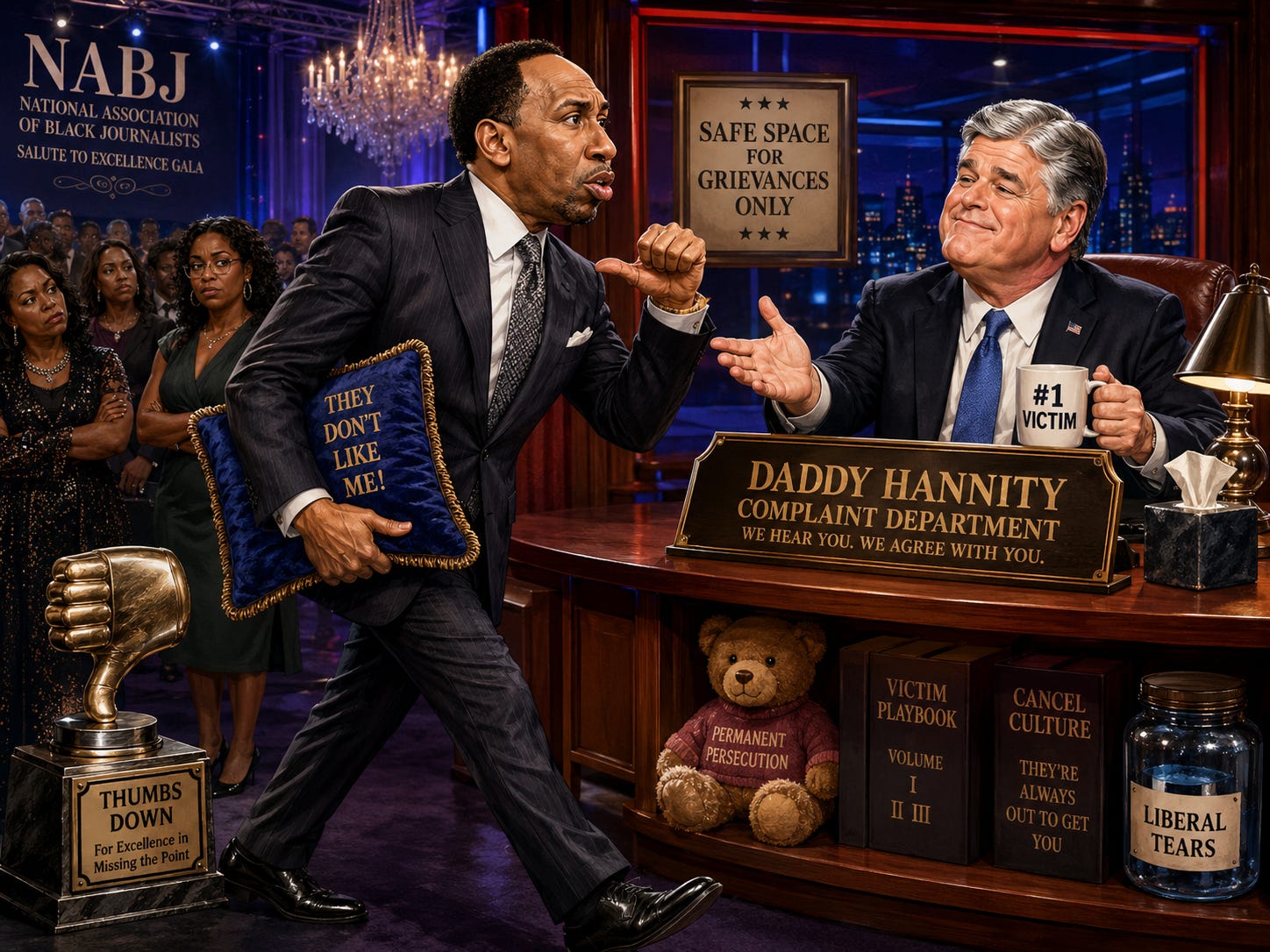
Every time I write about Stephen A. Smith, I feel like I lose a small but measurable percentage of my soul. Not enough to require medical attention, but enough that eventually I may need to itemize it on my taxes. The problem is that I know this man is full of shit. Not think. Know. I do not believe for one second that Stephen A. Smith was genuinely wounded by NABJ giving him that Thumbs Down award. If anything, I think he has been circling this kind of distinction for a while now like a man trying to earn enough loyalty points for a complimentary upgrade to Professional Victim.
And I keep writing about him because Stephen A. Smith is not just some random loud man with a microphone and an unlimited data plan. As much as I hate admitting it, his words carry weight around the Black community — not necessarily because Black people are sitting around waiting for Stephen A. to tell us what to think, but because white Republicans listen when he tells them what to think about us. That is the danger. Stephen A. says something stupid about a Black woman, a Black politician, or Black grievance, and somewhere in America a white Republican leans toward the television and says, “See? Even Stephen A. agrees with me.” Suddenly the bad take has a Black permission slip stapled to it. He is not merely talking. He is supplying ammunition and then acting astonished when somebody notices which direction the gun is pointed.
And it is not an accident who he chooses to leave alone. Trump can call Stephen A. “dumb as a rock,” insult him publicly, and treat him like a man who accidentally wandered onto the national stage while looking for the ESPN cafeteria, and Stephen A. suddenly discovers restraint, decorum, and reverence for the presidency. He will tell you he does not want to get personal. He respects the office. He starts finding nuance in places scientists have yet to detect it. Let Jasmine Crockett criticize him, though, and suddenly Stephen A. is standing at DEFCON 2 demanding everybody clear the runway.
Sure, Stephen A. will tell Trump to stop showing up at Knicks games because he is messing with the energy. Apparently that is where the courage kicks in. Racism? Authoritarianism? Attacks on Black women? Stephen A. would like to review the tape. Bad juju at Madison Square Garden? Sir, you have crossed a line. Trump can insult him personally and Stephen A. turns into Emily Post. Let a Black woman challenge his analysis and suddenly he is Suge Knight with a SiriusXM subscription.
So after Stephen A. got dragged by Black journalists, Black Substackers, Roland Martin, Don Lemon, D.L. Hughley, and enough other Black folks to qualify as an unofficial family reunion, I knew he was going to need emotional support. And where does a grown Black man go when the National Association of Black Journalists hurts his feelings? Apparently he goes home to Daddy Hannity.
Errin Haines had offered Stephen A. a private conversation. No cameras. No ambush. No producer in his ear telling him they were coming back from commercial in thirty seconds. Just two adults talking. Stephen A. looked at that option and apparently thought, Absolutely not. I need Papa. So off he went to Sean Hannity’s show, where he could explain to a white Republican audience why the Black journalists were being unfair to him and receive the kind of unconditional reassurance normally reserved for toddlers who have fallen down without actually hurting themselves.
You can almost hear the conversation. “Daddy Hannity, the Black journalists said I disparage Black women.” And Papa Sean, polishing the grievance machine, responds, “Son, have you considered that they are liberals?” Stephen A. wipes away the imaginary tear: “I knew you would understand me, Papa.” Then they spend the next segment discovering that the real victim of Black women being disparaged was, somehow, Stephen A. Smith.
And that is exactly why going to Hannity matters. When Black journalists challenge Smith, he does not stay in the community and work through the criticism. He does not accept Haines’s offer to talk privately. He does not go sit across from Roland Martin and explain himself to somebody who might actually know the receipts. He runs to a white conservative host whose audience is packed with white Republicans already predisposed to believe that liberals, Black journalists, Black women, DEI, political correctness, cancel culture, and probably oat milk are conspiring against him.
That is not accidental. Stephen A. Smith is not stupid. He knows exactly what Hannity’s audience wants from him, and he knows exactly what Hannity provides in return: affirmation without accountability. Daddy does not ask why six different Black women keep describing the same pattern. Papa does not pull up the clips. Papa pats him on the head, tells him those mean liberals just do not appreciate independent thought, and sends him back out into the world with another segment booked for Thursday.
The point was never dialogue. The point was finding the room where Stephen A. would not have to explain himself to the people he actually offended. He wanted absolution without confession, vindication without examination, and a sympathetic white Republican audience willing to treat accountability as persecution. And whenever the Black community gets tired of the act, Stephen A. seems to know exactly where Daddy keeps the spare key.
Think about the sequence for a second. NABJ, a Black organization, tells Smith he has a pattern of disparaging Black women. Smith’s first move — before he processes it, before he sits with it, before he does anything resembling reflection — is to run to a white conservative pundit on Fox News to defend himself against the accusation of being anti-Black. And not just any network: Fox News, a place that has managed to be sexist toward women of every available complexion. This is the network that helped make Megyn Kelly a star, where she later said Roger Ailes sexually harassed her, before she eventually landed at SiriusXM parsing which sexual predators apparently qualify as the really bad kind while defending the same Donald Trump who once responded to her debate questioning by talking about “blood coming out of her wherever.” If Stephen A. was looking for the International Headquarters of Respecting Women, the Uber took a catastrophic wrong turn.
And the level of outrage itself is hilarious. Dude, they gave you a Thumbs Down. They did not revoke your Black card on national television, declare you Public Enemy No. 1 of Black America, or send somebody from NABJ headquarters to repossess your First Take chair. It is literally a thumbs-down award. The organization said, in effect, Brother, we have noticed a pattern and we need you to do better. Stephen A. reacted like they had lowered his portrait from the rafters and announced that his entire bloodline was under investigation.
On Hannity’s show, Smith didn’t offer a shred of introspection. He called the award “utterly ridiculous,” said being labeled this way was “highly offensive,” and insisted, “I want everybody out there to know there’s no such thing. That is a flat-out lie, and that never happened.” Then, sitting across from Sean Hannity — a man whose career has included enough manufactured grievance about Black women in politics to qualify for frequent-flyer status — Smith reached for his mother and sisters as a human shield: “I was raised by five Black women. My mother, God rest her soul, and my four older sisters. I have two daughters, I have 10 nieces.”
That defense has never made any sense to me. Being related to Black women is not diplomatic immunity from treating Black women badly. Plenty of men have mothers, sisters, daughters, wives, nieces, cousins and aunties and still manage to say sexist nonsense before lunch. Family proximity is not character evidence. If anything, being raised by that many Black women ought to make the standard higher. You don’t get to say, “I know Black women — some of my favorite relatives are Black women,” and expect the case to be dismissed.
And then Smith did the thing Smith always seems to do when accountability gets uncomfortable: he found his way to blaming “the modern liberal community.” Not NABJ specifically. Not the actual examples. Not the question of whether six different Black women and a Black journalism organization might have noticed something worth examining. The liberals. “Their attitude is that you have to parrot their speech lock, stock, and barrel or you’re absolutely positively against them,” he told Hannity, somehow turning a Black professional organization’s criticism of his own public record into another episode of The Liberals Have Gone Too Far.
That is one of Stephen A.’s favorite magic tricks. Someone produces a criticism, Stephen A. produces a liberal, and suddenly nobody has to discuss the criticism anymore. It’s the political equivalent of pulling a rabbit out of a hat, except the rabbit is Sean Hannity nodding sympathetically and whispering, “Those people are crazy, son.”
The internet noticed the irony before I even had to point it out. One commenter summarized the optics perfectly: Smith went on Fox News — a network with its own impressive résumé of publicly disparaging Black women — to defend himself against allegations that he publicly disparages Black women. Another reduced the entire media strategy to four words: “running to Hannity to cry.” I hate when the internet gets to the joke before I do, but sometimes you have to respect efficiency.
And that’s the whole business model in one segment. When Black people hold Smith accountable, he doesn’t remain in Black spaces and work through it. He doesn’t take Errin Haines up on the private conversation. He doesn’t go somewhere the receipts might actually get placed on the table. He runs to the room most likely to tell him the problem isn’t what he said — the problem is that liberals had the nerve to notice.
That isn’t dialogue. It’s grievance customer service, and Daddy Hannity keeps the complaint desk open late.
To really understand the mechanics of what Smith is doing, the best book to read is Clay Cane’s The Grift: The Downward Spiral of Black Republicans from the Party of Lincoln to the Cult of Trump. Cane’s book isn’t about Stephen A. Smith — it’s a history of Black conservative figures, from Frederick Douglass-era Black Republicans down through Tim Scott, Ben Carson, and Candace Owens — but the mechanics Cane lays out explain exactly what Smith is running.
Cane’s core argument is that “the grift” isn’t really about ideology. Plenty of Black conservatives, historically, held genuinely conservative beliefs for genuinely held reasons. That’s not who Cane is writing about. He’s writing about the opportunists — what Zora Neale Hurston called “skin folk who ain’t kinfolk” — people who use proximity to Blackness as a credential, then trade that credential to a white conservative audience hungry for a Black face to validate what it already wanted to believe. The Black figure gets money, platform, and protection. The white audience gets a permission slip. And the actual Black community gets thrown under the bus as the toll for the transaction. Cane’s own definition of it is blunt: “Grifting is a betrayal.”
That’s not a bad description of Stephen A. Smith’s second career. Smith doesn’t need to register Republican, announce some dramatic ideological conversion, or even maintain the same political position from Tuesday to Thursday. He just has to keep showing up in rooms where his Blackness does part of the work for him — a Black man telling a largely white Republican audience that maybe they’re right about Black women, Black politicians, racism, liberals, and whatever else has been placed on today’s grievance buffet. He’s not really selling conservatism. He’s selling validation with a Black face attached, and Hannity’s show is the toll booth he pulls up to whenever the community he claims to speak for gets tired of paying the price.
At some point, Black people have to stop treating this like a misunderstanding we can clear up if we just invite Stephen A. to one more meeting and explain ourselves with the proper PowerPoint. I respect Errin Haines for offering him a private conversation, an open door, a call-in instead of a call-out. But that works on somebody who genuinely doesn’t understand the pattern. Stephen A. understands the pattern so well he practically has the analytics dashboard.
He knows what happens when he goes after Jasmine Crockett or Joy Reid. He knows who gets pissed off, who applauds, who clips it, who invites him onto the next show, and who suddenly discovers that Stephen A. Smith is the bravest Black man in America because he told another Black person to stop complaining. This isn’t somebody who accidentally wandered into a profitable lane. He built the lane, tested the traffic, opened a toll booth, and learned which cars pay cash.
That’s why I don’t have much faith in reasoning him out of it. Smith’s political persona increasingly looks less like a set of convictions and more like a business model, and business models don’t have crises of conscience. They have quarterly reports. NABJ can offer him a seat at the table as many times as it wants. Stephen A. keeps looking over his shoulder at the audience outside the room because that’s where the applause — and increasingly the money — seems to be.
And if anybody thinks I’m exaggerating how dramatically this man has changed, we don’t need to conduct an archaeological dig. We only have to go back six years.
In September 2020, when the Brooklyn Nets hired Steve Nash — a Hall of Fame player with zero coaching experience — Stephen A. didn’t hedge. He didn’t mumble something about meritocracy or warn Black people against seeing race everywhere. He called it white privilege. He said a Black man wouldn’t get that opportunity without experience, named Black coaches who had been passed over, and asked why Black people so often had to be “twice as good to get half as much.” A year later, when Tim Tebow received another NFL opportunity after years away from football, Stephen A. called that white privilege too and essentially told anybody bothered by the phrase to stay bothered.
And this wasn’t 22-year-old Stephen A. Smith discovering James Baldwin in a dorm room and immediately annoying everybody at Thanksgiving. The man was 52 years old. His understanding of race in American institutions was sufficiently developed that he could identify structural advantage on national television without needing Sean Hannity to hold his hand through it.
Then February 2026 arrives. Stephen A. is 58, sitting across from Robert Costa on CBS Sunday Morning, contemplating a presidential run, and suddenly racism is not “as prevalent as some on the Left would like us to believe.” He added that a vast majority of Americans judge people by the content of their character rather than the color of their skin.
Okay.
Some who?
Who exactly is this mysterious “some on the Left”? Which people are telling Stephen A. that racism is crouched behind every mailbox waiting to mug him on the way to Starbucks? How much racism do these unnamed people supposedly think ex…