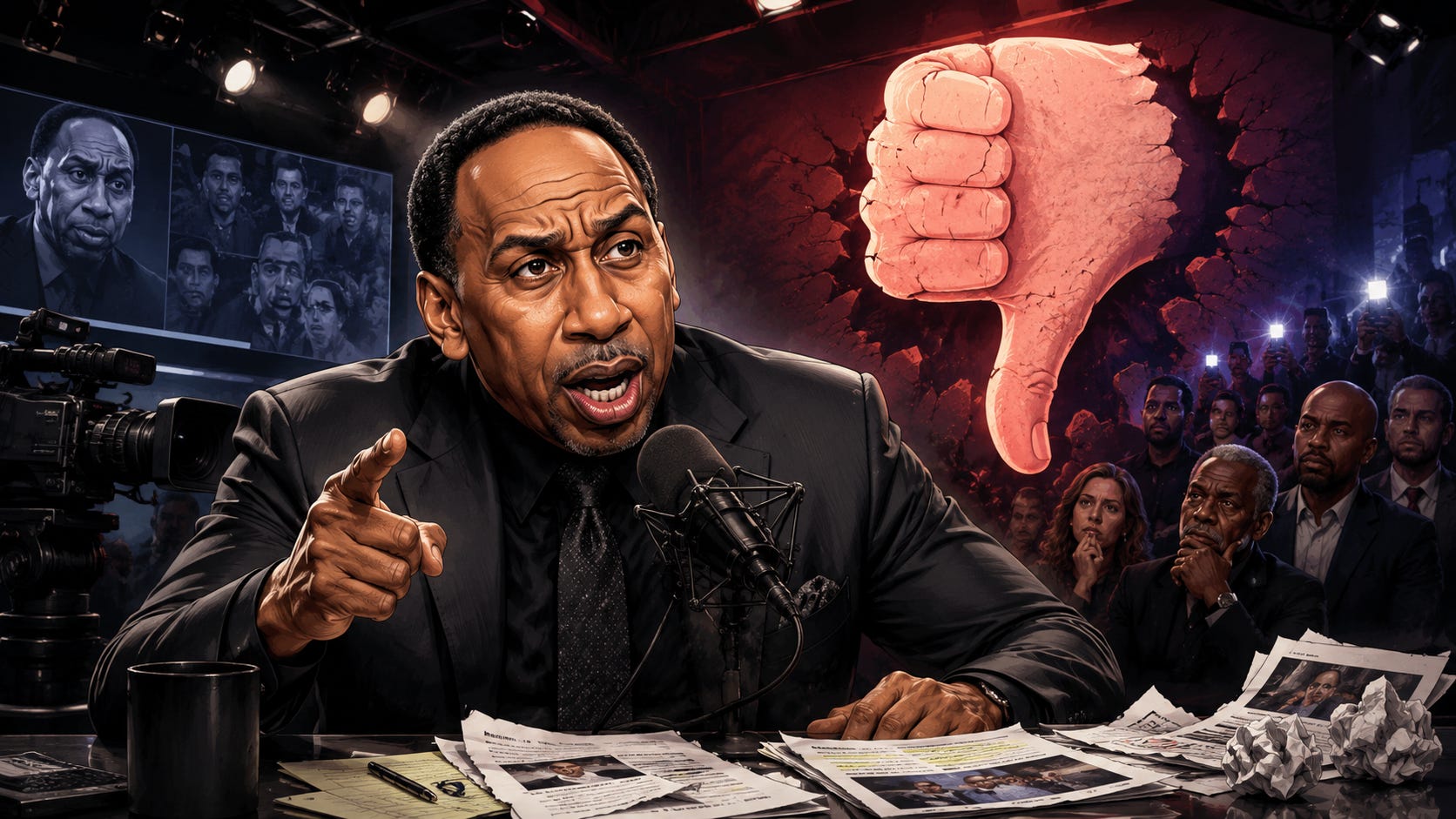
I often wish I could go one month without having to think about Stephen A. Smith. Just thirty consecutive days. A billing cycle. A free trial. Anything.
Stephen A. Smith is easily the highest-profile analyst at ESPN. He makes millions of dollars a year to talk shit about sports, which, for a lot of men, is basically the American Dream with better tailoring. Historically, some of his sports takes have been dead-on and some have been spectacularly stupid — but who cares? It’s sports. Nobody loses Medicaid because Stephen A. thinks the Knicks need another point guard.
But somewhere along the way, sports stopped being enough. Apparently yelling about the Cowboys 200 days a year left too much intellectual real estate undeveloped, so Smith expanded his portfolio to SiriusXM, where he now gives political takes that are often described as anti-Black, misogynistic, anti-women, anti-poor, and generally positioned on the wrong side of whatever issue just walked through the door. To put Stephen A.’s takes in perspective: if there is a wrong side of an issue to be found, Stephen A. makes sure he finds a spot there. Like a Vegas residency.
For the last two years or so, Stephen A. has received plenty of criticism from people in Black media — not exclusively Black media, but mostly. He has been called a sellout, a token, a coon, and several other things I have no interest in repeating. I have written multiple articles about Smith, and I have never called him a coon because I don’t believe in calling other Black people racial slurs, even when they appear determined to turn Fox News green rooms into a rewards program.
What I have accused him of is tap dancing — figuratively — because that is exactly what it looks like when he sits with Sean Hannity, Bill Maher, and assorted wealthy white men who discovered Black grievance somewhere around their third podcast contract, then spends half the appearance explaining what is wrong with Black people. Especially Black women. Smith didn’t stumble into this lane. He paved it, painted the lines, installed a toll booth, and turned it into his second career.
As for whether Stephen A. is a sellout, that’s ultimately between Stephen A. Smith and Stephen A. Smith’s accountant. I don’t have to assign the motive for him. He talks about his money constantly. He flaunts it, defends it, reminds everyone that he is an unapologetic capitalist, and even when he periodically flirts with the idea of running for president, one of his most reliable reasons for not doing it is that public service might interfere with the bag.
So I don’t have to call Stephen A. Smith a sellout. I can just listen to Stephen A. Smith explain, repeatedly and without embarrassment, that money sits somewhere near the center of his decision-making process. At a certain point, I’m not accusing the man of anything. I’m taking minutes.
One of the things that always fascinates me is watching Black people build entire careers saying anti-Black things, then react like somebody violated the Geneva Conventions when another Black person points it out. Apparently, the offense is not saying the thing. The offense is accurately describing the thing afterward.
White racists pull the same stunt all the time. Laura Loomer can call Candace Owens a “nappy-headed Black bitch” and then immediately turn around and insist she isn’t racist, as if racism only counts if you notarize it first. Stephen A. Smith runs a version of the same play. He doesn’t want to be described as hostile toward Black women even though, time and time again, Black women somehow keep ending up directly underneath the flamethrower. Black men catch it too — absolutely — but Black women have gotten enough repeat business to qualify for a loyalty card.
This past weekend, that pattern finally got something close to an official verdict. At the National Association of Black Journalists’ Salute to Excellence Gala in Atlanta, NABJ handed Smith its “Thumbs Down” award — very much the kind of distinction you do not put on the résumé — reserved, in the organization’s own words, for “especially insensitive, racist or stereotypical reporting, commentary, photography or cartooning about the Black community or for engaging in practices at odds with the goals of NABJ.”
And NABJ didn’t exactly leave Smith wondering what they meant. The citation said he “has established a recurring public pattern of disparaging commentary directed at prominent Black women across politics, sports, and media.” Not one unfortunate comment. Not one badly phrased rant. Not one morning where Stephen A. woke up, skipped breakfast, and accidentally chose misogynoir. A recurring pattern.
He wasn’t alone on the list. FCC Chairman Brendan Carr, CBS, The Washington Post, and Circle City Broadcasting’s DuJuan McCoy also got the “Thumbs Down” this year, which is important because NABJ wasn’t simply convening an emergency meeting of People Tired of Stephen A. Smith. They were calling out a broader group of people and institutions whose conduct makes the work of Black journalists harder.
NABJ president Errin Haines made that clear from the stage. “We are here to confront the systems and the people whose choices make your jobs harder,” she said, describing the recognition as “not simply a thumbs down, but a call to do better.”
Which is about as diplomatic as telling somebody, in public, that everybody has noticed what they’ve been doing.
Of course, Stephen A. being Stephen A., he didn’t just shrug it off. He didn’t take it as a moment to look inward and ask why an organization he’s been associated with for decades — an organization that has invited him and ESPN back to its convention multiple times — was suddenly telling him, on stage, in front of his peers, that he has a pattern problem. That would require self-reflection, and Stephen A. treats self-reflection the way Dracula treats sunlight. Instead, Smith did what Smith does: he came out swinging, and because apparently mere indignation wasn’t theatrical enough, he came out threatening too.
“This is the epitome of Christmas arriving early,” Smith posted on X. “The @NABJ wants to call folks out, fine! You had your turn, now mine is coming. And make no mistake…..,I’m coming.” He promised to scrutinize NABJ’s own record after — in his words — staying silent about the organization for years.
Brother, this is an awards controversy, not the trailer for Taken 4.
Let that sit for a second. The National Association of Black Journalists — an organization Smith has been associated with for decades — hands him a public rebuke for what it says is a recurring pattern of disparaging Black women, and Smith’s first instinct isn’t, “Let me examine whether there might be something to this.” It’s basically, “Fine. Now I’m opening the files on all of you.” That’s not a man processing criticism. That’s a man turning constructive feedback into the first meeting of his enemies-list committee.
Because apparently threatening the organization wasn’t enough, Smith also decided to invite NABJ president Errin Haines onto his platform to hash it out. And here’s the part Stephen A. somehow managed to turn into another grievance: Haines didn’t tell him to kick rocks. She didn’t ghost him. She didn’t block his number and change her name. According to Smith’s own account, she essentially said, sure, let’s talk — but let’s have a private conversation first. That’s it. That’s the scandal. A grown woman suggested two adults speak before turning the disagreement into content.
Smith treated this like she’d demanded diplomatic immunity.
“How come I never got a call?” he demanded on his podcast. “How come the NABJ never reached out to me to have a conversation? And you would go on stage, Ms. Haines, and accuse me of disparaging Black women with no evidence, just your feelings.”
“With no evidence” made me burst out into hysterical laughter, but we’ll get to that later.
He called the whole thing a “personal hit job” and insisted NABJ “didn’t engage in journalism when it came to critiquing me,” which is a fascinating complaint from a man whose preferred method of conflict resolution appears to be inviting somebody onto his own show, under his lights, with his producers, on his platform, so he can prosecute the case himself.
I’m not sure what in Stephen A.’s recent history makes him think a respectable Black woman he’s just had a public confrontation with is supposed to walk cold onto his show, cameras rolling, without so much as a conversation first. Errin Haines runs an entire journalism organization. She has spent a career being deliberate about how, when, and where she speaks. Wanting to talk before she talks on camera is not evasion. It’s basic professional caution — especially with a man who has developed a habit of turning disagreements into televised arraignments where he gets to be the host, prosecutor, bailiff, and guy yelling during recess.
Wanting a private conversation first wasn’t Haines ducking Stephen A. It was Haines refusing to walk voluntarily into the Stephen A. Smith Cinematic Universe and discover halfway through the segment that she’d been cast as the villain.
Which begs the obvious question: did Smith actually want to have a conversation with Errin Haines, or did he want to bring her onto his show and ambush her? Because those are not the same invitation. One is, “Let’s talk.” The other is, “Come sit in my studio while I turn your disagreement with me into this week’s episode.” And the fact that Smith either couldn’t tell the difference — or preferred not to — tells you which invitation he was really extending.
Haines didn’t let that framing sit there, either. Two days later, ▶she went on Don Lemon’s show and explained exactly what she had actually offered. She made clear that the “Thumbs Down” wasn’t some new category NABJ invented after Stephen A. irritated everybody at lunch. The organization has been handing these things out for decades, and the standard has never been whether NABJ personally likes the recipient. “This is not about whether we personally like or dislike somebody,” she told Lemon.
What mattered was the pattern, and Haines said it plainly: “there is a pattern here,” one NABJ felt “compelled to address” because of what that rhetoric normalizes when it is repeatedly directed at powerful Black women, especially at a moment when similar attacks are already coming from the highest levels of government. In other words, NABJ wasn’t sitting around a conference table asking, “Who pissed us off this year?” Stephen A.’s name got there the old-fashioned way: repetition.
Then Haines went straight at Smith’s central complaint — that she supposedly refused to come on his show. She never said that. What she said was that she didn’t think the first step should be the president of NABJ walking cold onto Stephen A.’s platform like she was reporting for cross-examination. “I don’t believe the first step should be for the President of NABJ to go on his platform,” she told Lemon. Her reasoning was almost offensively reasonable: “accountability begins with listening.”
She wanted to speak privately first — not because she was hiding from Smith, but because she suspected the rebuke had hit him personally, given how much NABJ has meant to his career, and she didn’t think the mature response was to immediately “turn you feeling some type of way into a televised confrontation.” Talk first. Listen. Figure out what actually happened. Then decide what public conversation makes sense. Radical stuff, apparently.
And then Haines delivered the line that should end any serious debate over who was acting in good faith: “If the conversation is only worth your time because the cameras are on, then we may have different definitions of accountability.”
Whew.
Don Lemon translated that from Responsible Adult into television English: what Smith wanted looked like a “gotcha, clickbait moment, a la Piers Morgan.”
And that’s really the whole dispute in miniature. Haines offered a conversation. Smith wanted a production. She offered dialogue; he wanted content. He needed the cameras rolling, the microphones hot, the thumbnails ready, and preferably somebody in the control room already deciding whether the clip should say STEPHEN A. DESTROYS NABJ PRESIDENT in all caps.
When the president of an organization that helped nurture his career suggested they maybe speak like two adults before turning the disagreement into programming, Smith treated the request like she’d asked him to surrender his passport.
Errin Haines didn’t duck Stephen A. Smith. She just refused to show up for her own ambush carrying a release form.
I should say upfront — I’m a member of NABJ. Have been since I was young, back when the organization was essential to my development as a journalist. I stepped away for a while, but when I started my Substack, I knew NABJ’s allyship was going to matter to my growth as an independent writer, so I came back into the fold. Full disclosure: I’m also probably late on my dues right now — don’t check, I’ll get to it — but even behind on payment, I’m proud of that membership.
And NABJ is not perfect. I’m not writing this as some starry-eyed defender of the organization pretending every decision out of headquarters belongs in the Smithsonian. I’ve had my own issues with them, and none irritated me more than the decision to put Donald Trump onstage at the 2024 convention in Chicago.
That entire episode was embarrassing as hell for the organization.
NABJ invited a man with a decades-long history of race-baiting into a room full of Black journalists and somehow seemed surprised when he immediately began race-baiting the Black journalists. Trump got onstage, was asked a completely fair question by ABC’s Rachel Scott, and responded the way he usually responds when a Black woman asks him something he doesn’t like: he attacked the questioner, complained about being treated unfairly, and then baselessly claimed Kamala Harris had somehow “turned Black,” as if Blackness were a software update she downloaded after becoming vice president.
It was stupid even by Trump standards, which is a competitive category.
Here was a man sitting in front of the National Association of Black Journalists, apparently confused by the concept of a biracial Black woman, explaining racial identity with all the sophistication of a guy who just discovered the Census has more than one checkbox. And NABJ had handed him the microphone.
But what pissed me off most wasn’t simply that Trump said it. Trump saying something racist or stupid is about as surprising as finding fries at McDonald’s. What bothered me was that nobody from NABJ leadership ran onto that stage and checked him in real time. Nobody said, plainly, you are not going to sit on our stage, at the National Association of Black Journalists, and talk about a Black woman like that.
That was the humiliating part. Trump behaved exactly like Trump. Nobody needed Nostradamus to see that coming. The embarrassment was watching an event meant to showcase Black journalism turn into another episode of Donald Trump Learns Something About Black People Against His Will, while nobody representing the organization visibly stepped in and told him, No. You don’t get to do that here.
Prominent members like Jim Trotter and Ernest Owens publicly blasted the decision, and some called for leadership to resign. I understood the anger. I was angry enough that I seriously considered canceling my membership myself. There are networking events where you expect s…