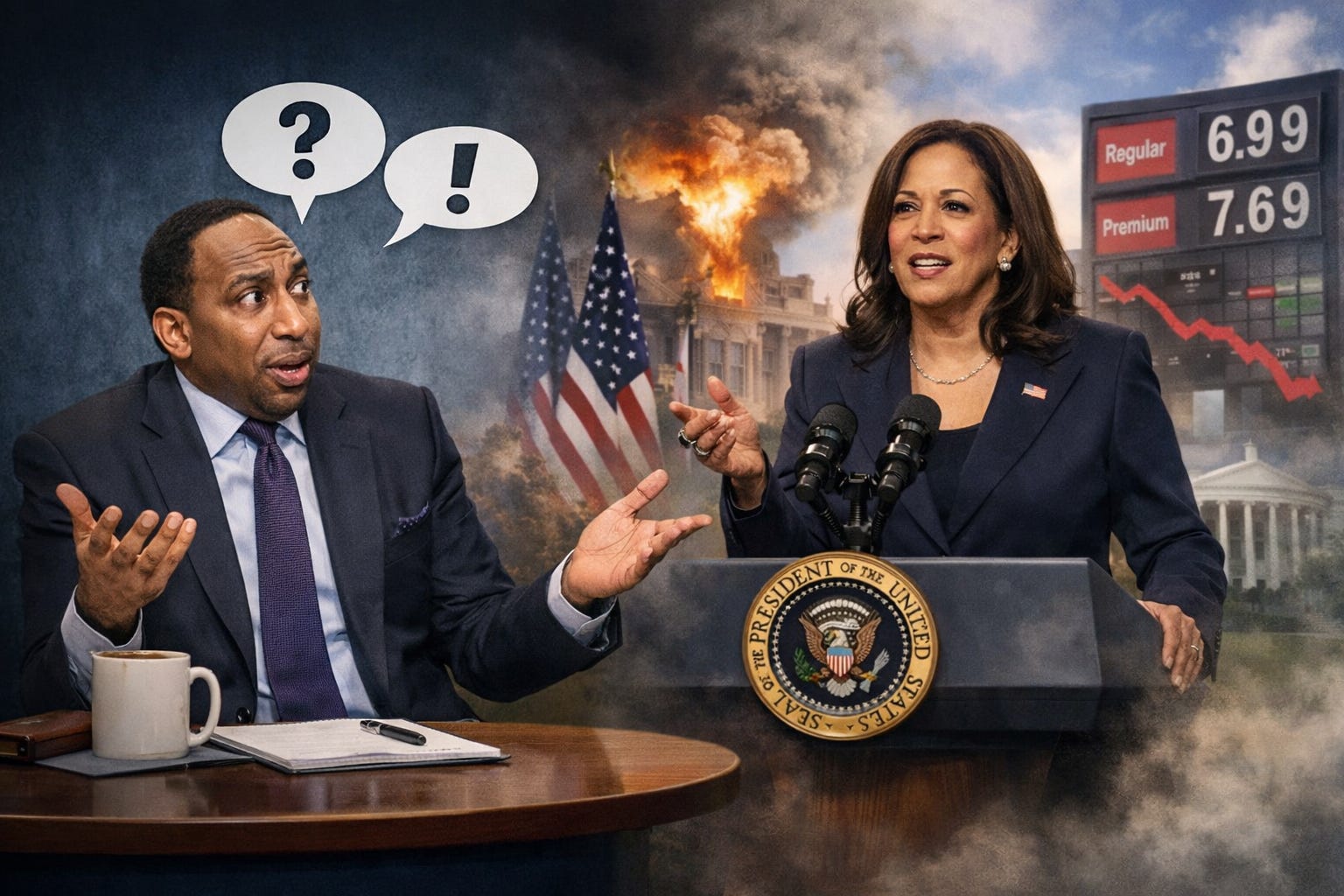
There is a very specific kind of confidence that only shows up when someone is arguing about something that never actually happened. It is smooth. It is polished. It is completely unburdened by evidence. And in the hands of Stephen A. Smith, it becomes something close to performance art.
What Stephen A. is doing in his conversation with Sage Steele is argumentum ad speculationem — speculation dressed up as argument. He is judging a presidency that exists only in his imagination while treating the one that actually exists like a minor inconvenience. The Latin sounds fancy. The plain English is that he made something up and is defending it like it happened.
Stephen A. admits he voted for Kamala Harris. Not reluctantly, not under protest. He voted for her, and then almost immediately began building a case for why that was a mistake. He describes the 107 days between her entering the race and election day like a man slowly losing faith — as though he was watching events unfold in real time and gradually losing confidence in someone he never fully believed in to begin with.
But here is the problem: he still voted.
If those 107 days were as disqualifying as he now claims, the vote makes no sense. And if the vote made sense at the time, then everything he is saying now looks less like analysis and more like a man managing his reputation across two audiences simultaneously. Stephen A. did not vote his conscience. He voted his aesthetic. His objection to Trump was never about policy — it was about comportment. Trump was a “belligerent child.” The agenda was fine. Just use your inside voice. And when this man tells you in the same breath that he would have voted for Marco Rubio or Nikki Haley “in a heartbeat,” I need you to sit with that for a second.
Marco Rubio once looked directly into a camera and called Donald Trump a con man and a fraud. He said it with conviction. He meant every word of it — right up until it was no longer convenient, at which point he became Trump’s Secretary of State without so much as a farewell to his own spine. And Nimrata Randhawa — who ran an entire presidential campaign on the barely concealed argument that Trump was unfit for office, collected donations from people who believed her, and then endorsed him the moment the math stopped working in her favor — is Stephen A.’s idea of the responsible alternative. His backup plan was not different values. It was not even better judgment. It was the same agenda, delivered by people who are better at pretending they do not know what they are doing.
Then there is the “consensus government” argument, which should embarrass him the most. He voted for Harris not because he believed in her leadership but because he was betting on a split Congress to keep her in check. He was not voting for anything. He was voting for gridlock as a safety net. That is the political equivalent of ordering food you do not want because you are afraid the kitchen will mess up your real order — and then, when the meal arrives tasting exactly like what you should have expected, standing up and announcing that the chef you did not pick would have been worse.
The venue for this conversation is interesting. Stephen A. did not take this argument to a neutral platform. He took it to ** The Sage Steele Show**, and that choice is doing a lot of work.
There is no such thing as half Black. Not in America. The correct formulation is not that you are half Black and half something else — it is that you are Black with whatever else is in your background. I am Black with ** Waccamaw Siouan**, Jamaican, and Syrian heritage. That is how it works. The “half” framing implies there is an exit ramp, and America has never offered that exit ramp to anyone it read as Black in the street, in a courtroom, in a traffic stop, or in a job interview. The one-drop rule was not invented by Black people as a source of pride. It was invented by white supremacy as a containment strategy, and it does not come with an opt-out clause for people who find it inconvenient.
Sage Steele finds it inconvenient.
She has spent years treating the Black part of her identity like a garment she puts on and takes off depending on the temperature of the room. When ESPN colleagues said she was not respected by the real Black community and excluded her from a race-related special, she and Stephen A. reframed it as a diversity of thought issue. Not a moment for self-reflection. Not an occasion to ask why the people most directly affected by racial injustice did not find her a credible voice on the subject. A persecution narrative. The Blackness gets claimed when it provides access and set aside when it comes with expectations — and the moment anyone responds to the distancing, it becomes an attack by mean Black people who cannot handle an independent thinker. Had Sage Steele walked into a real debate on any of this and gotten properly checked, she would have walked out describing it as mean Black people ganging up on her. That is the playbook. It is always the playbook. And Stephen A. Smith, who is smart enough to know exactly what he is looking at, sat across from her and validated every step of it.
Last week I wrote about ** Black MAGA and the Performance of...**, and I wish I could say things have improved. Cannon thought he was dropping knowledge from that beach cruiser. He had the cadence. He had the gravity. He was nodding like a man who had just cracked a code the rest of us had missed entirely. Then the internet responded, the backlash arrived on schedule, and Cannon quietly deleted the video. Sat with that. This man was so confident in his educational contribution to Black America that he un-published it. No clarification. No correction. Just a silent erasure — which is a fascinating move for someone who was supposedly speaking truth to power from a convertible. If the knowledge was real, why erase the classroom?
And then Cannon had the nerve to invoke W.E.B. Du Bois in that same conversation, citing Du Bois on the one-party theory as intellectual cover for everything he and Amber Rose were saying. Du Bois spent his entire life documenting the structural machinery of anti-Black oppression in America. ** Amber Rose** spent the 2024 Republican National Convention standing at a podium as the designated proof that Donald Trump is not racist. I am not a theologian, but Du Bois would have had notes. Extensive ones.
Amber Rose is in a category by herself. I have never in my life seen a woman as purely, unapologetically, almost philosophically proud of being dumb as Amber Rose. Most people who are wrong feel at least a flicker of discomfort when the evidence shows up. Amber Rose has never once appeared inconvenienced by a fact. That is not ignorance. That is a discipline. She has put in the work. The woman argued on that beach cruiser that white people should be allowed to use the N-word, declared herself a former liberal who has seen the light, and delivered all of it with the confidence of someone who has never been introduced to a follow-up question. When ** Joy Reid** pointed out that she was on tape saying she did not identify as a Black woman, Rose went on X and said she never said that — she said she identifies as biracial. The tape exists. Amber Rose knows it exists. She just does not care, and honestly at this point I respect the consistency.
This is the ecosystem Stephen A. Smith is operating in when he sits down with Sage Steele and constructs an imaginary Kamala Harris presidency to explain away the real Donald Trump one. He is not an outlier. He is the most polished, most media-trained version of the same move: build the narrative that flatters you, defend it with confidence, and never let actual outcomes get close enough to complicate the argument.
Here is what makes that move particularly indefensible in this case: Kamala Harris was not speculating during that campaign. She was forecasting. She called the tariffs a “Trump sales tax” and warned they would drive up household costs — and every independent economist backed her up. She warned about the trade war. She warned about international instability. She warned about what unchecked executive power looks like in practice. Harris has since described the current economic situation as the ** “greatest man-made economic crisis in modern presidential history”** and noted, without any apparent satisfaction, that the tariffs arrived exactly as predicted. The war. The prices. The chaos. She called all of it. So what Stephen A. is actually doing is contrasting an imaginary Harris failure against a very real Trump disaster that the woman he is dismissing predicted in advance. He is using speculation to discredit the person who was dealing in reality the whole time.
And then there is the presidential ambition, which I would be doing you a disservice if I did not address. Stephen A. Smith believes he could win a presidential race because he would, in his words, punch people in the face with common sense. Setting aside the fact that a man with actual common sense would know he has spent the last several years methodically alienating every voter bloc that would have ever considered him — Black voters have watched him audition for MAGA approval in real time, and white conservatives were never pulling that lever regardless — he then admitted he will not run because equal time laws would force him to give up his media career and his money. Stephen A. Smith will punch you in the face with common sense, but not if it costs him the check. The diagnosis is available. The sacrifice is not on the table. He will identify the disease from the broadcast desk and decline the surgery because the co-pay is too high. That is not common sense. That is a man who has confused having a platform with having a constituency.
What actually happened is this: Stephen A. Smith voted based on the information available at the time. Trump won. Trump is now governing. The consequences are not hypothetical. They are measurable, observable, and ongoing. If the argument is that Harris would have been worse, make it — specifically, with evidence, against the conditions currently in front of us. Not against a fictional scenario assembled after the fact to protect a personal brand from the inconvenience of being wrong.
Anything else is just speculation.
And speculation, no matter how confidently it is delivered on a two-hour podcast with a woman who treats her own Blackness like a revolving door, is not a substitute for reality.