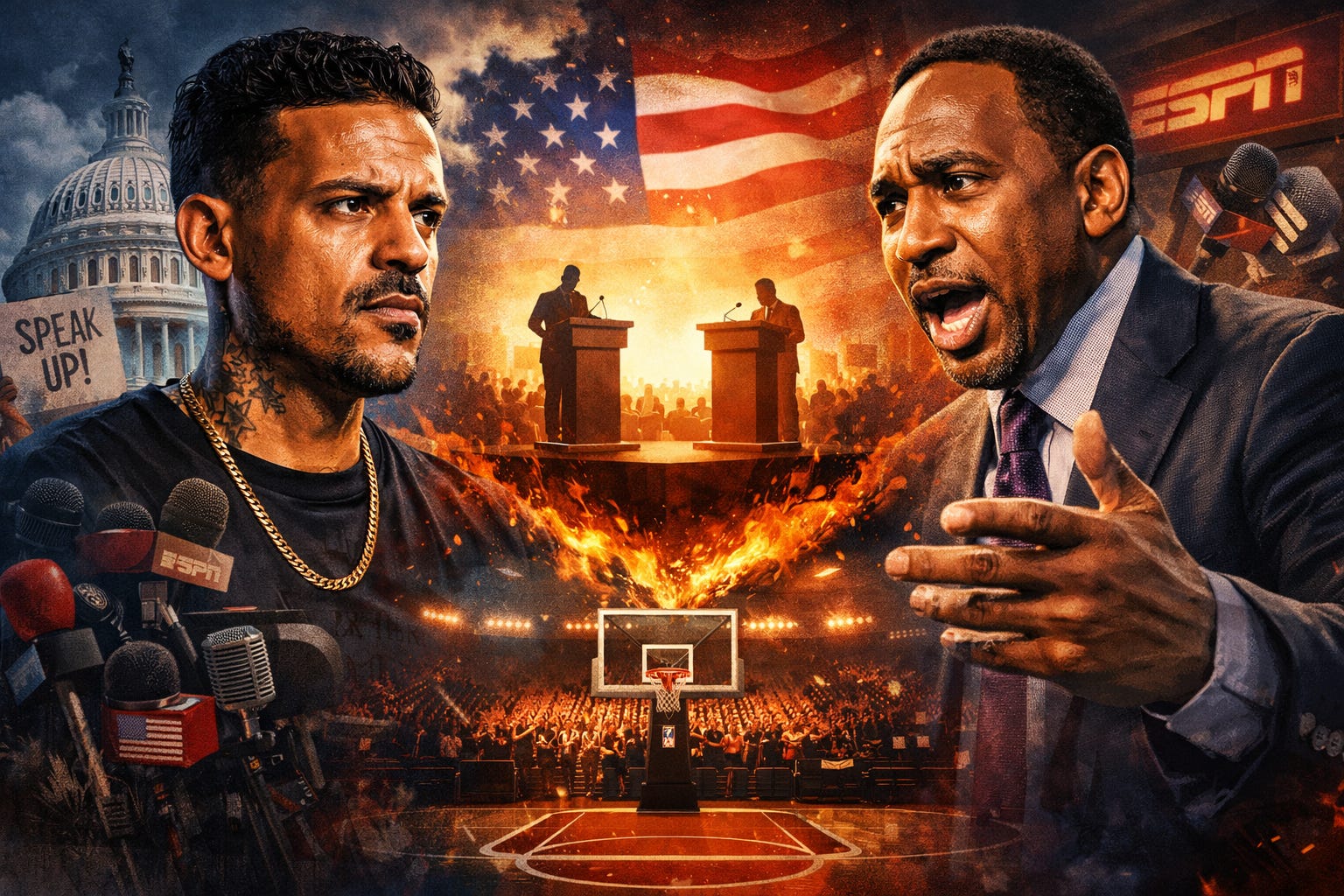
This week, Matt Barnes and Stephen A. Smith had one of the more entertaining and substantive public exchanges we’ve seen in sports media in a long time, and there is so much to unpack that I genuinely don’t know where to start. So let’s just start at the beginning and work our way through all of it, because every layer of this story is worth examining — from LeBron James casually torching a majority-Black city between golf swings, to Stephen A. Smith riding in on his high horse like he’s the guardian of Black America, to Jason Whitlock showing up in costume to prove every point Matt Barnes was making. Buckle up.
LeBron James said he doesn’t enjoy playing in Memphis and suggested the Grizzlies should relocate to Nashville. He said it on a golf course, in front of a camera, the way wealthy and famous people sometimes speak without fully calculating the weight their words carry. I’m a LeBron fan — that’s not changing. And I’m sure he wasn’t thinking that deeply about the economic implications when he said it. But when you are arguably the most recognizable athlete on the planet, casually suggesting a majority-Black city should lose its NBA franchise has real consequences for real people whether you meant it that way or not. Memphis is 63 percent Black. The people who feel that relocation in their pockets aren’t staying at the Ritz. They’re the vendors, the service workers, the small business owners who built livelihoods around that arena. LeBron is entitled to his opinion. It just probably didn’t come off the best. I’ll leave it there because LeBron isn’t really the story. He was just the match.
Stephen A. Smith was the one who decided to pour gasoline on it.
Which is rich. Deeply, historically, almost cosmically rich. Here is a man who has spent years taking shots at Serena Williams, Kamala Harris, and Jasmine Crockett — a man whose political commentary reads like it was drafted by Bill O’Reilly’s research team on a slow news day — suddenly positioning himself as the guardian of Black economic interests in Memphis. The concern would be almost touching if the messenger weren’t so thoroughly disqualified by his own recent record. But Stephen A. Smith has never let irony slow him down, and he wasn’t about to start now.
Matt Barnes saw exactly what I saw. Barnes, who actually played in Memphis and has genuine love for the city, pushed back on Smith the way you push back on someone you used to respect — not with contempt, but with the specific, almost heartbroken disappointment of watching someone you once looked up to become something unrecognizable. Barnes told Smith directly: the version of you I met in Philadelphia twenty years ago would be embarrassed by who you are today. That’s not a Twitter beef. That’s an intervention.
I watch All The Smoke regularly. I don’t always agree with Barnes or Stephen Jackson. There are takes on that show I’ve rolled my eyes at hard enough to pull a muscle. But here is what I have never once accused either of them of: deliberately misinforming people. Barnes asks questions because he is genuinely curious. That is a character trait, not a performance. It is also the sharpest possible contrast with Stephen A. Smith, whose political commentary has nothing to do with curiosity and everything to do with the market for manufactured outrage. One of these men operates in good faith. The other operates in both-sides theater. I’ll let you figure out which is which.
Barnes came from the same place I came from. I was born in Inglewood, California, raised in Los Angeles, moved to East Tennessee in middle school and spent a decade in Knoxville before coming back to LA in 2005. Barnes is from the Sacramento area, four years at UCLA, fourteen seasons in the NBA, built credibility the hard way. I don’t know the man personally, but I know exactly where he comes from and what that means, and I promise you — with every ounce of credibility I have as someone from that world — Matt Barnes is not a fake tough guy. Emmanuel Acho and the Speakeasy panel can have several seats with that take.
Let me explain what Acho actually said, because your ability to appreciate how wrong he is depends on understanding the argument he was making. Acho’s panel looked at Barnes going at Smith publicly and concluded that Barnes was performing toughness for the camera — that the “real” Matt Barnes is calm and measured, and the aggressive version you see online is a character he puts on to seem hard. They pointed to the fact that Barnes smokes weed on camera as evidence of this performance, as if lighting a blunt is somehow proof of inauthenticity rather than, I don’t know, a personal choice that has absolutely nothing to do with the validity of his political critique. The panel’s argument boiled down to this: Barnes doesn’t really mean it, he’s just playing a role, and the weed thing proves it. This is respectability politics dressed up as media analysis, and it does the right wing’s work completely for free. What Barnes does on his own time has zero bearing on whether his critique of Stephen A. Smith is accurate. It is accurate. The blunt is irrelevant. And before anyone gives Acho a pass here, let’s be clear about what he is. Acho isn’t Stephen A. Smith. He doesn’t yell. He keeps the volume down and the lighting flattering. But he plays the same both-sides theater, just at a lower register. Where Smith is loud and sloppy about it, Acho packages the same instinct in blazers and measured tones, which in some ways makes it more insidious because it reads as reasonable. The fake tough guy take on Barnes wasn’t an accident. It was Acho doing what Acho does — finding the most respectable-sounding way to undermine someone who refused to play by the respectability rules. The delivery is different. The effect is identical.
The fake tough guy narrative also falls apart the moment you spend thirty seconds looking at Matt Barnes’ actual biography. This is a man who grew up biracial in Sacramento enduring genuine racism, fought his way through academic probation at UCLA, stuck around all four years, got drafted, got cut before his rookie season even started, spent two years in the D-League when most people would have quit, and eventually carved out a fourteen-year NBA career through sheer refusal to go away. He then drove to Derek Fisher’s house at one in the morning over a personal matter and didn’t lose that argument either. Matt Barnes is not performing toughness. That is just who Matt Barnes is. Acho should know better. And for what it’s worth, when Terrell Owens had his own very public beef with Stephen A. Smith a couple of years back, the place he chose to go and air his grievances was All The Smoke — the same podcast Smith is now dismissing as an influencer operation. Make that make sense.
Now let me pull some rank here, because somebody has to. I am a political scientist. I hold advanced degrees in political science and public administration, I teach at the college level, and I write political commentary professionally. I say that not to be arrogant but because Stephen A. Smith has decided that yelling about LeBron James for fifteen years qualifies him to lecture the rest of us about Black economics, political authenticity, and the moral failures of prominent Black figures. It does not. And when Smith dismissed Barnes as merely an influencer while reminding everyone that he himself is a reporter — a reporter — that word was doing an enormous amount of heavy lifting.
Yes, Stephen A., you are a reporter. A sports reporter. You were the first to break LeBron’s decision to leave Cleveland for Miami in 2010 and that was genuinely impressive journalism. Operative word: sports journalism. But being a great sports reporter does not make you a political reporter any more than being a world-class ballroom dancer means you can pop lock. The skills don’t transfer. The training isn’t the same. The floor is completely different. And the fact that you can waltz beautifully in one room does not mean you should be freestyling in another one and calling everyone who notices a hater. Matt Barnes’ political opinion is at least as valid as Stephen A. Smith’s. I would actually argue it’s more valid, because Barnes isn’t getting his talking points from Bill O’Reilly’s research team.
He also had the nerve — the unmitigated, breathtaking nerve — to call Barnes’ critique clickbait. Stephen A. Smith. The human clickbait factory. The man who has constructed an entire $100 million career on saying something sufficiently inflammatory before 9am so that the rest of the internet spends the remainder of the day reacting to it — that man looked directly into a camera and used the word clickbait with a straight face. The self-awareness deficit required to pull that off is not just staggering. It is, in a strange way, almost impressive. You almost have to respect the audacity.
And then, as if this week needed one more gift, came the debate comment. Smith declared that he would beat Gavin Newsom on a debate stage. And Kamala Harris. And, in his words, most of the Democratic Party. Fine. Let’s be generous. Let’s give him that one. DL Hughley already delivered the only rebuttal that matters: Stephen A. Smith could probably beat LeBron James in a debate too. That doesn’t mean he should be starting at point guard. Debating is a performance skill. Governing is a completely different sport played on a completely different field with completely different rules. I have spent years studying political institutions, political behavior, and the mechanics of how power actually functions in a democracy. I can tell you with professional certainty that winning a shouting match on television has nothing to do with any of that.
But let me save you some trouble, Stephen A. You are not running for president and even if you did, nobody Black is voting for you — not after years of watching you cozy up to the very people working against Black interests. And those conservative white men you laugh it up with on Hannity’s couch and at Bill O’Reilly’s dinner table? They are not voting for you either. Not now, not ever. You have spent years auditioning for an audience that will never cast a ballot in your favor while simultaneously alienating the one that might have. That is not a political strategy. That is a cautionary tale.
What makes the debate comment especially rich is the timeline. In the span of twelve months, Smith said he had no desire to run for president, then said he had no choice but to consider it, then said he couldn’t imagine running, then said he hadn’t ruled it out, then said he was giving it strong consideration, then went on Sean Hannity’s podcast and announced it was officially off the table — because, and I want you to sit with this, the presidential salary of $400,000 a year would require him to give up his $100 million ESPN contract. And then, days later, declared he’d beat most of the Democratic Party in a debate. The only consistent position in that entire sequence is the one that protects the bag. He calls it being a reporter. I call it protecting the bag dressed up as civic duty. Take your pick.
Now, about Jason Whitlock.
Matt Barnes warned Smith that people were beginning to put him in the same category as Jason Whitlock. Barnes meant it as a warning. Whitlock apparently received it as an audition notice. Within days, Whitlock posted a video in blackface-adjacent makeup, impersonating Barnes, mocking his mixed heritage, and calling both Barnes and Smith ‘negro wranglers’ paid to keep Black audiences dumb. Let that land for a moment. The man who rode to Smith’s defense did so in full costume, questioning the Blackness of a mixed-race man on camera. And people want to talk about who the fake tough guy is.
This is not the first time Whitlock has run this particular play. He did it to Colin Kaepernick. There is a pattern here that is not remotely subtle: Whitlock has appointed himself the official auditor of authentic Blackness, and his targets are consistently light-skinned Black men with the nerve to be outspoken about anything that matters. The psychological projection involved in a man doing Tucker Carlson’s bidding full-time while questioning other people’s racial authenticity would be fascinating as a case study if it weren’t so vile in practice.
Whitlock spent years performing apolitical respectability for a living. Never voted. God not government. The real problem in the Black community is that we forgot about faith, not politics. He said some version of this for years while collecting checks from corporate media outlets. Then, one by one, every corporate media outlet he had ever worked for showed him the door. Tucker Carlson opened his. And suddenly Jason Whitlock had very specific political opinions and a very specific set of targets. The both-sides routine was never a principle. It was a market position. When the market dried up, he went where the remaining money was. I want you to look at that arc and then look at Stephen A. Smith’s arc and tell me Barnes wasn’t right to issue that warning.
Stephen Jackson, meanwhile, has his own unfinished business with Smith — the ‘snitch’ accusation over the Russell Westbrook situation, the friendship Smith publicly dissolved, and now Jackson’s cryptic ‘I know you know I know’ on social media. Smith called Jackson’s move weak and dismissed it as social media tough talk, saying that addressing Jackson directly would be like Christmas coming early. Which is a fascinating response coming from a man with a well-documented history of running that exact same play on other people. Smith told LeBron James to ‘be happy with the things I haven’t brought up’ — specifically dangling LeBron’s absence from Kobe Bryant’s memorial service over his head like a loaded weapon he was choosing not to fire yet. He told Terrell Owens he should ‘thank his Heavenly Father’ that Smith hadn’t zeroed in on him yet, and threatened to dedicate an entire podcast episode to exposing everything T.O. had allegedly done behind the scenes to ‘brothers’ over the years. That is the same energy. That is word for word the same move. Stephen A. Smith has built a significant part of his public persona on the veiled threat — the implication that he is sitting on damaging information and magnanimously choosing not to deploy it. When Stephen Jackson does it, it’s…