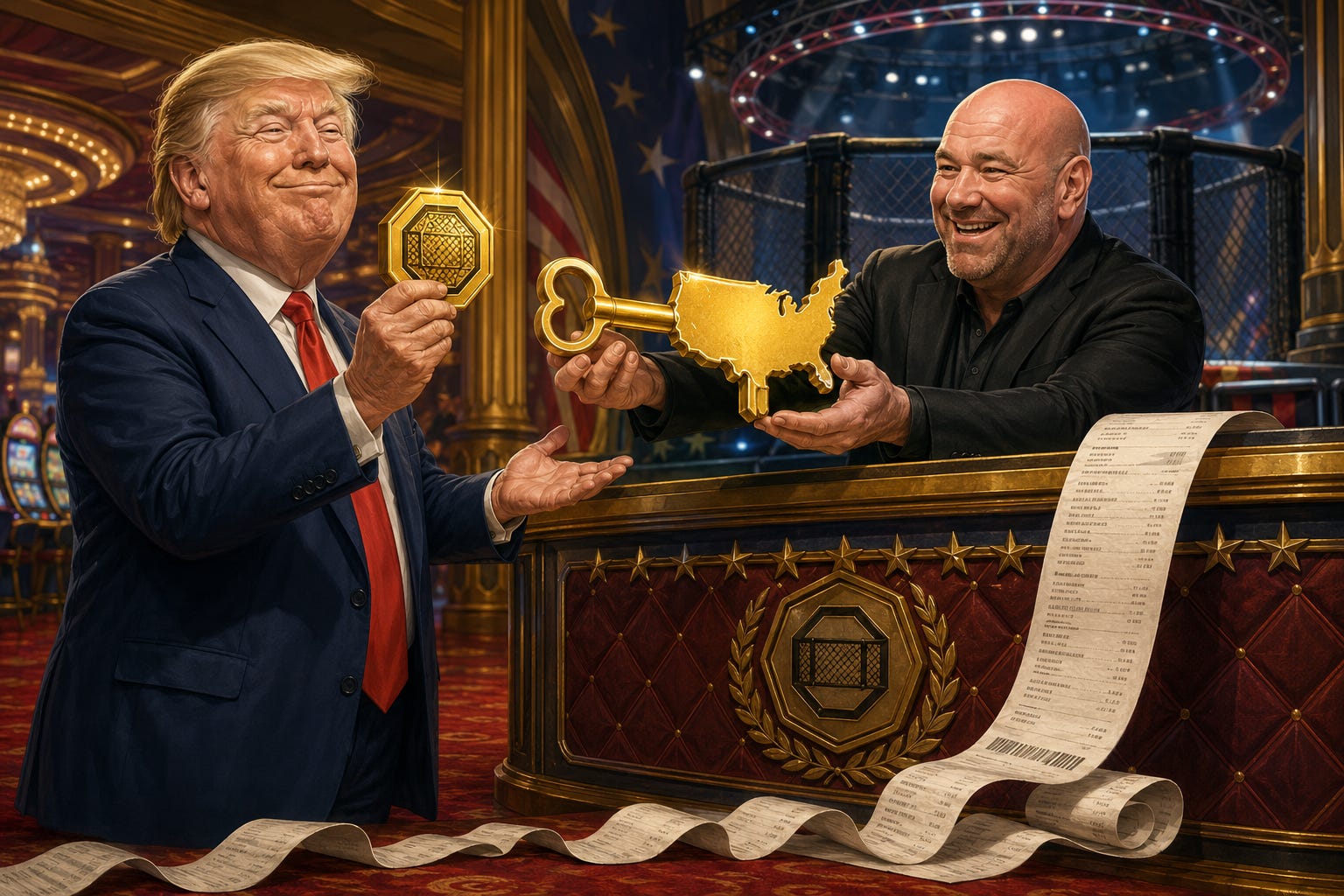
I woke up this morning to an email from a student asking whether I had seen Dana White’s interview on The Breakfast Club. I had not. I am not a regular viewer of the show, and anyone familiar with my work knows I have criticized Charlemagne tha God repeatedly for the irresponsible political games he played, particularly during the 2024 election. But this interview, despite being three months old, was worth going back to because Charlamagne managed to get White to explain, almost perfectly, one of the central pathologies of American politics: the substitution of personal loyalty for political judgment. So I will give Charlemagne credit where it is due. I have criticized him when he deserved it, and I undoubtedly will again, but intellectual honesty requires acknowledging when somebody gets something right—even when that person has previously tap-danced on your last nerve. This was a good interview. Charlemagne kept pressing until White accidentally delivered a miniature dissertation on cronyism without realizing he was the case study. In fact, I have now decided to assign my students the interview and have them dissect White’s argument for themselves. I hope the student who sent it to me is not mad, but this is an important lesson in higher education: never show a professor something interesting unless you are prepared for him to turn it into homework.
Before going any further, we should define the term, because “cronyism” is one of those words people throw around whenever somebody’s cousin gets a government contract. A crony is a close friend or associate who receives access, influence, employment, or some other advantage because of the relationship rather than individual merit. Cronyism is the broader practice of allowing personal allegiance to override qualification, competence, or fitness for a position. White is obviously not appointing Trump to office himself, but he is defending the same underlying logic from the voter’s side: Trump once helped me, therefore I will support him for a job whose consequences extend far beyond me. It is favoritism dressed up as loyalty and personal indebtedness masquerading as political analysis. The presidency is not supposed to be awarded like a lifetime-achievement plaque because somebody let you hold cage fights in his casino during the Clinton administration.
When The Breakfast Club pressed White about his relationship with Trump, he did not attempt to disguise the arrangement. He called Trump “a good friend of mine” and traced that friendship back 25 years to the period when Trump hosted early UFC events at the Trump Taj Mahal while other venues wanted nothing to do with the sport. White insisted that “nothing with us is transactional,” although nearly every explanation he subsequently offered involved a transaction from 25 years ago that he appears determined to repay until one of them dies. When Charlemagne asked whether White could tell his friend that he was failing the people who helped make UFC successful, White’s answer amounted to: that is not what friendship is for. He would rather discuss the wonderful things he sees from close range that the rest of us “either don’t see or don’t want to see.” In White’s formulation, none of this is political. It is merely loyalty to a man who supported him when others would not. Unfortunately, when the friend in question is president of the United States, “I owe that guy one” stops being a private expression of gratitude and becomes a remarkably stupid theory of democratic governance.
Look, I understand loyalty. I understand feeling indebted to people who showed up when you needed them. I spent half my childhood in Los Angeles and the other, more formative half in Knoxville, Tennessee. Knoxville was a strange place when I lived there. I had all kinds of friends, including white friends who held bigoted beliefs and had parents who could have treated a Confederate flag as an interior-design theme. Here is the complicated thing about bigots: some of them can know you, genuinely like you, and be extraordinarily kind to you while remaining deeply prejudiced toward everyone they imagine you represent. In their minds, you are not evidence that their beliefs might be wrong. You are simply the exception they have graciously issued a hall pass. Some of these people helped me when my car broke down. Some let me stay in their homes when I was not getting along with my mother or my former stepfather. I remember those acts of kindness, and I remain grateful for them. But their kindness toward me did not magically erase their bigotry toward other people. It only proved that a person can treat one Black kid well without suddenly becoming Thurgood Marshall.
Psychologists have a name for the mental trick I was witnessing: subtyping. When someone encounters an individual who contradicts a stereotype, that contradiction does not necessarily persuade them to reconsider the stereotype. That would require reflection, humility, and possibly admitting they have been talking out of their ass for several decades. ▶Subtyping offers a much less strenuous alternative. The person simply creates a special category for the exception: You’re not like the rest of them. The individual gets upgraded without the group stereotype ever being audited. Prejudice survives untouched because the inconvenient evidence has been moved into a separate mental folder marked, “One of the good ones.” It is not intellectual growth. It is bigotry performing an administrative workaround.
I understand this dynamic, and I also understand the personal loyalty White is describing, because I faced my own version of it when I was 21. A friend’s father was running for an important office—I will leave the specific office out of it—and he asked me directly, “Ealy, can I count on your vote? Can you stump for me?” I told him I could not. When he asked why, I explained that his political beliefs did not align with mine. At 21, my political philosophy was still wet cement. I had convictions, but I certainly was not sitting around the house reading John Locke in a smoking jacket. Even then, however, I understood that gratitude and political support were not interchangeable currencies. The most I could promise was that I would not actively campaign against him. I could not give him my vote, and I damn sure could not stand on a stage pretending his platform had suddenly become brilliant because I knew his son.
To his credit, the man understood. He did not throw a tantrum, declare me disloyal, or produce an itemized invoice for every kindness his family had ever shown me. Nobody repossessed a meal. Nobody demanded the return of previously administered life advice. This happened before MAGA converted every disagreement into an act of treason, so I cannot guarantee that the same conversation would go as smoothly today. But at the time, two adults managed to disagree politically without either of us posting a seven-minute video from the driver’s seat of a truck. That experience taught me something I have never forgotten: your vote is not something you owe another person. Friendship can create affection, gratitude, and loyalty. It cannot manufacture ideological agreement or confer qualifications for public office.
That is what makes White’s position especially revealing. During the interview, he acknowledged that his own politics probably lean more liberal than conservative. In other words, this is not ideological agreement producing political support. White is not defending Trump because he studied the man’s policies, weighed their likely consequences, and concluded that authoritarianism with a side of tariffs was the closest approximation of his worldview. He is defending Trump because Trump helped the UFC at the Taj Mahal 25 years ago. Apparently, one casino favor now comes with a lifetime presidential endorsement and no expiration date. Trump could announce a federal ban on cage fighting tomorrow, and White would probably explain that the rest of us simply do not know the generous man he knows.
A real friendship should be capable of surviving the sentence, “I love you, but you should not be president.” In Trump’s orbit, however, affection is measured by obedience. He imposes a binary loyalty test on everyone around him: total submission means friend; disagreement means traitor, loser, or deranged lunatic who was never particularly talented in the first place. There is no space for independent judgment because independent judgment is itself treated as betrayal. White presents his refusal to challenge Trump as evidence of an unusually honorable friendship. What he is actually describing is a relationship in which one man receives unconditional political protection and the other gets to call his silence loyalty.
People are sometimes surprised that I can coexist with MAGA supporters. I can. I do not burst into flames when a Republican enters the room. I have boundaries, however, and they are not particularly difficult to understand: do not be racist, sexist, homophobic, or xenophobic around me. Clear that astonishingly low bar, and we can probably watch a game, argue about politics, and continue living our lives. One by one, every MAGA friend from whom I eventually separated crossed one or more of those lines. What struck me was that, before MAGA became a movement, those same people rarely crossed them so openly. The beliefs may already have existed, but Trump created a permission structure that encouraged people to drag every private prejudice out of the basement, put sunglasses on it, and take it to brunch.
Refusing to tolerate that behavior does not mean I stopped loving those people. It means love does not require me to volunteer as the crash-test dummy for somebody else’s toxicity. Boundaries are not evidence that affection has disappeared; sometimes they are evidence that self-respect has finally arrived. And the principle extends beyond MAGA. I would not pledge my vote to a MAGA friend merely because we were close, and I would not pledge it to another Democrat on that basis either. The Democratic Party is not a friendship rewards program, and ten years of knowing me does not earn anyone a complimentary Senate seat. I still have to believe the person shares enough of my values, possesses the necessary judgment, and can do the job effectively.
My vote is a precious commodity, not currency for settling a personal debt. I will not hand it to a MAGA candidate because he once helped me change a tire, and I will not hand it to a Democrat because we have matching opinions and an impressive brunch history. Qualification still matters. Judgment still matters. The consequences for everyone outside the friendship still matter. And honestly, if you genuinely love someone, you should be capable of telling them they are not equipped for a particular job. Sometimes the kindest thing you can do for a friend is prevent them from embarrassing themselves in front of the entire country. Dana White has apparently decided the kinder option is to let his friend embarrass the country instead.
I will give White a modicum of credit for admitting the cronyism out loud, even if he would rather chew through the Octagon fence than call it that. Most people in Trump’s orbit at least bother inventing an ideological justification for their obedience. White essentially said, The man booked my fights when nobody else would, so now I owe him the presidency for the remainder of his natural life. It is refreshingly candid in the same way a bank robber is refreshing when he skips the ski mask and hands the teller his business card. White has removed all ambiguity about the transaction. The only person still insisting it was not transactional is the man describing the transaction.
White is hardly an outlier. Trump’s second administration was explicitly assembled around personal loyalty to Trump, with transition officials examining prospective appointees’ previous statements and political donations for signs of insufficient devotion. That is cronyism in its purest institutional form: competence becomes negotiable, experience becomes decorative, and loyalty to one man becomes the only credential nobody is permitted to lack. Charles Kushner, the father of Trump’s son-in-law, went from receiving a presidential pardon after a federal conviction for tax evasion, campaign-finance violations, and witness tampering to being confirmed as ambassador to France. Alina Habba went from serving as Trump’s personal attorney to becoming the top federal prosecutor in New Jersey, despite having no prosecutorial background, through an appointment that courts later ruled unlawful. At some point, the federal government stopped resembling a professional civil service and started looking like the rewards counter at Dave & Buster’s. Defend Trump long enough, collect enough loyalty tickets, and perhaps you too can leave with an ambassadorship.
Political scientists sometimes describe arrangements like this as patron-client relationships. The patron distributes access, protection, appointments, pardons, or status. The client responds with obedience, public defense, and political labor. The relationship can feel deeply personal to the people inside it, but that does not make it less transactional. It merely means the transaction comes with hugs. White gave Trump his public endorsement, introduced him at Republican conventions, and helped place him before an enormous audience of younger men. Trump, in return, gave White proximity to presidential power and treated the UFC as a favored cultural institution. This is not a friendship that happens to brush against politics occasionally. It is a political alliance wearing a friendship bracelet.
The larger problem is that White did not keep this arrangement inside his personal life. He imported it into the UFC. There was a period when the promotion at least pretended to maintain institutional standards. In 2013, the UFC suspended Nate Diaz for 90 days and fined him $20,000 for using a homophobic slur. That same year, it indefinitely suspended Matt Mitrione after declaring itself “appalled” by his transphobic attack on transgender fighter Fallon Fox. The UFC described Mitrione’s comments as offensive, unacceptable, and a serious breach of its code of conduct. Apparently, the code of conduct later entered the Octagon without protecting itself at all times and got knocked unconscious.
By 2024, Sean Strickland could unleash a homophobic and anti-LGBTQ rant during a UFC press conference, and White’s response was, “Free speech, brother.” White insisted that fighters could say and believe whatever they wanted, as though the First Amendment contains a little-known provision guaranteeing middleweights freedom from workplace consequences. It does not. The government could not imprison Strickland for his remarks. Nothing in the Constitution required his private employer to provide the microphone, promotional machinery, and pay-per-view audience. White was not defending Strickland’s constitutional rights. He was making an institutional choice about what the UFC was willing to normalize—and then hiding that choice behind a pocket-sized copy of constitutional law he apparently found inside a protein-powder container.
Then Bryce Mitchell decided…