I was watching a video of Stephen A. Smith “clapping back” at D.L. Hughley this week, and I swear this isn’t another Stephen A. Smith article. He’s just where the thought started. Hughley had criticized Smith’s White House dinner with Donald Trump and asked a simple question: why are people who have disdain for Black folks so comfortable around him? Or, as Hughley put it, it “says something about you when the people who hate us like you.”
Smith answered the way Smith always answers: by turning up the volume and hoping nobody notices the argument is missing. On his SiriusXM show, he demanded to know, “What you doing for the Black community other than popping shit?” He told Hughley he looked like he had horns coming out of his head, cracked that it had been a long time since The Hughleys, and sneered that Hughley couldn’t even get to the “Black House.” Then, ▶in a follow-up video, he accused Hughley of breaking a promise not to attack Black people and dragged the other Kings of Comedy into it. I swear, Stephen A. could be asked what time it is and somehow end up screaming about somebody’s television ratings from 1998. The man has built an entire second career out of confusing decibel levels with intellectual horsepower. It was a pathetic, childish display from a man who apparently believes shouting constitutes a peer-reviewed argument.
Hughley, for his part, brought receipts. He has been to the White House multiple times, and he noted, “I wasn’t Bill Maher’s plus one.” As for what he’s done for Black people, he listed satirical books, a Peabody-winning documentary, and benefit concerts for Flint and Buffalo, then called the administration’s $500 million HBCU commitment a shell game that moved money already allocated to other minority-serving programs. Stephen A. showed up with insults about Hughley’s forehead. Hughley showed up with a résumé. Somewhere, a debate coach threw a chair through a window.
After watching that circus, and thinking about people like Michael Cohen and Bill Maher, I couldn’t stop thinking about credibility. What it means to our professional and personal relationships. How outsiders perceive us. The kind of people who gravitate toward us. The reaction people have when our names come up, particularly when we’re nowhere around to defend ourselves.
I started thinking seriously about credibility in 2012, right as I finished my MPA in justice administration at Anna Maria College. The woman I was with at the time and I weren’t seeing eye to eye on much of anything, and a good deal of that was my fault. I was having trouble finding a job, briefly experienced homelessness, had no money coming in, and was making decisions that suggested my common sense had taken an unpaid leave of absence. I was gaining weight, getting rejected at interviews, and generally having the kind of year that makes you wonder whether somebody upstairs accidentally put your name on the wrong list.
There was one job that made me interview five times. I didn’t have a car, and the office was thirty minutes away by car, but by bus and three different trains it took two and a half hours each way. I made that ridiculous journey four times for a maybe. After the fifth interview, I got home to the dreaded email: thank you for your time, we’ve decided to go with someone else, good luck in your future endeavors. Five interviews, twenty hours of commuting, and enough public transportation to qualify as an honorary employee of the transit authority. The problem was experience. I had the education, but I hadn’t established the professional credibility they were looking for. I was trying to get someone to take a chance on me, and nobody was interested in gambling.
Looking back, I was a handful. I was constantly broke, frustrated, angry, and about as enjoyable to be around as a mandatory staff meeting on a Friday afternoon. Now, I’m sure my ex had her moments, too. Neither of us was exactly auditioning for sainthood, and I doubt she’d describe herself as a bed of roses. But I’ve had fourteen years to reflect on that relationship, and knowing the man I eventually became makes it a whole lot easier to recognize where I screwed up. I can only be responsible for my own behavior, and mine left plenty of room for improvement. Before life started kicking my ass, I’d been a fun person, a hard worker, and somebody she could depend on. But the more lemons life threw at me, the less lemonade I made. Eventually, I stopped making lemonade altogether and just sat there surrounded by rotten fruit, wondering why everything smelled like shit.
The credibility I’d built with her gradually disappeared. Even when my circumstances improved, the relationship had accumulated so much baggage that we probably needed a separate flight just to transport it. We eventually went our separate ways, and looking back, I understand why. I don’t need to rewrite history to make myself the hero or her the villain. We were two people who had reached the end of what we could reasonably expect from each other. That experience taught me something I’ve carried ever since: professional credibility has to be established, personal credibility has to be maintained, and neither comes with a customer service department willing to process returns.
The classic definition of credibility comes from Carl Hovland and his colleagues at Yale in 1953, who identified two central elements: expertise, whether you know what the hell you’re talking about, and trustworthiness, whether people believe you’re being straight with them. James McCroskey and his colleagues later emphasized a third dimension, goodwill, which concerns whether people believe you have their interests at heart. You can be brilliant and still be a lying sack of shit. You can be the nicest person in the world and still be completely unqualified to do your job. And you can be competent and honest while having all the goodwill of a parking enforcement officer watching you sprint toward an expired meter.
Look at my 2012 experience through that lens. Professionally, I hadn’t established the credibility that comes with experience. Personally, I’d managed to squander quite a bit of the trust and goodwill I’d already earned. Years later, when Cal State Fullerton hired me to teach political science, I didn’t even have to interview. I’d spent years establishing myself as a professor, writer, and political analyst. A Google search showed who I was and the work I’d done. They ran the background check, it cleared, and they told me when to start. In 2012, I couldn’t get hired after five interviews and enough train rides to qualify as a character in a Charles Dickens novel. Years later, I got hired without anyone asking me where I saw myself in five years. Thank God, because I’ve always hated that stupid question.
Credibility is hard to build and easy to lose, and there’s actual research behind that. Psychologist Paul Slovic called it the asymmetry principle: trust is considerably easier to destroy than to create. One bad experience can outweigh a long history of good ones. You can spend ten years establishing yourself as dependable, and one spectacular act of stupidity can have people reconsidering whether you should be trusted to water their houseplants. Peter Kim and his colleagues found that repairing trust depends partly on what damaged it. People are generally more forgiving of mistakes involving competence than violations involving integrity. In other words, people might forgive you for being an idiot. Convincing them you’re no longer a dishonest idiot is considerably harder.
In my PhD studies in organizational leadership, we examine the psychology of organizations, and since my business is politics, I’m particularly interested in how people develop their political beliefs. In political science, we call this political socialization, the process through which people acquire political values, attitudes, and perceptions from the world around them. Family is usually the first major agent, and religion frequently comes along for the ride. Most of us inherit our earliest beliefs before we’re old enough to understand what the hell we’re inheriting. It’s a lot like sports fandom. I’m a Lakers and Dodgers fan because I grew up in Los Angeles. Nobody sat me down at age four with a spreadsheet comparing the Lakers to the Boston Celtics. I was born into a culture, and certain allegiances came with the birth certificate.
Religion works much the same way. It’s not like most five-year-olds are sitting around weighing the theological merits of Christianity, Judaism, Islam, and Buddhism before making an informed decision. Your parents tell you you’re going to church, and congratulations, you’re going to church. Nobody asks whether you’d prefer to stay home and watch cartoons. You’re putting on uncomfortable clothes, sitting through a sermon you barely understand, and learning that questioning the Lord’s mysterious ways is a fantastic way to get yourself in trouble with your mother.
And God forbid you’re the kind of kid who actually asks questions. Imagine sitting there trying to understand the Old Testament.
“Hey, Mom, why did God need people to sacrifice animals?”
“Because Jesus hadn’t died on the cross yet.”
“Okay, but why did animals have to die in the meantime? Couldn’t God just forgive everybody?”
“Because that’s how it was done.”
“Okay, but who made that rule?”
“God.”
“So God made a rule requiring dead animals until he could send Jesus to die so we wouldn’t need dead animals anymore?”
“Boy, don’t you have some homework to do?”
And just like that, your theological inquiry has been adjourned without further explanation. You came looking for answers about Leviticus and left with a warning about your tone. Try appealing that ruling to your father and see how far you get.
Family doesn’t retain a monopoly on our beliefs forever. Political socialization is especially influential during childhood and adolescence, but it continues throughout our lives. We meet new people, encounter new ideas, attend different schools, and occasionally discover that some of the things we were taught as children make considerably less sense when we’re old enough to question them without getting grounded.
Religion was part of that evolution for me. When I was younger, I identified as a Christian. As I got older, though, the religion began losing credibility with me, largely because of the behavior of religious actors I encountered in everyday life. I wasn’t sitting around trying to disprove the existence of God between Lakers games. I was watching people who claimed to represent Christianity behave in ways that made me question whether they had read the same book they kept telling everybody else to follow. Eventually, the religion stopped aligning with my understanding of the world. That doesn’t make Christianity inherently bad, but it certainly made me reconsider the people presenting themselves as its authorized customer service representatives. We’ll get back to religion in part two.
In media and teaching, we’re paid to know what the hell we’re talking about. As a political science professor, the bare-bones basics of my job are to explain the science of politics: how the machinery works, who holds power, and how people use that power. I often tell my students they can take what I teach them and use it for good or evil. My responsibility is to teach them the science based on the research, my education, and what I’ve observed in practice. What they decide to do with that knowledge is between them, their conscience, and possibly a federal grand jury.
Credibility opens doors that would otherwise stay shut. I learned that the hard way on a bus and three trains. In politics, though, the appearance of credibility can be manufactured, and one of the oldest tricks is talking fast. In a 1976 study, researchers Norman Miller and his colleagues found that rapid speech could increase perceived credibility and persuasion. People often interpret a confident, fast-talking person as knowledgeable, even when they haven’t established whether the person knows a damn thing. Later research has also shown that excessive speaking speed can interfere with comprehension. Imagine that. The human brain sometimes mistakes a mouth operating at 195 words per minute for a mind producing 195 worthwhile words per minute. If that were how intelligence worked, every auctioneer in America would have a Nobel Prize.
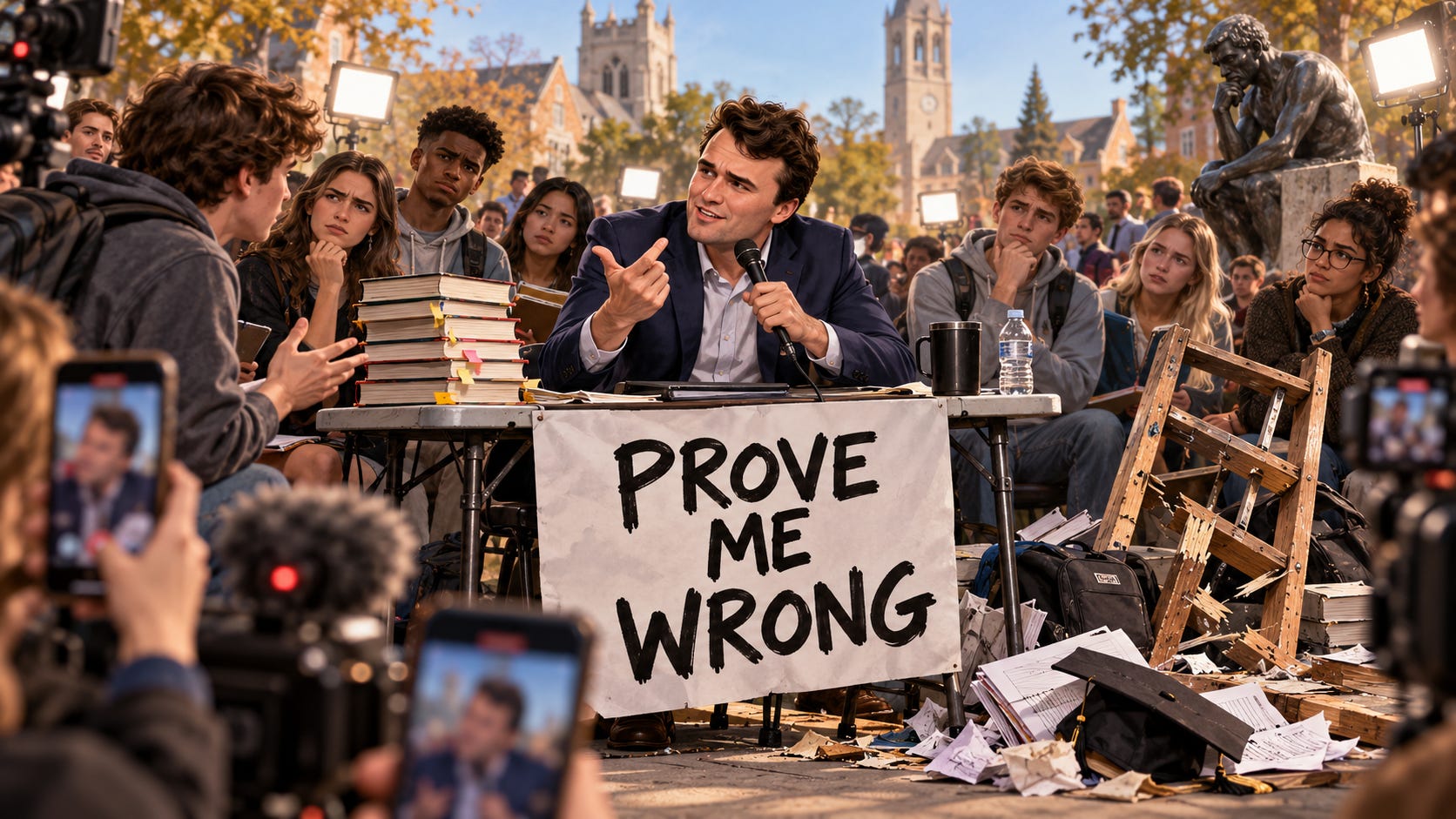
The late Charlie Kirk built a career around this kind of manufactured authority. I maintain that his death was a tragedy and nobody should be murdered for expressing political opinions. But I’m not rewriting his intellectual history because somebody killed him. Kirk was something of an offshoot of Ben Shapiro, who turned rapid-fire debate into a conservative spectator sport. The funny thing is that much of Shapiro’s perceived intellectual authority comes from his academic credentials. He graduated from UCLA and Harvard Law School, practiced law, and then used those credentials to argue that much of higher education was a waste of money. The man climbed the academic ladder, pulled it up behind him, and started charging people admission to a seminar on why ladders are unnecessary. Kirk took that lesson a little too literally. He dropped out of Harper College after one semester and spent much of his career visiting college campuses to interrogate students pursuing degrees he never finished.
Kirk always struck me as someone who was jealous of those students. Think about the absurdity of the situation. Kirk was going from campus to campus challenging young people who were pursuing the education he’d abandoned. Many of those kids were on their way to developing specialized knowledge and becoming far more intellectually accomplished in their fields than Kirk ever demonstrated himself to be. He was sitting outside institutions of higher learning, effectively demanding that students prove their intelligence to him. Imagine dropping out of medical school after one semester, then spending the rest of your life standing outside Johns Hopkins asking medical students to explain why you shouldn’t be allowed to perform surgery.
The psychology behind that behavior fascinates me because it illustrates how people can protect their self-image by discrediting something they haven’t successfully achieved. Social psychologists call one mechanism the self-serving bias: people tend to take personal credit for successes while attributing failures to external circumstances. Cognitive dissonance can reinforce the process. When someone’s self-image conflicts with…