When I started writing for Substack, I had no idea it would turn into a second career. That I would make taxable income doing what I love, on my own terms, without waiting for some editor at a major publication to decide my topic was worthy of their masthead. No pitch emails. No rejection letters. No explaining to a gatekeeper why something matters. Just me, my laptop, and the readers who show up because they want to.
Now that the newsletter actually turns a profit, I’d be lying if I said revenue doesn’t cross my mind before I start typing. Money is a barometer. If people are reading and paying, the topic landed. If it didn’t, maybe I misjudged the room. It happens.
Kevin Warsh is not going to make me any money. I know this going in. He is a nobody. Not a celebrity nobody. Not a political nobody with good hair and a cable news contract. A genuine, actual nobody — the kind of person whose name you would walk past on a building plaque without slowing down. And yet here I am, writing about him on a Saturday, for free, spiritually speaking. Because sometimes the joy of roasting a fully initiated cult member is its own reward. Consider this my donation to the culture.
But before we roast, we need to establish why this particular nobody matters. Because the job Warsh is auditioning for will touch your mortgage, your car note, your credit card interest rate, and whether your employer can afford to keep you employed. The Federal Reserve is not an abstraction. It is the reason you can walk into a bank and reasonably expect your money to still be there.
The Federal Reserve is the central bank of the United States, created by Congress in 1913 not as a partisan favor to anyone but as a structural fix for a banking system that kept collapsing and wiping out ordinary people’s savings in the process. Think of it as the financial nervous system of the American economy. It sets interest rates — which means it controls how much it costs to borrow money. When the Fed raises rates, your mortgage gets more expensive, your car loan gets more expensive, your credit card balance gets more expensive. When it cuts them, borrowing gets cheaper and economic activity tends to pick up. The Fed also supervises banks, runs the country’s payment infrastructure, and serves as what its own website calls ‘the government’s bank’ — handling Treasury accounts and keeping the plumbing of federal finance from backing up. It answers to Congress, not the White House. That separation is not a bureaucratic accident. It is the entire design philosophy.
And for most of American history, the Fed was exactly as exciting as that sounds. It was staffed by economists. Governed by people who read monetary policy papers voluntarily, on weekends, for fun. Discussed primarily in settings where khakis were considered business casual. I know this firsthand because I have stood in front of classrooms and lectured on the Federal Reserve. It was nap time. Every. Single. Time. I would be up there breaking down the Federal Open Market Committee and rate adjustment cycles and I could physically watch my students’ will to live drain from their faces in real time. And honestly? There were moments the material was putting me to sleep, and I was the one giving the damn lecture. That is not a critique of the institution. That is the point of the institution. The Fed is boring because boring means stable. Boring means the people running it care more about the Consumer Price Index than about which county in Pennsylvania swung the last election.
The kind of person who historically wanted to work at the Federal Reserve was someone with a genuine passion for monetary economics. Not someone chasing power. Not someone angling for a Fox News hit. Definitely not someone whose primary qualification was surviving a loyalty test administered by a man who has described himself, without irony, as a stable genius.
But here we are.
MAGA has made everything a fight. Everything. And I am not sure at this point it is even ideological — it feels more psychological. Trump decides something is a problem, and within the same news cycle, the entire Republican Party infrastructure decides that thing is a problem too. It is the most efficient opinion distribution system since the fax machine, except instead of documents it transmits grievances.
The Fauci situation should have been our warning. Anthony Fauci served as director of the National Institute of Allergy and Infectious Diseases under seven presidents — Republican and Democrat, starting with Ronald Reagan. George W. Bush gave him the Presidential Medal of Freedom. He was the closest thing American public health had to a nonpartisan institution in human form. Then Trump decided that the COVID pandemic was a personal enemy rather than a public health crisis, Fauci became the enemy by extension, and fifty years of bipartisan service evaporated overnight. Not because his science changed. Because the cult needed somewhere to point.
The FBI was the conservative movement’s favorite law enforcement institution for decades. Right-wing politicians wore its credibility like a badge. Then the Bureau opened an investigation into Donald Trump and it became the corrupt deep state overnight. Same building. Same agents. Same mandate. Different relationship to the cult leader, different verdict.
The Department of Justice had maintained its independence from the White House as a post-Watergate norm for fifty years — a consensus so durable it barely required defending. Trump dissolved it and turned the DOJ into a personal legal weapon, and the Republican Party responded by checking if the cameras were on before nodding.
The Bureau of Labor Statistics. I need you to pause on that. The Bureau of Labor Statistics. An agency so comprehensively, professionally, almost aggressively boring that most Americans could not have identified it in a lineup before 2025. It publishes jobs reports. Economic data. The numbers that economists and markets use to understand what the labor market is doing. Trump fired its commissioner because he did not like a jobs report. A career statistician — gone — because the data was inconvenient. The cult came for the Bureau of Labor Statistics. I will never not be furious about this.
So forgive me for not being shocked that they came for the Fed.
Here is the thing. I used to have a very different relationship with Federal Reserve conspiracy theories. Back in my first year of teaching, a friend pulled me aside with the urgency of a man who had just discovered a government secret. He told me the Federal Reserve was, and I am quoting directly, bullshit. I asked him how he had arrived at this conclusion. He said he had seen a video. I asked who made it. He said some guy named Glenn Jacobs.
I said — Glenn Jacobs? He said yeah. I asked what Glenn Jacobs’ credentials were. Did he have a background in finance? Economics? Monetary policy? My friend, very confidently, said he had a degree.
So I watched ▶the video.
I want to be very clear about what I saw. Glenn Jacobs — sitting in what appeared to be a serious room, in front of what appeared to be a serious plant, wearing glasses, a blazer, and a tie — looked, for approximately forty-five seconds, like a man who might know something about central banking. He had the cadence. He had the gravitas. He had the glasses, which apparently do a lot of the heavy lifting when it comes to credibility.
What my friend had not mentioned, and what I discovered roughly forty-six seconds into watching, is that Glenn Jacobs is Kane. The professional wrestler. The seven-foot, fire-summoning, mask-wearing WWE superstar Kane, who once tombstoned Pete Rose at WrestleMania and has won more tag team championships than most economists have published papers. That Glenn Jacobs.
He does have a degree. A genuine, confirmed bachelor’s degree from Truman State University. In English Literature. I want to be fair — English Literature is a legitimate field of study that requires real intellectual effort. What it does not confer, under any known academic framework, is expertise in central banking, fractional reserve systems, monetary supply theory, or sovereign debt mechanics. It makes you very good at close-reading Victorian novels. Which is wonderful. It is just not the same thing as understanding the Federal Open Market Committee.
Kane is, by his own account, a committed libertarian who has been skeptical of the Federal Reserve for decades. He is now the Mayor of Knox County, Tennessee — a position whose very invention is its own separate conversation that we will absolutely be having another day — and he has been packaging this brand of Fed skepticism for years in a way that sounds just credible enough to fool a smart person who does not already know the subject.
And I get it. I genuinely do. The Jekyll Island stuff he mentions in the video — a secret 1910 meeting where powerful bankers drafted the Federal Reserve Act — is actually real. It happened. What Kane leaves out is that the resulting legislation was then publicly debated, amended, and passed by Congress before being signed into law in 1913. A secret planning session that produces a publicly voted-on law is not a conspiracy. That is a committee meeting with better scenery. His claim that the dollar is backed by debt is partially true — Nixon did end dollar-gold convertibility in 1971 — but the leap from that to ‘paying off the national debt would eliminate all money’ does not survive contact with any serious economic analysis. And his argument that Fed stimulus harms average people through inflation is half a sentence dressed up as a complete thought. Inflation hurts. Deflation, bank panics, and depression-level unemployment hurt considerably more, as 2008 was kind enough to demonstrate.
Kane gives you the true parts and quietly omits anything that would complicate the story. It is a very clean presentation. It is also, if I am being honest, exactly the same rhetorical move that MAGA has been running on every institution it has decided to make a target. Find the kernel of legitimate grievance. Strip the context. Hand it to an audience that is already primed to be suspicious. Let the conspiracy fill in the blanks.
I filed the Kane video away as fringe at the time. This was before MAGA. Before any of this felt like it could scale. I should have paid closer attention. Because what Glenn Jacobs and Donald Trump actually have in common — despite coming from completely opposite ideological directions — is that they both want to destroy the independence of the Federal Reserve. Kane wanted to abolish it on libertarian principle. Trump wants to own it. He wants a Fed chair who cuts rates when it is politically convenient, juices the economy before midterms, and has the good sense not to answer the phone when the data contradicts the narrative. Opposite starting points. Same destination. A Federal Reserve that answers to a man instead of a mandate.
Which is where Kevin Warsh comes in.
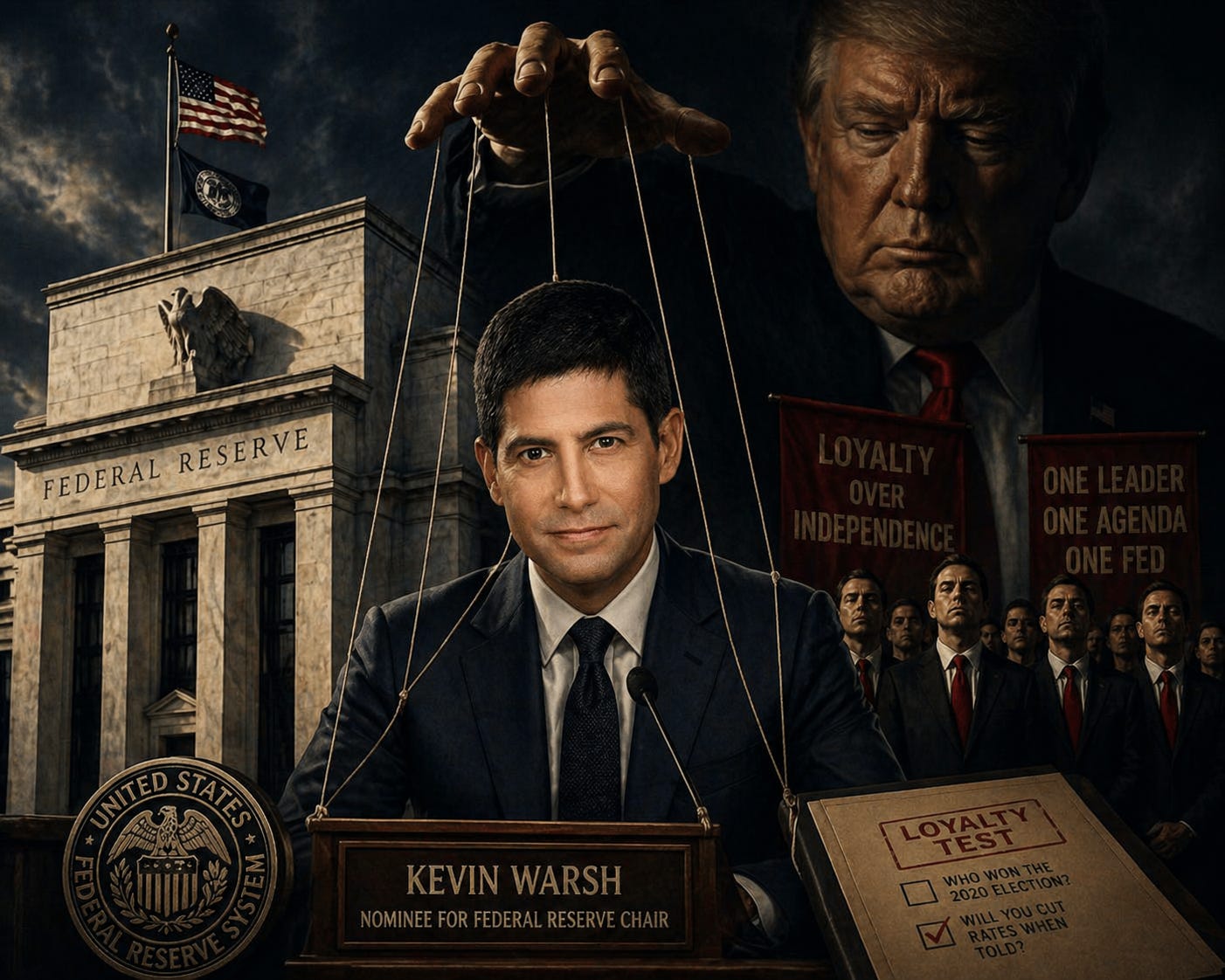
Warsh is Trump’s nominee to replace Jerome Powell as Fed chair. Former Fed governor. Wall Street veteran. A man who has spent the better part of a year positioning himself for exactly this moment with the focus of someone who has already mentally redecorated the office. He is not stupid. He is not unqualified. He is something more concerning than either: a credentialed man who has concluded that the shortest path to the job he wants runs straight through Mar-a-Lago, and who has adjusted his posture accordingly.
There is a litmus test. One question. It requires no expertise in economics, law, or foreign policy. It is not a trick. It has a documented, litigated, certified answer that has been confirmed by seventy-four court cases, every state government, the United States Senate, and Donald Trump’s own attorney general. The question is: who won the 2020 presidential election?
The answer is Joe Biden. Full stop. This is not debatable. It has not been debatable for years.
And yet the cult has a script, and its initiates read from it faithfully. Pam Bondi told senators Biden was ‘duly sworn in’ but could not locate the words ‘Trump lost’ anywhere in her vocabulary. Kash Patel confirmed Biden ‘served as president’ — a verbal gymnastics routine that would medal at the Olympics of cowardice. Markwayne Mullin refused to answer at his Homeland Security hearing. Russell Vought skipped the dodge entirely and told the Senate in writing that he believes the election was ‘rigged.’ Four flavors. Same recipe.
On April 21st, Kevin Warsh sat down in front of the Senate Banking Committee and ordered off the same menu.
Senator Elizabeth Warren asked him directly: did Donald Trump lose the 2020 election? Warsh said — and I want you to feel the full weight of this — that he tries to ‘keep politics out of the Federal Reserve’ and that he believes ‘this body certified that election many years ago.’ That is his answer. That is what a man who wants to run the most powerful financial institution in the world offered in response to a factual question with a known answer. Not a policy disagreement. A fact. A settled, documented, court-confirmed fact. And he could not say it.
Warren was not finished. She asked him to name one aspect of Trump’s economic agenda he disagreed with. One. Pick anything. Warsh responded by suggesting the Fed had ‘wandered outside its remit’ — which is a talking point, not a disagreement — and when pressed again, cited Trump’s comment that Warsh looked like he came ‘out of central casting’ as a point of intellectual distance between them. That was the disagreement. A casting note. The man called himself independent and a tough guy, and when Elizabeth Warren handed him the microphone, that is what came out.
Her response was the only one available: ‘If you can’t answer these questions, you don’t have the courage and you don’t have the independence.’
She is right. And here is why it matters beyond the symbolism. The 2020 question is not about 2020. It is a diagnostic. It tells you whether the person in front of you is still capable of choosing documented reality over personal loyalty when those two things conflict. If Warsh cannot say a settled election was settled, what exactly is supposed to happen when the data says raise rates and Trump is on Truth Social demanding cuts? What happens when the jobs numbers are bad and the White House needs them to look good? What happens when the Fed’s mandate and the cult’s needs are pointed in opposite directions?
We already know what happens. We watched it happen in that hearing room.
There is also the small matter of the $100 million in assets Warsh declined to detail in his financial disclosures — a document whose entire purpose is to provide transparency, not perform it. His holdings include significant cryptocurrency positions across dozens of companies, including Solana and other decentralized finance vehicles, which Fed ethics rules prohibit officials from holding in large quantities. Warren raised questions about potential business entanglements connected to Jeffrey Epstein’s financing vehicles. Warsh’s answer to all of it was that he would sell everything within ninety days of confirmation. Which is not an answer to what the assets are or who they connect him to. It is an answer to a question nobody asked.
The confirmation itself is stalled because the DOJ — under Trump — [opened a criminal investigation into Jerome Powell](https://www.npr.org/2026/04/…