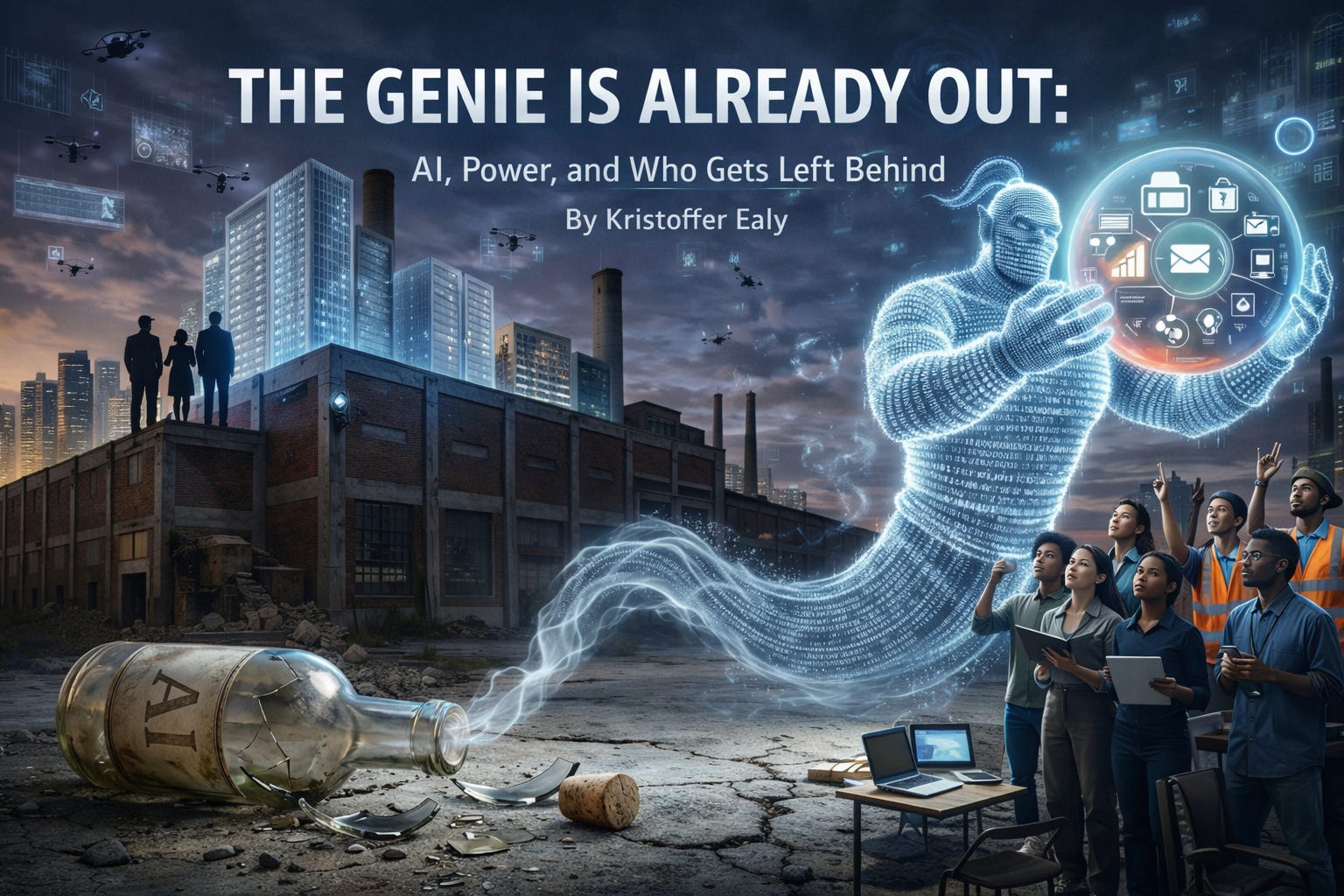
If you follow the Senate Health, Education, Labor and Pensions Committee with any regularity — and let’s be honest, most people have better things to do on a Tuesday — you were treated in October 2025 to something genuinely worth watching. Bernie Sanders, the committee’s ranking member, released a report with a title that could have doubled as a campaign slogan: The Big Tech Oligarchs’ War Against Workers: AI and Automation Could Destroy Nearly 100 Million U.S. Jobs in a Decade. He followed that up in December 2025 with a Guardian op-ed warning that AI poses unprecedented threats and demanding Congress act now. Then in February 2026, he took the show on the road to Stanford, standing beside Representative Ro Khanna before a packed auditorium and delivering what can only be described as a secular sermon about the coming disruption. Bernie Sanders has been giving variations of the same sermon since approximately 1987, but this time the congregation might actually need to hear it.
His concerns are real and they are worth taking seriously. Sanders warned that the billionaire class — Elon Musk, Jeff Bezos, Mark Zuckerberg, Peter Thiel — is pouring hundreds of billions of dollars into AI and robotics not out of any sense of civic duty to the working people of America, but because it will make them exponentially wealthier and more powerful. He raised alarms about job displacement at a scale the country has never seen. He talked about the mental health crisis already unfolding among young people — kids who can’t finish a book, whose attention spans have been colonized by algorithmic feeds, who are increasingly turning to chatbots for emotional support that used to come from other human beings. He called for a moratorium on new data center construction. He sat with Nobel Prize-winning AI researcher Dr. Geoffrey Hinton — widely considered the Godfather of AI — and asked the kinds of questions a senior senator should be asking. Good for him. Genuinely.
If you know me, then you know my relationship with Bernie Sanders is complicated at best. I genuinely respect his labor politics. His instinct that working people are getting robbed in broad daylight by a ruling class that has spent forty years dismantling every protection they ever had — that instinct is correct. Where I part ways with the Senator is on the question of identity. Bernie has a long and frustrating history of treating racism, misogyny, and structural inequality as symptoms of economic failure rather than as independent, durable American diseases with their own roots, their own logic, and their own remedies. As I wrote for Lincoln Square last year in “Bernie’s Working-Class Fairy Tale Has a Big Blindspot,” his mantra has always been some variation of: fix the economy, and magically racism goes away. Black voters — who have lived in this country long enough to know better — have never bought what he was selling on that front, and they were right not to. That framing is not progressivism. Dressed up in the right language, it is a right-wing talking point wearing a democratic socialist Halloween costume. The economic anxiety explanation for American racial resentment has been debunked so many times it should be embarrassing to still reach for it. Bernie reaches for it anyway, with the confidence of a man who has never once considered that he might be wrong about this particular thing.
But none of that changes the validity of what he is raising about AI. The concern is legitimate. The urgency is appropriate. Where I want to push back — gently but firmly — is on the timing.
I was listening to a recent episode of the Clay Cane Show on SiriusXM when Cane said something that stopped me cold because of how simply and correctly he framed it: Bernie Sanders is out here warning us about the harm AI can do when it gets here. But AI is already here. That is not a rhetorical flourish. That is the factual situation we are in right now. The genie is not approaching the bottle. The genie blew the bottle up, left the building, and is currently appearing on every platform you use, embedded in every application you open, processing decisions that affect your insurance claim, your mortgage application, your social media feed, your search results, and the hiring algorithm sitting between your résumé and a human being who might have actually read it. Calling for a moratorium on AI in 2026 is the policy equivalent of standing in the parking lot of a Spotify office demanding that Napster be shut down. That ship has not just sailed — it is in international waters and nobody is coming back for you.
We have been here before, repeatedly, and the story always ends the same way. When the cotton gin arrived, there was no congressional committee that could have voted it away — and the fact that it turbo-charged the demand for enslaved labor rather than reducing it is a lesson in what happens when powerful technology lands in the hands of people with no moral guardrails and no accountability. When Napster showed up in 1999, the music industry sued it into oblivion and celebrated like they had won something. What they had actually done was teach an entire generation that music wanted to be free, and out of that wreckage came iTunes, then Spotify, then an entire streaming economy that now defines how artists are paid and how music reaches audiences — on terms the record labels would never have agreed to if anyone had asked them. Nobody asked them. When Netflix mailed its first DVD in a little red envelope, Blockbuster had 9,000 stores and the institutional confidence of a company that had never once imagined its own irrelevance. We all know how that story ended. The Blockbuster in Bend, Oregon is a tourist attraction now. People take pictures with it.
The question was never whether the technology would arrive. The question was always: who controls it, who benefits from it, and who gets left holding nothing when the dust settles?
Before we go further, it is worth pausing on a critique that comedian and commentator Adam Conover has been making with considerable evidence and zero chill. In ▶a video that circulated widely, Conover argued that much of what gets called artificial intelligence today is more accurately described as imitative intelligence — systems that do not think, do not understand, and do not reason, but instead predict the next probable word or pixel based on an enormous database of human-created work they were trained on without compensating the humans who made it. He called these systems stochastic parrots. He called the current AI moment a hype cycle comparable to the Metaverse, Web3, and Crypto — all of which were going to revolutionize human civilization until they very publicly didn’t. He also pointed out that companies like Spotify and Snapchat have been slapping the word ‘AI’ on existing features the way that Subway started calling its workers ‘Sandwich Artists.’ The rebrand does not change what’s in the bread.
Conover also raised something that does not get discussed nearly enough: the human cost of building these systems. OpenAI reportedly paid workers in Kenya less than two dollars an hour to sift through graphic, disturbing, and psychologically damaging content in order to train the safety filters that make ChatGPT presentable in polite company. While tech billionaires were collecting magazine covers and congressional testimony slots, actual human beings in the Global South were absorbing genuine psychological trauma so that the product could feel clean on your end. That is not a footnote. That is a structural feature of the business model — and the same business model that talks endlessly about democratizing intelligence is built on the same extractive logic that has always defined how wealthy countries relate to poor ones.
In ▶a follow-up video, Conover went after OpenAI’s video generation tool Sora with particular ferocity, arguing it is less a genuine product than a hype mechanism designed to keep investor dollars flowing while the company searches for a profitable business model. His math on the economics deserves to be taken seriously: for the current level of AI investment to generate a return by 2030, these companies would collectively need to earn roughly two trillion dollars annually — more than the combined revenue of Apple, Microsoft, Amazon, Alphabet, Meta, and Nvidia. He calls this a bubble. He may be right.
Here is where I land: I agree with most of Conover’s critique and I think the parts I disagree with are the least important parts. The idea that AI is going to replace human beings wholesale — that Elon Musk’s prediction of a world where none of us have jobs is an accurate forecast rather than the unhinged ramblings of a man who thinks sleeping on a factory floor is a personality trait — strikes me as more science fiction than economic analysis. What AI does well is pattern recognition and synthesis at scale. What it cannot do is originate. It cannot have a bad day that becomes the emotional core of a great piece of writing. It cannot feel the specific absurdity of living in this particular American moment and translate that into the kind of joke that makes someone laugh because it is too true to be fully funny. A human being is what gives a joke its bite. The AI is what carves it out. That distinction matters more than the hype on either side would have you believe.
Now let us talk about the story that should be dominating the conversation about AI in this country but has instead been buried under the daily avalanche of manufactured outrage that passes for governance in the second Trump administration.
In February 2026, a remarkable confrontation played out in public between the Trump administration and the AI company Anthropic, the maker of the AI model Claude. Anthropic had an existing contract with the Pentagon worth approximately two hundred million dollars. The Defense Department — which Trump has taken to calling the Department of War, because subtlety left the building sometime around January 2025 — came to Anthropic with a demand: remove all restrictions on how the military could use Claude. Open it up entirely. No guardrails. No limits. Every lawful use, as the Pentagon defined lawful.
Anthropic said no.
Specifically, Anthropic CEO Dario Amodei said the company could not in good conscience accede to the Pentagon’s demands. The two red lines Anthropic refused to cross were the use of Claude for mass surveillance of American citizens and the use of Claude in fully autonomous weapons systems — weapons that make lethal decisions without any human involvement. These were not exotic hypotheticals cooked up by overcautious lawyers. These were the specific uses the Pentagon refused to contractually exclude. They wanted those options on the table. Anthropic said those options were never going to be on the table, and if that was a dealbreaker, then they were at an impasse and Anthropic wished them well with the transition.
Defense Secretary Pete Hegseth — who arrived at the Pentagon with approximately zero relevant qualifications and approximately infinite confidence — responded by calling Amodei to Washington for a meeting and then issuing an ultimatum: agree to unrestricted military use by Friday or lose the contract. He also threatened to invoke the Defense Production Act, a Cold War-era law designed for genuine national security emergencies, to commandeer Anthropic’s technology. And he threatened to designate Anthropic a ‘supply chain risk’ — a label that would prohibit any company doing business with the military from using Anthropic’s products. That designation had never previously been applied to an American company. Not once.
Amodei’s response to the two simultaneous threats was precise: they were inherently contradictory. You cannot simultaneously label a company a national security risk and invoke emergency powers declaring its product essential to national security. That is not a legal strategy. That is a toddler wanting two incompatible things and screaming until someone figures out how to give him both. Anthropic called the legal basis for both threats extremely flimsy — an assessment a former senior Defense Department official later confirmed to the BBC, adding that Anthropic appeared to have the upper hand and, with the kind of candor that only comes from someone who no longer has to attend those meetings, that ‘this is great PR for them and they simply do not need the money.’
That last detail deserves to be underlined. The Pentagon contract was worth two hundred million dollars. Anthropic’s valuation at the time of this standoff was three hundred and eighty billion dollars. Donald Trump attempted to bully a company worth nineteen hundred times the value of the contract it was walking away from — and lost. On Truth Social.
Trump’s response was exactly what you would expect. He went to his platform and wrote: ‘We don’t need it, we don’t want it, and will not do business with them again!’ Then, because apparently that was insufficient, he added that Anthropic had better be helpful during the phase-out period, ‘or I will use the Full Power of the Presidency to make them comply, with major civil and criminal consequences to follow.’ The Full Power of the Presidency. Against a tech company. Because they refused to help build a domestic surveillance apparatus. That sentence should be read aloud slowly, in a quiet room, by every person in this country who ever claimed to care about government overreach.
It is also worth noting who folded and who didn’t. Google folded. OpenAI folded. Elon Musk’s xAI — which is to say, the AI company owned by the man currently running a shadow government from inside the administration while simultaneously dismantling the federal workforce — folded immediately and enthusiastically. Anthropic was the last AI company standing, and it held its line specifically on mass surveillance and autonomous weapons. Even Sam Altman of OpenAI sent a memo to his staff saying OpenAI had the same red lines on those specific uses — which is a very interesting thing to say after you have already signed the deal, but noted.
The administration that campaigns on the government getting out of the way of private enterprise attempted, through explicit threat and coercion, to commandeer a private American company’s technology for domestic surveillance purposes, got publicly refused, and then threw a tantrum on social media. Every Republican senator who has spent the last decade performing outrage about government overreach was largely silent. The most pointed criticism came from Republican Senator Thom Tillis of North Carolina, who called the Pentagon’s conduct unprofessional and said Anthropic was trying to do their best to help us from ourselves. Senator Mark Warner called it bullying and said it demonstrated the complete absence of AI governance at a Defense Department that had already quietly fired its top military lawyers and signaled to those who remained that their job was not to raise legal objections but to facilitate operational decisions. In other words: the lawyers whose job it was to say ‘you can’t do that’ have been replaced by lawyers whose job it is to find a way to do that anyway.
The most important fight happening right now about artificial intelligence is not about whether AI will take your job. It is about who controls it, what they are permitted to do with it…