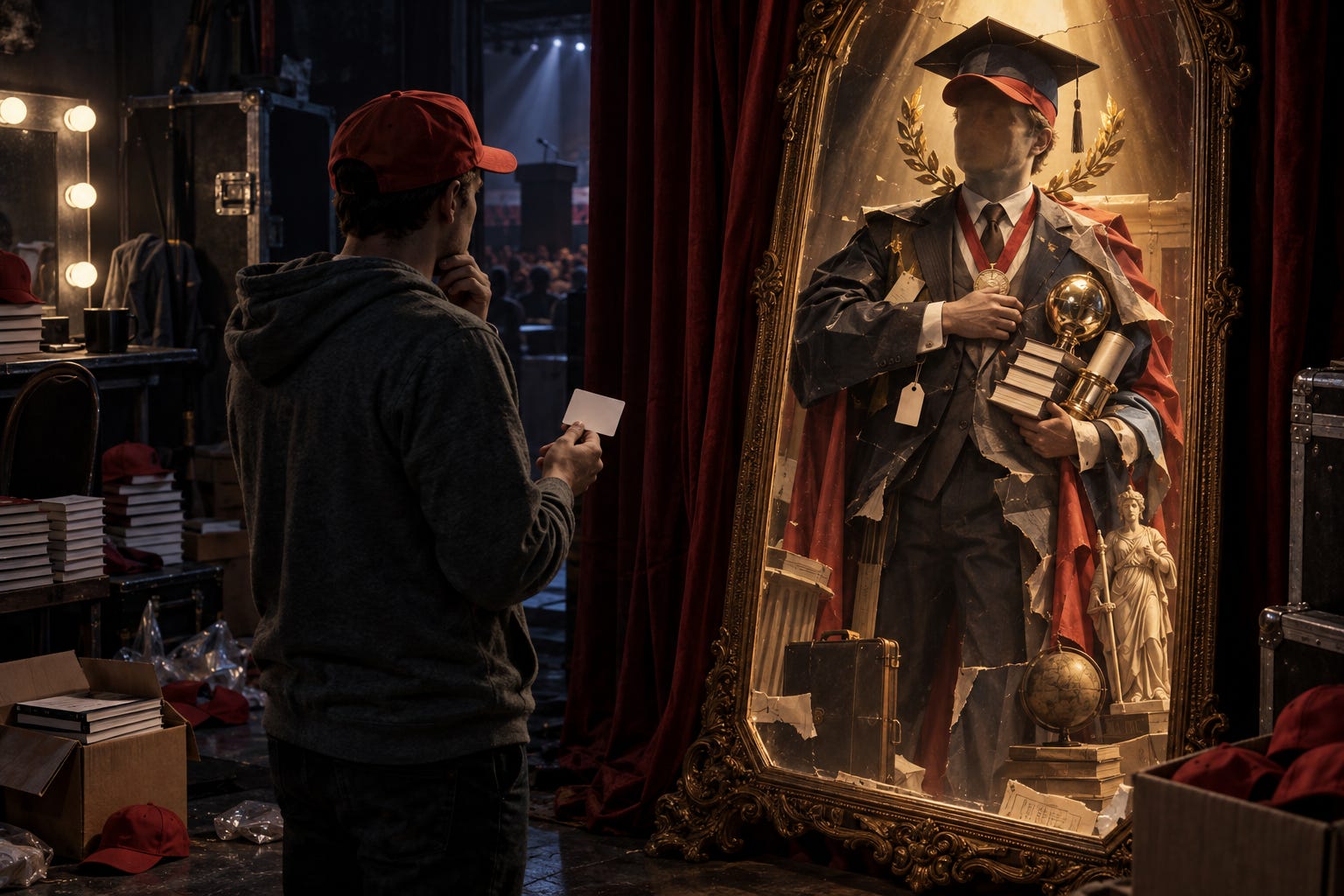
A couple of weeks ago, I went down an academic rabbit hole looking for a good video on symbolic self-completion theory. It’s a formal social psychology concept, but it applies to politics just as well—and it applies with terrifying precision when we’re talking about MAGA.
That search led me to Lucas Bean. Bean is a YouTuber, podcaster, and fellow Substack writer who has built a massive library of videos dissecting the psychology of the modern right. The man is ridiculously sharp. If you enjoy my deep dives into political psychology, you’re going to love his channel. Go subscribe and tell him I sent you.
While falling through his catalog, I ran across ▶his video explaining why the MAGA crowd adores Charlie Kirk. Incredible video. He wasn’t even focusing on the exact concept I originally typed into the search bar, but when he casually pivoted to it, he delivered one of the single best breakdowns of symbolic self-completion I’ve ever heard.
His description was dead-on: symbolic self-completion is what happens when there is a massive, embarrassing canyon between who you want to be and who you actually are. But instead of doing the brutal, unsexy work of closing that gap—you know, like studying, practicing, or growing up—you just buy the shortcut. You grab the hat, the bumper sticker, or the graphic tee. For Kirk’s audience, that meant stockpiling Turning Point USA merchandise, buying his book The College Scam, and carrying around a plastic membership card to stand in for the college diploma they never earned, dropped out of, or secretly felt inadequate for not having.
So I’m going to build on Bean’s framework here—without stealing his shine, of course. (Lucas, if you’re reading this, your link is right there. We’re legally and ethically solid.)
Bean’s core insight is that Kirk’s audience operates on a very specific psychological exchange. The folks who bought The College Scam, draped themselves in TPUSA gear, and flashed their official membership cards got to feel academically validated without having to write a single research paper or pass a mid-term. The symbol did all the heavy lifting that a four-year degree was never going to do for them.
And Kirk knew exactly what he was selling. He became a millionaire by turning anti-intellectualism into a subscription service. Telling a room full of people that higher education is a total scam is one of the highest-margin grifts in American history, and it worked because his customer base was starving for someone to validate their resentment.
To understand how this operates in everyday life, think about sports fans. When the home team wins the championship, it’s always “WE won!” Out come the $150 jerseys, the snapback hats, and the obnoxious social media posts acting like they were in the huddle. But the second the team suffers a humiliating blowout? Suddenly it’s “THEY lost,” and that jersey mysteriously vanishes into the back of the closet until next season. You never played a single down, caught a pass, or broke a sweat, but you borrowed the team’s glory to feel like a winner—and you dumped them the second they stopped inflating your ego.
Social psychologists actually have wonderfully pretentious academic names for both sides of this coin: Basking in Reflected Glory (BIRGing) and Cutting Off Reflected Failure (CORFing).
And you don’t even have to look at sports or MAGA to see this in full effect—just look at the Democratic Party during the 2024 presidential election. The second Kamala Harris stepped up as the nominee, Democrats were BIRGing at maximum capacity. Overnight, everyone was suddenly a passionate “coconut tree” enthusiast, Beyoncé’s “Freedom” was blasting on an infinite loop, and party insiders were strutting around like political geniuses.
Then the election night results rolled in, and the CORFing was instantaneous and merciless. The moment she lost, the establishment dropped her like a hot brick and sprinted for the exits. The narrative flipped in 24 hours from “our visionary savior” to “well, she was far too establishment, completely tied to Biden’s inflation, ran a sterile campaign, leaned way too hard into identity politics, and frankly, we never really wanted her anyway.” The campaign hats went straight to Goodwill, and party elites attempted a collective memory wipe.
That is symbolic self-completion in a nutshell. Whether you’re a sports fan wearing a championship ring you didn’t win, a political party erasing your own campaign enthusiasm, or a MAGA follower buying a plastic membership card to substitute for an education, the underlying mechanism is identical: borrow the high, dodge the hangover, and let the cheap symbol cover up the work you didn’t do.
I plan to write an entire standalone article on BIRGing and CORFing down the road, so stay tuned for that.
But symbolic self-completion goes well beyond Charlie Kirk’s target market. It is the core engine of the entire MAGA grift. The whole operation is built on letting social dropouts and washed-up celebrities know they don’t have to do the heavy lifting to become better human beings. They can get by being the most repulsive versions of themselves, and the movement will slap a red hat on their head and call it a profile in courage. I’ve written before about how outrage became a lucrative business model and about the rightward drift of outlets like The Young Turks, and the exact same psychological baseline sits underneath both. There is always an audience living with an identity gap, and there is always a grifter happy to sell them the plastic symbol that covers it up.
That’s where my Red Hat Rebranders come in. I call them RHRs: public figures who committed absolute career suicide or did genuinely heinous things, and who, instead of dealing with the real-world consequences, found comfort in the loving, non-judgmental arms of MAGA. When you can’t earn genuine redemption, you put on the red hat and let a stadium of angry partisans scream that you’ve been redeemed. The red hat isn’t a political philosophy—it’s a get-out-of-jail-free card for people who lack the integrity to apologize.
Take Hulk Hogan. True redemption for Hogan was always going to require actual work. After a tape surfaced of him spewing casually vile racist slurs, WWE fired him, scrubbed him from their website, and threw his legacy in the dumpster. What followed was a series of weak, self-pitying non-apologies where he essentially lamented getting caught—never actually taking accountability for the hostility and bigotry of the offense itself.
Enter Booker T—a WWE Hall of Famer, a Black wrestling legend, and one of the most respected locker-room leaders in the industry. Booker T offered Hogan a legitimate, dignified off-ramp: a joint speaking tour where the two of them could talk to young people about race, accountability, and the hard work of reconciliation. Mark Henry, another legendary Black wrestler and Hall of Famer, extended a similar hand, making it clear that if Hogan wanted real forgiveness, he needed to show up in Black communities and earn it.
Hogan turned them both down. Why do the grueling work of personal growth when you can take a shortcut? Instead of doing the work, Hogan put on a red feather boa, ripped his shirt off at the Republican National Convention, and got cheered like a hero by a crowd that didn’t care about the tape as long as he yelled the right slogans.
Russell Brand and Lawrence Taylor tell the exact same story. Brand went from a pseudo-intellectual comedian to facing multiple, devastating allegations of sexual assault. Rather than face his accusers or do any soul-searching, he suddenly “found Jesus,” started ranting about the Deep State on YouTube, and rebranded as a right-wing martyr. Lawrence Taylor, a football icon who pleaded guilty in 2011 to patronizing a 16-year-old prostitute and sexual misconduct, showed up at a Trump rally looking for the exact same absolution. Neither man did the work of facing consequences or making amends. They just picked up the symbol, pandered to the crowd, and let the MAGA echo chamber wash them clean.
This is symbolic self-completion at its purest and most cynical. The gap between who these men actually are and who they’d need to become to earn real forgiveness is an ocean. Instead of swimming it, they grabbed a red jet ski. It’s their way of saying, “Screw doing the work—as long as I kiss the ring of Dear Leader and wear his merch, my redemption arc is complete.”
The catch is that psychological theory says symbols only work if the audience agrees to validate them. Hogan proved that before he died. The same red-hat routine that got him thunderous applause at the RNC flopped spectacularly when WWE trotted him out in front of a stadium crowd in Los Angeles. His absolute final memory in a WWE ring was a wall of deafening, relentless boos. The red hat doesn’t make you a better person—it only counts when you’re standing in front of an audience that has agreed to pretend it does.
Here’s the saddest, most pathetic part of this whole circus. For a good chunk of these people, the symbol isn’t being validated by clueless fans—it’s getting rubber-stamped by people who actually know better, people with actual credentials, advanced degrees, and high-profile platforms.
Think about what that does to the psychological dynamic. The entire engine of symbolic self-completion relies on the audience. The symbol only works if somebody looks at it and agrees to treat it like it’s real. When the person doing the noticing is some random, avatar-less account in a comment section, that’s one thing. But when it’s a doctor, a lawyer, or a professor with actual letters after their name handing over the co-sign? That’s something else entirely. The credentialed enabler hands over the one thing the symbol could never produce on its own: institutional legitimacy.
I’ve written before about this exact pattern with RFK Jr. and the rest of the credentialed charlatans. These are people who use a legitimate degree to open the door of authority, step inside, and then spend the rest of their careers telling everyone else that education is a scam and the door shouldn’t exist. The credential becomes purely decorative. RFK Jr. has a law degree, which somehow got converted into him acting like an expert on public health and vaccines. Ben Shapiro has a Harvard law degree that he primarily uses to speak at 400 words per minute while dodging actual legal arguments. Tucker Carlson dropped out of college and built a multi-million-dollar brand out of it, as if failing out of school somehow makes you an authentic voice of the working class. The rules apply to everyone except the elites selling the snake oil.
Which brings us to the Oprah Winfrey daytime television assembly line of fake authority.
It should be noted, of course, that Oprah’s best friend is Gayle King. And look, Gayle is fine—she hasn’t done anything entirely unforgivable yet. Sure, she seems perfectly comfortable falling right in line with the corporate suits at CBS and whatever new media overhead Bari Weiss is peddling this week, but hey, a paycheck is a paycheck. Oprah herself is great if you need a fiction recommendation for your book club, but we have to admit as a society that we should never have trusted her to hand out medical licenses.
Look at what her daytime couch spawned. Iyanla Vanzant at least proved herself not to be a complete nutcase—though, to be fair, she isn’t actually a medical doctor. But then you have Dr. Oz and Dr. Phil.
Dr. Oz went from a respected cardiothoracic surgeon to a guy hawking green coffee bean extracts on daytime TV, before pivoting to full-throated MAGA groveling just to get crushed in a Senate race. And Dr. Phil? Phil McGraw is a man whose psychological expertise apparently maxed out at exploiting troubled teenagers for Nielsen ratings. It was genuinely disgusting watching him tag along with ICE agents like a tactical ride-along influencer, turning actual federal deportations into a cheap spectator sport for his right-wing TV network. He spent decades pretending to heal family trauma on a soundstage, only to end up chasing immigration raids with a camera crew to prove his loyalty to the movement.
That’s the enabling layer. The MAGA grift works because people who did the work keep showing up to legitimize the people who didn’t. And they aren’t being fooled, which makes it infinitely worse. The insecure guy wearing the cheap merch is operating on feelings of inadequacy. The guy with the PhD or the MD who stands next to him and nods along is making a conscious, cynical business choice.
Which brings us directly to the guys who bankrolled Charlie Kirk. A kid who dropped out of community college got rich selling the idea that higher education is a scam—and he didn’t build that empire by himself.
When Kirk was just an 18-year-old kid with a microphone, a retired Tea Party activist named Bill Montgomery heard him speak at Benedictine University and urged him to skip college entirely to build a political operation. Then the ultra-wealthy donor class stepped in. At the 2012 RNC, Kirk cornered GOP mega-donor Foster Friess and walked away with a five-figure check. Friess was a first-generation college graduate with a business degree from the University of Wisconsin. Let that sit for a second: a man who literally used a college degree to build a massive financial fortune handed money to a teenager so he could go tell other people’s kids that getting a degree is for suckers.
Then there’s Joe Walsh. The former Illinois congressman met Kirk when Kirk was 16, mentored him, and helped guide Turning Point USA into existence. Walsh holds a master’s degree in public policy from the University of Chicago and taught American government at the college level. Now, to be fair to Walsh, he didn’t just quietly walk away—he completely blew up his political life to try to clean up the mess. He launched a kamikaze primary campaign against Trump in 2020, formally ditched the Republican Party, and has spent the last several years working alongside Democrats to sound the alarm on the modern GOP. He’s done podcasts, interviews, and live events essentially beating himself up,…