In the 1840s, Ignaz Semmelweis, a Hungarian physician, worked in the maternity ward of Vienna General Hospital. At the time, childbed fever was a leading cause of maternal death. In some wards, nearly one in five mothers died after giving birth.
Semmelweis discovered that requiring doctors to wash their hands with a chlorinated solution before examining patients dramatically reduced mortality. Yet his theory implied that physicians themselves were spreading disease, a suggestion many found deeply offensive. Rather than embracing his findings, much of the medical establishment ridiculed him and resisted his ideas.
The criticism left Semmelweis increasingly discouraged and isolated. During his lifetime, his life-saving practice never gained widespread acceptance. As a result, countless mothers continued to die from infections that could often have been prevented.
Years after his death, the scientific community finally accepted what Semmelweis had demonstrated. Once handwashing became standard practice, maternal mortality rates fell dramatically. In Semmelweis’s own clinic, deaths dropped from about 18 percent to less than 2 percent after hand disinfection was introduced. Today, he is remembered as the “Saviour of Mothers.”
When people criticize us, we may accept their judgments without examination, or we may be crushed by them. But not all criticism is valid. Many criticisms are rooted in ignorance, misunderstanding, envy, or prejudice. As Semmelweis’s story illustrates, criticism can be misguided, unfair, and profoundly harmful. If we let every critical voice dictate our actions, we may abandon ideas, goals, or contributions that would benefit not only ourselves but others as well.
People often criticize us when our behaviour does not align with what they think we should do. But why should we value their preferences more than our own considered judgments?
Yet criticism stings. How do we deal with other people’s criticism, especially when it is unfair? Here are some suggestions for handling unjustified criticism.
We tend to attach too much importance to what other people think of us. We worry about how we are perceived. We want everyone to accept us, even people we barely know. We fail to examine whether the criticism itself is valid. As a result, we change our behaviour, pretend to be what we are not, and compromise our values. Yet we gain little from this effort and risk losing something far more valuable: our integrity.
I have often wondered how it is that every man loves himself more than all the rest of men, but yet sets less value on his own opinion of himself than on the opinion of others. — Marcus Aurelius,Meditations 12.4
Other people judge us according to their own values, experiences, expectations, and prejudices. Their values may be misguided, and their understanding of us may be incomplete. Their judgments may be distorted by envy, admiration, misunderstanding, or simple lack of knowledge. Why, then, should we give their opinions greater weight than our own considered judgment?
When we become overly concerned with others’ criticism, we surrender our freedom. Instead of asking, “Is this the right thing to do?” we begin asking, “Will I be criticized for this?” We stop acting according to our principles and start performing for an audience. In effect, we allow others to dictate our behaviour.
This pursuit of approval rarely delivers the reward we expect. Even if we please one person, we may disappoint another. Public opinion is unstable and constantly changing. Someone praised today may be criticized tomorrow for the very same qualities. If our self-worth depends on others’ approval, we place it on a foundation that is always shifting. We decide on externals that are not in our control and give up the freedom to decide what is important to us.
Honest criticism can help us identify our blind spots and improve ourselves. But criticism should be examined, not automatically accepted. The important question is whether we are acting in accordance with our values or sacrificing them in pursuit of others’ approval.
Everyone is entitled to an opinion, but only we are responsible for our character.
When people disagree with us or criticize us, we often react with anger and defensiveness. This reaction arises from the impression that criticism can harm us. But that impression is mistaken.
The underlying assumption is that what others think of us can somehow damage us. Yet what others think is their business, not ours. Their opinions cannot harm our character. The only things that can affect our character are our own thoughts and actions.
Most principled people in history, from Lincoln to Gandhi to Mandela, have been criticized and reviled. Yet they continued to do what they believed was right. They were not swayed by criticism. They did not feel humiliated because their actions were consistent with their values.
Public opinion is fickle. It shifts constantly. If we allow it to guide us, we may abandon what is important to us and our development as human beings.
So instead of reacting immediately to criticism, examine the impression that you have been harmed. If you are criticized for living according to your values, how has that criticism harmed you? Your behaviour may not be consistent with someone else’s values, but if it is consistent with your own; why should you attach so much importance to their judgment?
When someone provokes you, if you respond with anger or some other negative emotion, your mind is tricked into believing you are being harmed. So it is essential not to respond to impressions impulsively. Take some time before reacting. You will see you are in better control. — Epictetus,Enchiridion 20
The only things that can truly affect us are our own opinions and actions. Our good and our harm come from ourselves. What others think and say is not under our control. And, what we do not control is nothing to us.
Choose not to be harmed, and you won’t feel harmed. Don’t feel harmed, and you haven’t been. — Marcus Aurelius,Meditations 4.7
We often interpret criticism as disapproval of our behaviour, which it frequently is. But we do not need others to approve of our behaviour if we are acting according to principles we believe in. Someone who seeks approval will adjust their behaviour to match other people’s principles in order to gain acceptance.
It takes trickery to cultivate approval. You have to make yourself like them. ... If I see you much acclaimed by everyone ... how can I help pitying you? For I know what road one must have taken to gain such popularity. — Seneca,Moral Letters 29
Compromising our principles to gain someone else’s approval compromises our integrity. If we choose to follow our own course, we should expect disagreements and even insults from time to time.
When we concentrate on what is important to us and stop seeking others’ approval, we become less concerned with criticism. We no longer measure ourselves by other people’s reactions. Instead, we evaluate ourselves by a more reliable standard: whether we are living in accordance with our values.
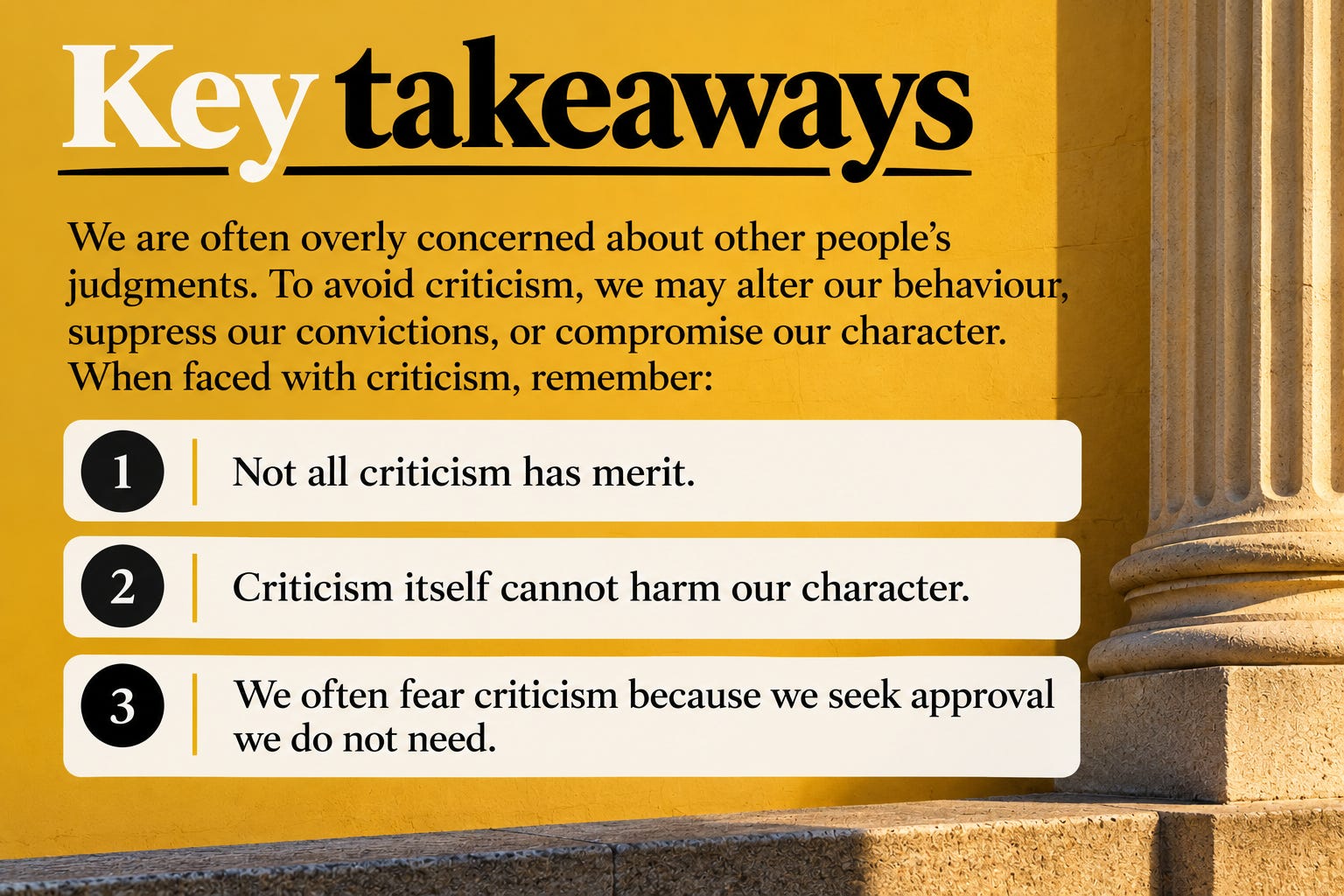
We are often overly concerned about other people’s judgments. To avoid criticism, we may alter our behaviour, suppress our convictions, or compromise our character. When faced with criticism, remember:
Not all criticism has merit.
Criticism itself cannot harm our character.
We often fear criticism because we seek approval we do not need.
The next time someone’s criticism bothers you, resist the urge to react immediately. Instead, write your answers to the following questions:
What exactly did the person criticize?
Is the criticism factually accurate? If so, which parts are true?
If I accept this criticism and change my behaviour, what values would I be serving?
If I ignore this criticism and continue as I am, what values would I be serving?
What would I advise a close friend in the same situation?
Now separate the criticism into two parts:
Information that may help you improve.
Opinions that reflect the other person’s preferences, biases, or expectations.
Keep the first and discard the second.
Finally, ask yourself:
If I am acting in accordance with my considered values, what real harm can this criticism do to me?
311026