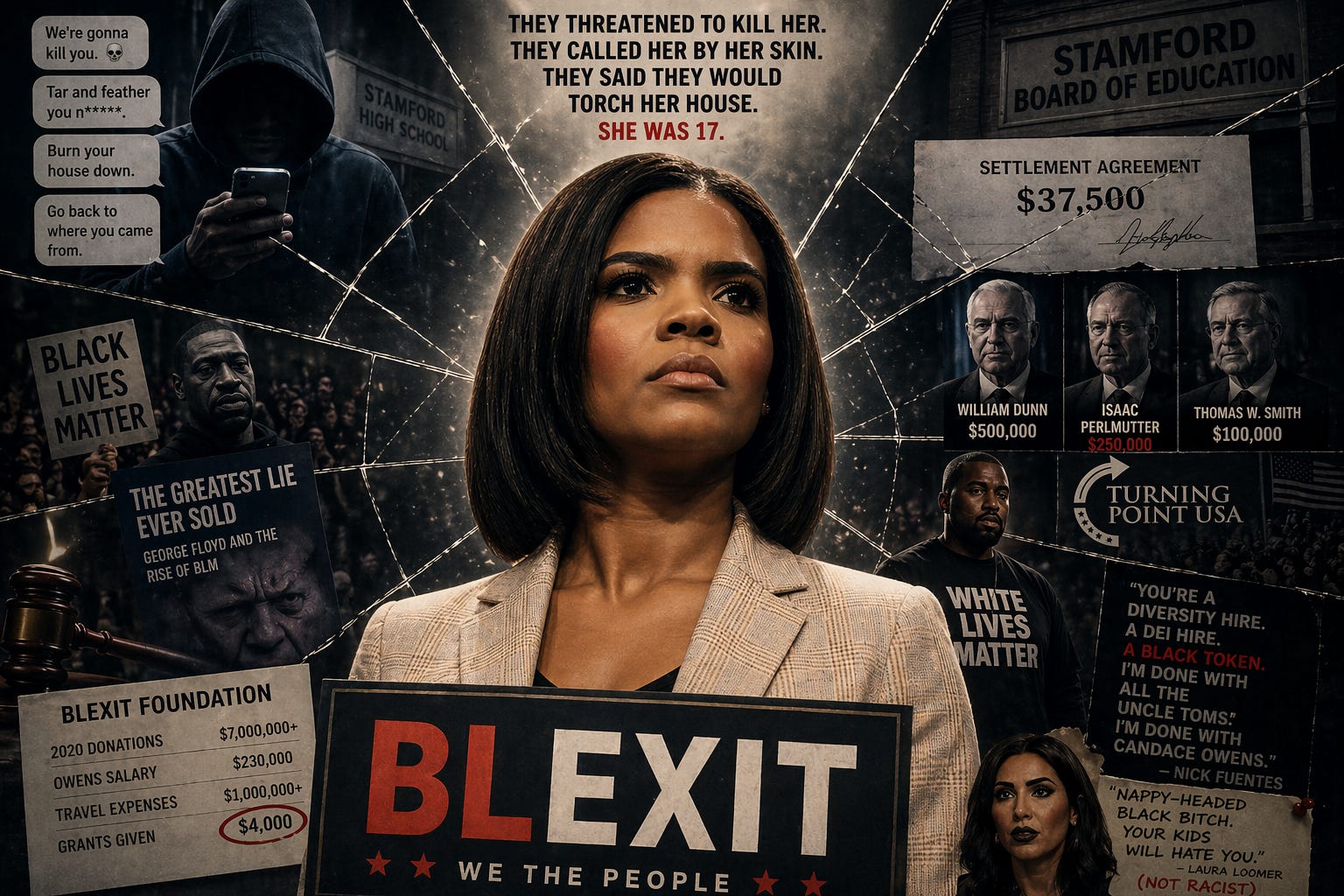
She was seventeen years old when her phone started ringing with messages that would change her life. The voicemails came from classmates — white boys who had decided that this particular Black girl in Stamford, Connecticut had gotten too comfortable, taken up too much space, existed too confidently in a world they felt belonged to them. The messages were not ambiguous. They threatened to kill her. They called her by her skin. They told her they would torch her house, that they would tar and feather her, that she would pay for whatever offense her very presence had apparently committed against them. She missed six weeks of school because the trauma of sitting in the same building as the boys who said these things was more than a seventeen year old girl should be asked to absorb. Her family didn’t handle it quietly. They called the one organization in America with both the institutional muscle and the moral authority to walk into a situation like this and demand accountability. They called the NAACP. The NAACP answered. The Stamford Board of Education eventually paid her family $37,500 to settle the lawsuit — a formal acknowledgment, signed and documented, that what happened to this girl was real, that the racism was real, that the harm was real.
That girl was Candace Owens.
I do not like Candace Owens. I never have and I never will. I do not agree with her politics, I do not respect her ideology, and I have zero interest in pretending otherwise. But what I am about to walk you through is not a defense of Candace Owens the person. It is an autopsy of a decision — the decision she made to take everything that happened to her in that Stamford schoolyard and bury it so deep that she could build a career on top of the grave. And it is a reckoning with the fact that the people she spent a decade defending just called her exactly what those white boys implied she was when they left those voicemails. The zip code changed. The vocabulary didn’t.
I am not sure why Owens made the decision to join this grift. Maybe she genuinely believed the ideology. Maybe the money was too good to pass up. Or maybe — and this is the explanation that keeps me up at night because it is the most psychologically coherent — she thought that if she could just show white conservatives that she was one of the good ones, they would be more inclined to accept her. That she could earn her way into a safety that her seventeen-year-old self never had. If that’s the case, what we are watching is not just hypocrisy. It is identification with the aggressor— a psychological phenomenon first described by Anna Freud in which a victim aligns themselves with the source of their trauma as a defense mechanism. The same people who terrorized her as a teenager, she grew up to defend. Internalized racism set the table. Identification with the aggressor was the mechanism. And repetition compulsion — the unconscious drive to return to the scene of the original wound and try to master it this time — is what keeps her locked in the cycle. She keeps going back to that schoolyard. She just switched sides.
What she built on top of that psychology was one of the most cynical operations in the history of modern conservative media. In 2018, Owens co-founded the BLEXIT Foundation — a nonprofit organization whose stated mission was to convince Black Americans to leave the Democratic Party and embrace conservatism. Before she did that, it is worth noting that she appropriated the Blexit name from a Minneapolis-based grassroots movement that had been founded in 2016 in the aftermath of the police killing of Philando Castile — a real Black economic independence movement that had nothing to do with conservative politics and whose name Owens took because it wasn’t trademarked. That tells you everything you need to know about the moral architecture of this project before we even get to the finances.
The finances are where it gets obscene. In 2020, as the country was convulsing over the murder of George Floyd and racial justice protests were filling the streets of every major city in America, the BLEXIT Foundation raised over $7 million in donations. Candace Owens took $230,000 in personal salary that year. The foundation spent over a million dollars on travel, some of it first class and charter. By 2021, donations had dropped to $2.3 million — less than a third of the prior year — but Owens gave herself a raise anyway, pulling $250,000 plus benefits while the foundation reported giving away exactly $4,000 in grants to actual Black businesses. Four thousand dollars. Out of seven million raised. The filings are public. The math is not complicated.
What is also not complicated, once you look at where the money came from, is who Blexit was actually serving. White billionaire William Dunn gave $500,000. Conservative billionaire Isaac Perlmutter gave $250,000. Investor Thomas W. Smith — a major funder of the anti-critical race theory movement — gave $100,000. All three also fund Turning Point USA, the organization that employed Owens while she was supposedly running this independent Black empowerment movement. The whole operation eventually merged with Turning Point USA in 2023, which is less a plot twist than a confession. Blexit was always a Turning Point product. It was always white conservative money paying a Black woman to tell Black people that the white conservatives didn’t need to change.
And if you need a single image to summarize what that service actually looked like in practice, look no further than October 2022, when Candace Owens showed up at Kanye West’s Paris Fashion Week show wearing a White Lives Matter shirt — a phrase the ADL describes as a racist response to Black Lives Matter adopted and promoted by white supremacist groups. That same year she produced a “documentary” — and I use that term as loosely as it has ever been used — called The Greatest Lie Ever Sold: George Floyd and the Rise of BLM, which argued that Derek Chauvin was essentially innocent and that Floyd was responsible for his own death. The Hennepin County medical examiner had already ruled Floyd’s death a homicide caused by restraint and neck compression. A jury had already convicted Chauvin. None of that mattered. Owens built a film on top of debunked claims and planned to monetize it on YouTube. YouTube pulled it. Then Kanye West — who had watched the documentary and apparently decided that Candace Owens was a reliable source of information, which tells you everything you need to know about his critical thinking at that particular moment in his life, though to be fair he was on Drink Champs so maybe we can blame it on the alcohol — went on the podcast and repeated her claims verbatim to millions of people, saying Floyd died from fentanyl and that Chauvin’s knee wasn’t even on his neck like that. The Floyd family’s attorneys immediately named Owens as an obvious co-defendant, telling TMZ her documentary contained blatant lies and that it was open season on anyone who had perpetuated them. Rather than respond with anything resembling humility, Owens threatened to counter-sue George Floyd’s family, saying their consideration of legal action was causing her “a ton of distress” and that she was “fighting for Black America to be freed from the lies.” She lost the YouTube revenue. She lost the credibility. Her source material got cited as evidence of harm by civil rights attorneys. And she responded by threatening to sue a grieving family. That is not someone who walked away clean. That is someone who tried to profit off a murdered man’s legacy, got stopped, and then threw a public tantrum about it.
Now, you will hear Black conservatives respond to all of this by saying that Black people are not a monolith — and they are right, as far as that goes. I will be the first person to tell you that Black people do not all think alike, do not all vote alike, and do not all share identical political views. That is true and it is important. But here is what that argument conveniently leaves out: the fact that Black people are not a monolith does not mean there is no consensus. There are consensus positions among Black Americans — around racial equality, around voting rights, around protection from state violence, around the basic expectation of dignity in public life — that emerge not from groupthink but from shared material reality. These are not manufactured opinions. They are the rational political conclusions of people who have been navigating the same system for generations and have drawn reasonable inferences from the evidence.
And if Black people were genuinely fleeing to the Republican Party in the kind of numbers that would make Blexit unnecessary, then Blexit would have been unnecessary. You do not build a $7 million funded pipeline where there is already a river. The very existence of Blexit — the frantic, well-financed effort to recruit Black voters to a party they were apparently choosing on their own — is an admission that the migration was not happening organically. What Candace Owens actually delivered to the Republican Party was not a coalition. It was just enough Black faces to provide plausible deniability. Enough to point at when someone called out the racism. Enough to say look, we have Black supporters, this isn’t about race, these are just differences of opinion. She didn’t change the coalition. She gave the coalition a license to keep doing exactly what it was already doing — and she cashed six-figure checks for the service.
The plantation framing she deployed to sell all of this deserves its own reckoning. Owens built a significant portion of her brand around telling Black Democrats that they were living on a Democratic plantation — that their loyalty to the Democratic Party was a form of psychological enslavement, that they needed to wake up and escape. She even wrote a book called Blackout: How Black America Can Make Its Second Escape from the Democrat Plantation. It is an insult to every human being who actually lived on a plantation. People who lived on plantations did not choose to be there. They were not there because of political affiliation or misguided loyalty. They were there because they were legally classified as property and the violence of the state was deployed to keep them there. To compare that to voting Democratic is not just analytically wrong — it is a desecration. And I will say clearly that while I am no fan of Black Republicans and particularly no fan of Black MAGA, I would never use that framing against them. The condescension of the plantation metaphor cuts only one direction — it implies that Black Democrats lack the cognitive agency to make a rational political choice, while Black Republicans are the enlightened ones who escaped. That is not political analysis. That is paternalism dressed up in the language of empowerment, sold to a white conservative audience that was more than happy to buy it.
The break with that audience began slowly and then all at once. In April 2025, Owens broke with the Trump administration over its targeting of Harvard’s funding, saying she didn’t recognize what the administration had become. Then the Iran war hit and the rupture accelerated. She went on Piers Morgan Uncensored and said she was embarrassed that she had told people to vote for Trump, that he had been a chronic disappointment, that this was not the candidate she had voted for. In April 2026, she called Trump a genocidal lunatic and suggested the 25th Amendment should be invoked. Trump responded on Truth Social by calling her a low IQ loser and a nut job, and then — in a move that tells you exactly how he sees women who stop being useful to him — attacked her physical appearance, writing that French First Lady Brigitte Macron was far more beautiful than Candace, not even close. The man who had once called her a very smart thinker reduced her to a beauty comparison the moment she stopped performing for him.
But Trump’s cruelty, at least, was ideologically consistent. What came next was something more specific. Nick Fuentes — a white nationalist labeled a white supremacist by the FBI, a man Owens had platformed on her own show — went on his program after a contentious interview with her and said what he apparently always thought. You are a diversity hire, you are a DEI hire, you pander, he said. She thinks she’s some kind of boss bitch. Yeah you’re a bitch but you didn’t get that way because you’re some sort of super smart boss. You got that way because you’re a super bitchy Black token. And then, as if he wanted to make sure nobody missed the subtext, he added: I’m done with all the Uncle Toms, I’m done with Jason Whitlock, I’m done with Candace Owens. You built your career on a grift that is now dead. You were hired when diversity quotas were a thing. You were hired when white guilt was a thing. I don’t feel white guilt, I never have.
There it is. Not coded. Not euphemistic. Fuentes told you exactly what Candace was to this coalition: a diversity quota. A white guilt prop. A token whose expiration date arrived the moment white guilt stopped being politically useful. He accidentally wrote the academic analysis of her entire career in one unhinged rant, and he did it because she stopped being useful to him. That is what happens when the performance ends. The audience tells you what they really thought of the show.
And then came Laura Loomer. If you read my previous piece, “Imagine Looking Like This and Daring to Clown Jasmine Crockett,” you already know that Loomer has a well-documented history of deploying racist and misogynistic attacks against Black women the moment they step out of line. This was not her first rodeo. This was not a bad day. This is a pattern. In a viral tirade posted to X, Loomer called Candace Owens a nappy-headed Black bitch and a resentful ghetto Black bitch, attacked her marriage, suggested her husband was secretly gay, and told the mother of three that her children were 100% going to hate her. And then — in a detail so perfectly illustrative of the motte-and-bailey fallacy that I could not have written it better myself — Loomer insisted in the same breath that she was not racist. Not racist. She deployed the lang…