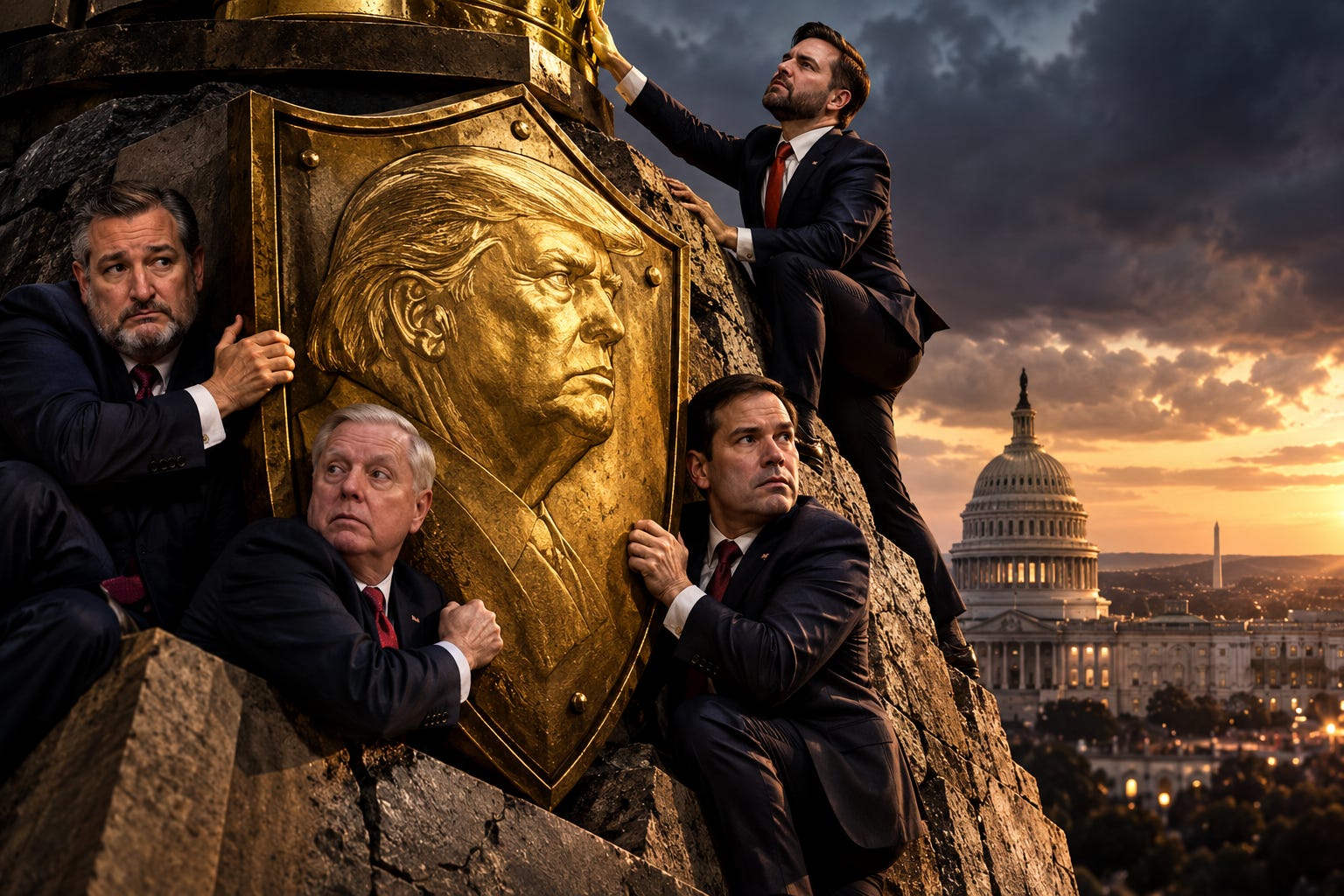
When I woke up Sunday morning, I genuinely wanted to take the day off. And by taking the day off, I mean doing absolutely nothing that required me to think about Donald Trump, Pete Hegseth, or any other member of the traveling constitutional crisis currently operating out of Washington.
Writing my last column about Pete Hegseth’s plan to turn a federal execution into a livestream had been so thoroughly draining, and so repulsive, that I literally needed a shower when I finished. Not a metaphorical shower. A real one, with soap, the kind you take after cleaning out a gas station bathroom that hasn’t passed a health inspection since the Clinton administration. I was exhausted, disgusted, and fully prepared to spend 24 hours staring at a wall that has never once suggested turning a firing squad into premium entertainment.
But then I started reading your comments. And I’m glad I did, because one of the things I appreciate most about this community is that you give me a chance to understand what people are thinking, what they’re worried about, and what questions my writing hasn’t sufficiently answered. You also have a remarkable ability to give me another article to write when I am supposed to be resting. At this rate, I’m going to have to start submitting vacation requests to my own comment section.
What struck me wasn’t disagreement. It was exhaustion. Several readers sounded understandably worn down by the seemingly endless parade of political misconduct coming out of Washington. They wanted Democrats to win the House and Senate in November, but some seemed to have lowered their expectations to simply “stopping the bleeding.” The possibility of Donald Trump, JD Vance, Pete Hegseth, and the rest of this administration ever facing meaningful accountability seemed so remote that some readers had practically filed it under science fiction, somewhere between time travel and Lindsey Graham discovering a principle he couldn’t negotiate away.
And I understand that frustration. Believe me, after more than two decades working in politics, I’ve learned that whenever you think Washington has finally hit rock bottom, somebody shows up with a shovel, a congressional lapel pin, and a federal pension. But I also want to offer some optimism, because I think there is a difference between recognizing how bad things have become and accepting that they cannot get better. The former is political awareness. The latter is precisely the kind of resignation that protects people who should be facing serious scrutiny.
“Stopping the bleeding” has been a central theme of my own writing for months, and I still believe it matters. But stopping the bleeding is the baseline, not the horizon. Nobody leaves the emergency room celebrating because the doctors announced that the patient has successfully advanced from “actively dying” to “still technically alive.” You stabilize the patient so you can begin repairing the damage. In political terms, that means recognizing that limiting an administration’s power and holding its officials accountable are different objectives. One can create the conditions for the other.
And here’s something else I want you to consider: for all the swaggering, chest-thumping, and carefully choreographed displays of confidence coming out of Trumpworld, this administration’s behavior around the upcoming election hardly suggests a political operation that feels completely secure. Trump and his allies would like Americans to believe that their dominance is permanent, their opponents are helpless, and the MAGA movement is some unstoppable historical force. Apparently, the only thing more important than making America great again is making sure everybody believes the Republican Party is doing just fine, even while its strategists are running around looking for electoral fire extinguishers.
Consider the administration’s aggressive efforts to obtain voter rolls, the proposed expansion of federal monitoring at polling places, and the concerns election officials have raised about possible federal interference. Voting-rights advocates have warned that some of these measures could intimidate or disenfranchise eligible voters, while the administration insists its actions are about election integrity. Whatever explanation its officials prefer, there is nothing particularly reassuring about a political movement that spends so much time describing elections as suspicious before voters have even finished casting their ballots. It’s like watching a football coach spend the entire week before the Super Bowl accusing the referees of cheating while insisting his team is obviously going to win.
Now, does any of this prove that Republicans are heading toward an electoral shellacking on November 3? Of course not. I’m a political scientist, not a psychic operating out of a strip mall next to a payday lender. Electoral outcomes depend on actual votes, turnout, candidate quality, and the political conditions in individual states. But the administration’s attempts to exert greater control over election procedures are legitimate reasons for scrutiny, not reasons to assume the results are predetermined. Political intimidation, whether real or threatened, should never be confused with political invincibility.
And that brings me to the larger point of this article. To understand how Trump acquired such extraordinary influence over the Republican establishment, we have to examine the incentives that led so many supposedly principled conservatives to abandon their previous objections to him. Most of these people didn’t undergo some profound ideological conversion. They resisted him, denounced him, and warned Americans about him, often loudly and on camera. Then they discovered that their own political futures might depend on the very man they had spent months describing as a national catastrophe.
Suddenly, the catastrophe had excellent leadership qualities, tremendous judgment, and a remarkable understanding of the Constitution. Funny how quickly a politician can discover somebody’s hidden virtues when the alternative is losing a primary election.
That transformation wasn’t necessarily evidence of newfound conviction. It was a lesson in political self-preservation. And if self-preservation helped turn yesterday’s Trump critics into today’s most enthusiastic defenders, we should examine what happens when the political incentives begin changing again.
I call it calculated alignment, and it runs on two old ideas the Romans would have recognized: convenientia, conforming yourself to fit whatever environment you’re standing in, and opportunitas super principia, opportunity over principles. Political scientists have a cleaner name for the mechanics underneath: preference falsification, Timur Kuran’s term for publicly expressing beliefs you don’t privately hold because telling the truth has become too expensive. One by one, Republican politicians looked at the political landscape, calculated that standing on principle might cost them their careers, and decided that integrity was a luxury item they could no longer afford. It’s remarkable how quickly a politician’s deeply held convictions can disappear when somebody threatens to take away the congressional parking space.
Nobody in this story looked in a mirror and experienced some profound ideological awakening about the virtues of MAGA. They read the room, checked their reelection math, and made a transaction. These weren’t men wrestling with complicated philosophical questions about the future of conservatism. These were men discovering that the easiest way to preserve their influence was to surrender whatever dignity they had left. And fortunately for the historical record, they documented their transformations so thoroughly that future political scientists won’t need archival researchers. They’ll need YouTube, a strong stomach, and perhaps a licensed therapist.
Start with Ted Cruz, a man Trump humiliated in ways most people only experience after accidentally sending their private messages to the entire company. Trump mocked his wife’s appearance and promoted a ridiculous tabloid conspiracy suggesting Cruz’s father had been associated with Lee Harvey Oswald. Cruz responded by calling Trump a “sniveling coward” and a “pathological liar” who was “utterly amoral.” Those are pretty serious accusations. Normally, when somebody insults your wife and circulates a conspiracy theory implicating your father in the assassination of an American president, the relationship is over. Ted evidently regarded the whole thing as a minor disagreement over the marginal tax rate.
By October 2016, Cruz was working the phones for Trump’s campaign, sitting underneath a Trump-Pence sign in Fort Worth and leaving voicemails for strangers who had the good sense not to answer. Imagine volunteering to make campaign calls for a man who promoted a story connecting your father to the Kennedy assassination. Most people would be consulting an attorney or planning an elaborate revenge fantasy. Ted was asking strangers whether they had a few minutes to discuss making America great again. The man took an insult to his wife, a conspiracy theory about his father, and a national humiliation, then converted the entire experience into unpaid campaign labor. That’s not turning the other cheek. That’s offering to have the other cheek embossed with campaign merchandise.
Then there’s Marco Rubio, who spent the 2016 Republican primary calling Trump a “con artist” who had spent decades exploiting working people. He warned that the “hounds of hell” would descend upon the Republican Party if Trump became its nominee. Rubio even started making jokes about Trump’s hands, which was an interesting campaign strategy for a man trying to convince the country he possessed the maturity necessary to command the world’s most powerful military. Marco was out there delivering playground insults while simultaneously applying for the nuclear codes.
Well, the hounds of hell eventually arrived, and Marco accepted a position as their diplomatic representative. He’s now Trump’s Secretary of State, which means the man who once warned Americans that Trump was a con artist is responsible for explaining Trump’s policies to foreign governments with a straight face. Somewhere between calling Trump a fraud and accepting a Cabinet position, Rubio discovered that the con artist was actually a visionary statesman. It’s an extraordinary professional transformation. Imagine spending months warning everyone that a restaurant serves contaminated food, only to accept the position of executive chef because the owner offered you a nicer parking spot. Marco didn’t just eat his words. He opened a catering company and started serving them at diplomatic receptions.
JD Vance deserves his own wing in this museum of Republican self-humiliation, preferably with a gift shop selling copies of everything he said before discovering the political advantages of pretending he had never said it. In 2016, he wrote in The Atlantic that Trump was “cultural heroin,” told NPR he couldn’t stomach Trump and found him “noxious,” and privately wondered whether Trump was a “cynical asshole like Nixon” or “America’s Hitler.” That’s quite a collection of character assessments. Most people who compare someone to Hitler generally avoid making that person the centerpiece of their career development plan. JD looked at the same résumé and evidently saw an opportunity for upward mobility.
His former law school roommate released the Hitler message in 2022, shortly after Trump endorsed Vance’s Senate campaign, which is the political equivalent of your ex showing up at your wedding reception with screenshots, a projector, and an HDMI cable. But the most extraordinary part is that Vance built his reputation writing about the destructive consequences of addiction, compared Trump to heroin, and then spent the next several years working his way up to vice president to the dealer. He went from warning Americans about the dangers of the product to becoming the product’s national distributor. If Hillbilly Elegy was supposed to be a meditation on escaping destructive cycles, his political career has turned into an unauthorized sequel called Hillbilly Relapse.
And this past Fourth of July, The Atlantic republished Vance’s original heroin essay on its tenth anniversary, sending it back toward the top of the publication’s most-read list. Imagine becoming the second-highest-ranking official in the United States and having one of your most enduring contributions to political literature be an essay explaining why the president you serve is a dangerous cultural narcotic. That’s not an inconvenient old article. That’s a character witness from your previous personality.
And then there’s Lindsey Graham, who spent years presenting himself as one of the Republican Party’s sensible institutionalists, a close associate of John McCain and a supposedly serious defender of American democratic traditions. In December 2015, Graham called Trump a “race-baiting, xenophobic, religious bigot” and suggested Republicans tell him to go to hell. A few months later, he warned that if Republicans nominated Trump, the party would get killed, get creamed, and deserve it. For once in his career, Lindsey had produced a remarkably accurate political diagnosis. Unfortunately, he seems to have confused identifying the disease with volunteering to become one of its most enthusiastic carriers.
Over the following years, Graham transformed himself into one of Trump’s most recognizable defenders. He went from warning Americans that Trump was a threat to the country to spending an extraordinary amount of time defending him on television and accompanying him on golf outings. Graham could deliver a passionate lecture about constitutional principles on Monday, discover those principles had become politically inconvenient by Wednesday, and spend Friday explaining why abandoning them was actually a demonstration of extraordinary patriotism. If intellectual consistency were a congressional ethics requirement, Lindsey would have needed a waiver renewed every 48 hours.
And somehow, South Carolina managed to turn the Graham political legacy into a sequel that makes the…