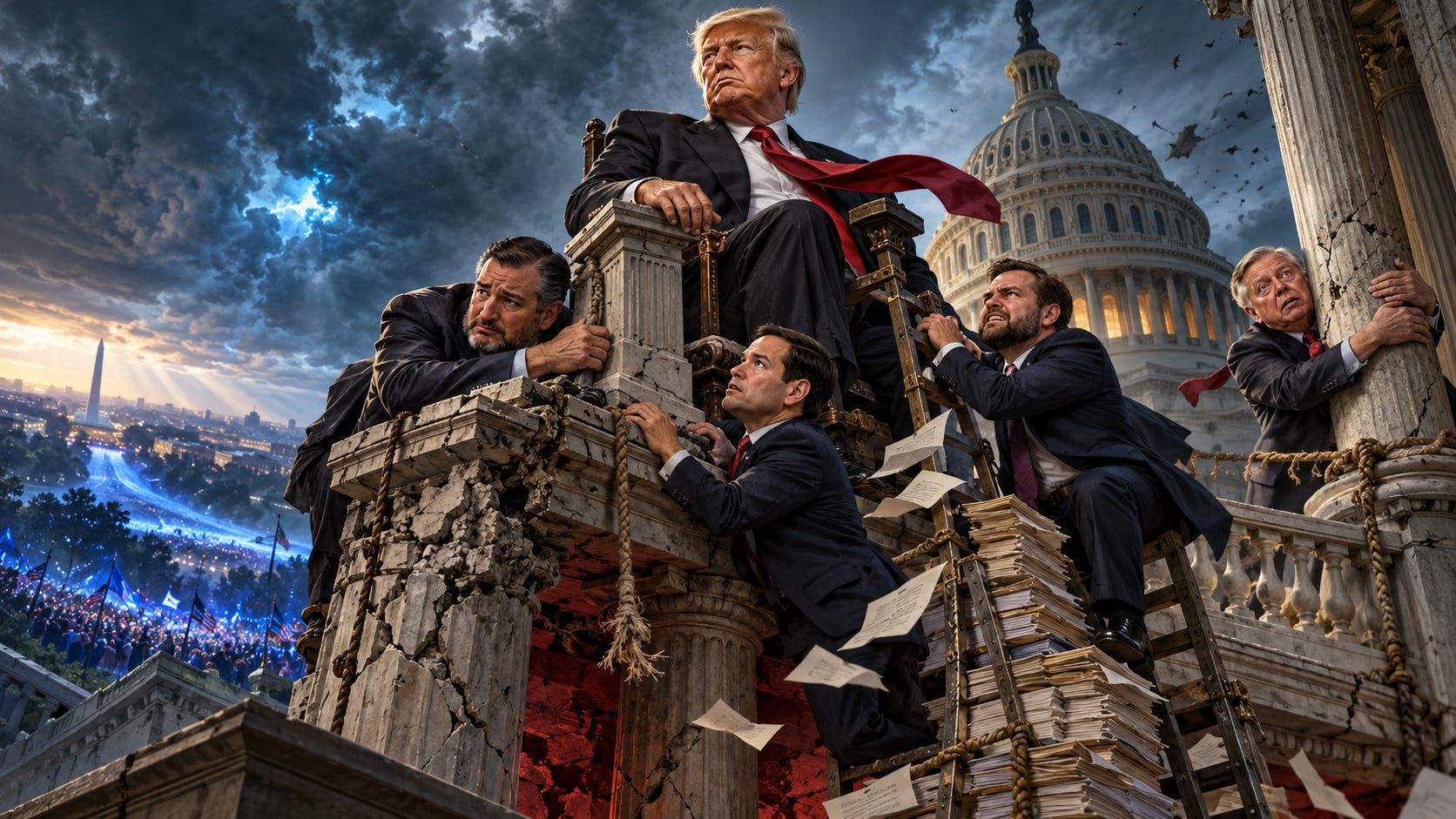
In Part 1, we revisited how Republican critics of Trump became his loyal defenders, trading their stated principles for political survival and advancement. The point wasn’t that these men suddenly found Trump more virtuous; they found him more useful. Today, we’ll distinguish between the “keepers” protecting power and the “climbers” pursuing it—and examine why a sufficiently large Democratic victory could change their calculations. I’m not counting on these people to discover a conscience. I’m counting on them to remain the same opportunists when protecting themselves starts requiring something different.
And the irony of Lindsey Graham’s political legacy is that the Senate seat he spent decades protecting has now become another headache for the Republican Party. His sister Darline is defending it against Democrat Annie Andrews, and the Cook Political Report has moved South Carolina from Solid Republican to Likely Republican. Understand what that means. Donald Trump carried South Carolina by approximately 18 points in 2024, and Republicans are now spending millions of dollars to protect a Senate seat they’ve held since the Eisenhower administration. Lindsey spent a decade paying political protection money through unquestioning loyalty to Trump, and Darline inherited the seat only to discover that the family insurance policy came with an enormous deductible. Apparently, nepotism doesn’t include complimentary electoral security.
But there’s an important distinction among these Republican converts that helps explain where their political loyalties might go next. What these men have in common is the transaction. What separates them is what they were purchasing. Some abandoned their principles to preserve power they already possessed. Others abandoned theirs to acquire power they had never held. For the purposes of understanding Republican behavior, I divide them into two categories: the keepers and the climbers. Think of it as a political taxonomy of opportunism, except every specimen insists it’s a patriot.
Graham and Cruz were keepers. Graham already possessed seniority, committee influence, national recognition, and an established political career. Cruz was a sitting senator who had watched Trump insult his family and dismantle his presidential ambitions in front of the entire country. Both faced the prospect of becoming targets of the same Republican electorate they needed to remain in office. Their loyalty was an exercise in political risk management. Neither needed Trump to give him a career. They needed Trump to refrain from taking one away. It’s the political equivalent of paying protection money to someone who just smashed your storefront window, then publicly thanking him for supporting small businesses.
Vance, on the other hand, was a climber. In 2016, he was an author and venture capitalist with no elected office, no established electoral constituency, and no meaningful position inside the Republican power structure. Trump’s endorsement helped propel him into the Senate, and Trump’s selection put him one heartbeat away from the presidency. The transformation wasn’t incidental to Vance’s political advancement. It became the mechanism through which that advancement occurred. Rubio occupies the hybrid category. He initially accommodated Trump while preserving his Senate career, then transitioned into the climber category when a Cabinet position became available. Marco managed to complete the full political lifecycle: critic, convert, employee, and eventually the human equivalent of a State Department press release with a pulse.
This distinction matters because the keepers and climbers face different incentive structures. Climbers derive their political advancement from maintaining access to the person who elevated them. Keepers are principally concerned with protecting positions they’ve already secured. Those interests overlap while the person demanding loyalty remains politically useful. But if that person’s influence begins threatening their survival, the calculation becomes considerably more complicated. The question isn’t whether these politicians possess enough integrity to abandon Trump. It’s whether their commitment to self-preservation could eventually become more powerful than their commitment to him. After everything we’ve witnessed, I wouldn’t build a political strategy around these people discovering a conscience. But I would absolutely study what happens when their polling numbers begin developing one.
Political scientist David Mayhew provided an important foundation for understanding this behavior in his 1974 book, Congress: The Electoral Connection. Mayhew described members of Congress as single-minded seekers of reelection, emphasizing how the pursuit of continued office shapes their political activities. His model doesn’t explain every congressional decision, but it provides a useful framework for understanding why politicians so frequently prioritize electoral survival over ideological consistency. In the Republican Party, we’ve watched that dynamic unfold with extraordinary clarity. These people can spend an entire Sunday morning explaining their devotion to constitutional government and the afternoon calculating whether constitutional government will cost them votes in the next primary.
Frederick Douglass famously warned that power concedes nothing without a demand, and that it never did and never will. Kuran’s work on preference falsification adds another dimension to that observation. Public conformity can create the impression of overwhelming consensus even when private preferences are far more complicated. Individuals may remain silent because they believe dissent carries unacceptable consequences, and their silence makes other people believe the consensus is stronger than it actually is. Under changing conditions, those calculations can shift rapidly. What looks like an unbreakable political coalition can turn out to be an elaborate arrangement of people waiting for somebody else to move first. Washington has produced plenty of those arrangements. Usually, the participants call them bipartisan working relationships right up until the subpoenas arrive.
And this is where I want readers to reconsider the assumption that Donald Trump’s political dominance is permanent. Trump has enormous influence within the Republican Party, but controlling the incentives of Republican politicians is not the same thing as controlling the future of American elections. Those are two very different propositions, and the electoral landscape is already providing plenty of reasons to examine the distinction.
Start with Texas, where Republicans have converted what was once relatively comfortable political territory into one of the most expensive Senate contests in the country. Trump backed Ken Paxton, the former attorney general who survived impeachment by the Texas House, and Paxton secured the Republican nomination. Now he’s facing Democrat James Talarico, and a Senate Leadership Fund-affiliated super PAC spent approximately $131 million in just 17 days supporting Paxton’s campaign. That’s roughly $7.7 million every single day. Republicans are spending the equivalent of a modest municipal budget trying to protect a statewide office in Texas, a place where their candidates once approached general elections with the confidence of people renewing a Costco membership.
And think about the political psychology behind that expenditure. Political parties don’t spend $131 million in 17 days because they enjoy setting enormous piles of money on fire. They spend that kind of money because the electoral stakes are substantial and the contest has become expensive to defend. Paxton’s scandals have created vulnerabilities, and Talarico has attracted enough support to make the race highly competitive. Republican donors are now financing a political rescue operation whose price tag looks like somebody accidentally added three extra zeros to the catering invoice. Trump endorsed Paxton, but the endorsement didn’t eliminate the general-election contest. Instead, Republican donors are discovering that loyalty to the president comes with a spectacularly expensive service agreement.
The spending pressures extend well beyond Texas. The Senate Leadership Fund has redirected resources away from North Carolina toward states including Kansas, where Republican Senator Roger Marshall is facing Democrat Adam Hamilton. Kansas is a state Trump carried by roughly 16 points in 2024, and Republicans are now devoting serious attention to protecting a Senate seat there. Kansas! We’re talking about a state that hasn’t elected a Democrat to the United States Senate since 1932. At some point, Republican strategists are going to open their electoral map and discover they’re spending emergency money in states where their grandparents were confident enough to leave the front door unlocked.
And don’t overlook South Carolina. The Senate Leadership Fund has committed another $5 million to defending Darline Graham against Annie Andrews. That’s five million dollars to protect a seat Republicans have controlled for more than six decades. When your national strategy requires expensive defensive spending in Texas, Kansas, and South Carolina, the political environment deserves a considerably more serious examination than simply declaring that Trump remains invincible. The Republican Party may still have plenty of money, but money that must be used defending traditionally secure territory is money that cannot be spent elsewhere. Campaign finance has a way of exposing anxiety that campaign speeches are specifically designed to conceal.
The broader Senate map has also changed. Democrats are defending competitive seats in Georgia, Michigan, and New Hampshire while contesting Republican-held seats in North Carolina, Maine, Ohio, Alaska, Iowa, Kansas, Texas, and other states. Reuters’ October 12 assessment describes a competitive landscape shaped by significant spending, shifting polling, and several unexpectedly close contests. Prediction markets and electoral forecasters have also registered substantial movement since Trump’s inauguration, although neither should be confused with an election result. The meaningful development is that control of the Senate has become a serious competitive question rather than an outcome Republicans can simply take for granted.
Now, consider what all of this means for the keepers. Suppose Democrats manage an extraordinary election night and emerge with 55 or 56 Senate seats. I’m deliberately choosing numbers that go well beyond what Democrats need for a bare majority, because the question I’m interested in isn’t simply who gets to select the committee chairs. It’s what happens to the Republican Party’s internal incentives when an election delivers a result so politically consequential that continuing to defend Trump requires a completely different calculation.