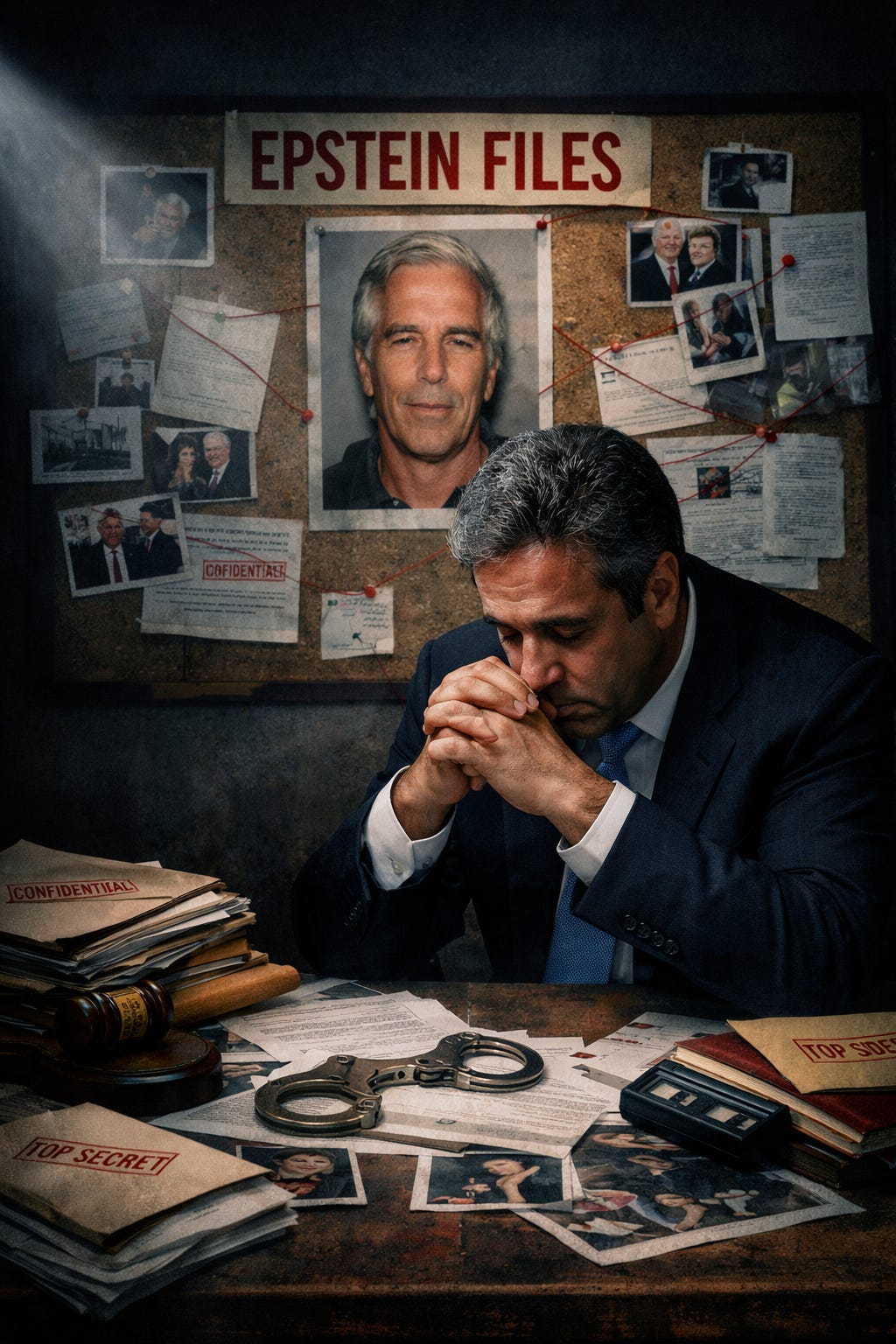
There is an old saying — one that predates politics, predates cable news, and certainly predates the current circus we are all trapped inside — that goes something like this: the evil we do in darkness has a way of finding us in the light. You can outrun a lot of things in this life. You can outrun your past relationships, your bad takes, even your criminal record if you have the right lawyers. But you cannot outrun a ** federal document dump**. And right now, Michael Cohen is finding that out the hard way.
I want to be clear before we go any further: I am not accusing Michael Cohen of anything. This is not a hit piece. This is not an indictment. What this is, is a ** political psychologist** watching one of the most psychologically fascinating figures of the last decade in real time — and feeling professionally obligated to say something about what I am observing. Because Michael Cohen, God bless him, has become a living, breathing, walking case study. And I have watched too many episodes of Scandal and Ray Donovan, and sat next to too many USC Annenberg classmates who genuinely aspired to be
For years — and I mean years — I watched Michael Cohen do the media circuit with the kind of righteous fury that only a truly converted man can muster. He was on MSNBC. He was all over the ** MeidasTouch Network**. He had a podcast. He wrote a book called Disloyal and sat in front of Congress and, if we are being honest, was genuinely entertaining. His roasts of Donald Trump were sharp, specific, and frequently hilarious in that specific way where you laugh and then immediately feel vaguely unsettled. He was giving us the inside game. He was the guy who knew where the bodies were buried — metaphorically speaking, of course — and he was naming names and pointing fingers and performing the kind of accountability that we are always told powerful men are incapable of.
I believed him. I want to say that plainly and on the record, because a lot of people did not — and those people are going to read this piece and feel vindicated, and I am here to tell them they should pump the brakes. The takes I kept hearing were that Cohen was always a snake in the grass, always a con man running a long game, that the whole ** redemption arc** was theater designed to sell books and secure cable news contracts. I heard that take repeatedly. I rejected it then and I still reject it now — because the cynical read, while emotionally satisfying, actually lets Cohen off the hook for something far more serious.
Here is what the ‘always a snake’ crowd gets wrong: if Cohen was never genuine, this is a simple story about a con man conning people, and we can all move on. But if the mea culpa was real — and I believe it was — then what we are watching now is something far more troubling. A genuinely transformed man discovering that transformation does not come with an expiration date on accountability. That you can mean every word of your public confession and still have a private ledger that has not been fully settled. The cynics are letting him off easy. I am holding him to a higher standard by insisting he meant it.
And the evidence that he meant it is not thin. This was not a man who gave a carefully lawyered statement and disappeared. He sat in front of Congress — under oath, on live television — and delivered specific, detailed, emotionally raw testimony about a man he had devoted eleven years of his life to. He did not speak in generalities. He brought receipts. He talked about Trump’s cruelty, his racism, his contempt for the people around him, the way he operated as though the rules were a suggestion for other people. He wrote an entire book called Disloyal and put his name on it in a political climate where that decision carried real personal risk. He showed up on MSNBC, on the MeidasTouch Network, on every platform that would have him, and he was consistent. Not perfectly consistent — no one who has been through what he went through would be — but consistent in the ways that matter. The specific details, the emotional texture, the self-implication. You do not fake that across years of sustained public appearances without eventually contradicting yourself in ways that collapse the whole narrative. The mea culpa held. And that is precisely why the current pivot is so damning.
And then the ** Epstein files** dropped.
Now, let us talk about what a ** fixer** actually does. Because I think a lot of people use the word without fully sitting with what it means. If you have ever watched Scandal, you know Olivia Pope. If you have ever watched Ray Donovan, you know Ray. The fixer is not the person who commits the crime. The fixer is the person who gets called after the crime — or after the potential scandal, or after the very inconvenient situation — and makes it disappear. They find the person. They have the conversation. They make sure that person understands, with crystalline clarity, the consequences of not staying quiet. They draft the NDA. They send the letter. They make the problem go away so thoroughly that it never existed.
That was Michael Cohen’s job description for over a decade. He was not peripheral to Trump’s operation. He was the mechanism by which problems became non-problems. And we have a very clean, very public template for exactly how he operated: ** Stormy Daniels**. He did not assault her. He did not threaten her physically. He made her afraid through the legal apparatus — NDAs, implied consequences, the entire infrastructure of silence that powerful men have used for generations to protect themselves from accountability. That is what fixers do. That is the job.
So when the Epstein files start surfacing documents that suggest Cohen was ** shopping knowledge** of Trump’s Epstein connections to the DOJ for a
I am not saying Cohen threatened any of Epstein’s victims. I want to be precise about that. But I am saying that if Donald Trump had any proximity to Jeffrey Epstein that required management — and the emails from Epstein himself suggest that proximity was real — then a fixer’s job would have been exactly what it always is: find the person with the problem, make sure they understand the situation, and ensure the silence holds. That is not a wild accusation. That is a job description. And Michael Cohen held that job for eleven years.
Now here is where it gets psychologically interesting — and I say that as someone who studies political behavior for a living. The mea culpa being genuine and this self-preservation pivot also being genuine are not mutually exclusive. People can hold both realities simultaneously. Cohen probably did mean what he said about Trump. The betrayal was real. The humiliation of being referred to as ** merely ‘one of my attorneys’** after the FBI raid — after eleven years of total devotion — cracked something open in him that was not performance. That was a man experiencing what trauma theorists call
But here is the thing about genuine remorse: it tends to be selective. ‘I regret enabling a con man’ is a very different confession than ‘I personally threatened and silenced vulnerable women on behalf of a predator.’ The first one gets you a book deal and a standing invitation to the Morning Joe greenroom. The second one gets you indicted. So what Cohen gave us in his mea culpa was true — and incomplete. He told us what Trump did. He was considerably quieter about what he did, or what he knows, that might connect him to the broader machinery of Epstein’s world.
And now, watching him do what can only be described as a mea culpa of his mea culpa, the full picture comes into focus. This is not a man who changed his mind about Donald Trump. This is a man who did a quiet audit of his own exposure when those files started dropping and did not like the balance sheet. The pivot is not ideological. It is actuarial.
Let us do the venue audit, because the receipts matter. Congressional testimony against Trump. A book called Disloyal. Dozens of MSNBC appearances. The MeidasTouch Network — until they ** fired him** after he suggested that prosecutors had
The logical architecture of Cohen’s pivot is also worth naming, because several specific fallacies are doing a lot of heavy lifting here. The most prominent is the ** motte-and-bailey**. The motte — the easily defended position — is ‘I never met Epstein, I never spoke to him, I have no direct knowledge.’ Safe. Narrow. Hard to disprove. The bailey — the much broader claim he has been making for years — is ‘there is nothing to see here regarding me.’ He retreats to the motte when pressed and expands back to the bailey when comfortable. The
Then there is the ** tu quoque** he deployed regarding his own testimony — suggesting that prosecutors
There is also ** special pleading** at work: one standard applied to everyone else, a different standard applied to Cohen. People who cooperated with prosecutors in Trump’s orbit are rats and liars. When Cohen cooperated, it was courageous truth-telling. Now that cooperation is complicated because of prosecutorial pressure. The rules keep shifting depending on what Cohen needs them to say in a given moment.
And finally, the ** kafka-trap**: any criticism of his pivot becomes evidence that the critic is simply part of ‘the mob’ that wants him to
Perhaps the most revealing moment in all of this comes from his appearance on Patrick Bet-David’s podcast, where Cohen admitted — unprompted — that he ** still loves Trump ‘like a brother’** and would take a phone call from him if he reached out. He also mentioned that he has drafted what he calls a
This is not the behavior of a reformed man who has simply evolved his thinking. This is the behavior of a man experiencing what psychologists call ** traumatic bonding** — the pull back toward the abuser that is not born of forgetting the harm but of a bond so totalizing that nothing else has filled the void. The idealization, the devaluation, the discard, the longing — it is all there. He organized his entire identity around Trump for over a decade, and the mea culpa tour was his attempt to reconstruct significance outside of that relationship. And it almost worked. Until the Epstein files reminded him that his significance came with a price tag he has not finished paying.
So here is where we land. The original mea culpa was real. The remorse was earned. And none of that changes the fact that Michael Cohen was a fixer — and fixers do not get to confess selectively. The work does not disappear because the relationship did. The silence he enforced, the threats he delivered, the problems he made go away — those are still out there somewhere, in documents and memories and federal files that are slowly, methodically, making their way into the public record.
There is an ancient concept in moral philosophy — and in most major religious traditions, if you want to go there — about the weight of past deeds. The idea that even genuine transformation does not erase what was done. That redemption is real, and so is accountability. That you can mean every word of your apology and still have to answer for what you did before you were sorry. Cohen seems to have believed, somewhere along the way, that the mea culpa was the ending. That once you confess enough of the truth, the rest of it stays buried.
The Epstein files are teaching him otherwise. And the rest of us are watching a man discover, in real time, that even when we try to do good — even when the remorse is genuine and the conversion is real — the evil we did in the dark has a way of finding us in the light.
You really cannot make this stuff up.
—If you appreciated this piece, please consider becoming a paid subscriber. Your support helps pay for the time, research, and reporting that go into writing work like this, and it helps me keep building The Thinking Class without having to water it down for algorithms or bad-faith media habits. I appreciate every single person who reads, shares, and supports this work.