In March 2024, Don Lemon interviewed Elon Musk, and for a man who had spent years marketing himself as civilization’s last great defender of free speech, Musk suddenly discovered that free speech becomes considerably less exciting when somebody else gets a turn.
The interview was supposed to launch The Don Lemon Show as part of a partnership with Twitter—a platform Musk ended up owning through sheer, weaponized incompetence. Let’s not forget how he acquired the place: after getting furious that the previous management was “policing speech,” Musk impetuously offered $44 billion to buy the company for $54.20 a share—because he literally couldn’t resist making a 420 joke in an SEC filing. When he sobered up, realized he’d wildly overpaid, and tried to back out, Twitter took him to court and legally forced him to buy the app anyway. He spent forty-four billion dollars on a vanity project he didn’t even want, all in a desperate attempt to prove he was the ultimate champion of unrestricted discourse.
Which made his sit-down with Lemon pure comedy. The interview was supposed to transform his reluctant new empire into a combination of global town square, media company, political salon, and billionaire group chat. Instead, Lemon started asking actual questions. He asked Musk about his ketamine use. He pressed him about hate speech on the platform. He asked about his meeting with Donald Trump in Palm Beach. And somewhere during this apparently shocking outbreak of journalism, the self-proclaimed free-speech absolutist began looking like a man who had spent forty-four billion dollars to purchase the entire town square, only to discover with horror that other people were still allowed to speak in it.
Musk became visibly irritated when Lemon questioned him about content moderation and hate speech, eventually reminding Lemon that he did not have to answer reporters’ questions. That is an extraordinary sentence from someone who had spent years presenting himself as a philosopher-king of unrestricted discourse. Apparently the marketplace of ideas is wonderful right up until somebody walks into the marketplace and asks Elon Musk a follow-up question.
Lemon taped the interview on a Friday. Musk killed the commercial partnership shortly afterward. His explanation was that the interview lacked authenticity because it was “really just Jeff Zucker talking through Don.” Lemon’s response was considerably more revealing: “free speech absolutism doesn’t apply when it comes to questions about him from people like me.” Lemon later sued, alleging that X had promised him at least $1.5 million a year before terminating the agreement.
There is actually a useful political-psychology lesson buried underneath the comedy. Musk’s conception of free speech has often appeared less like classical liberalism than asymmetrical tolerance: maximal freedom for the speaker in power and considerably less enthusiasm for the person challenging him. The principle sounds universal until the billionaire becomes the object of scrutiny. Then suddenly Socrates needs to wrap this up because Elon has another meeting.
To be legally precise, Musk did not violate Lemon’s First Amendment rights merely by canceling a private business arrangement. He couldn’t. The First Amendment constrains government action, not every wealthy man who throws a tantrum after an uncomfortable interview. The Bill of Rights is fundamentally a set of restrictions on state power.
What Musk demonstrated instead was an instinct: I get to speak without restraint, while your ability to challenge me exists at my pleasure. In 2024, that instinct belonged to a billionaire who could cancel a media deal when the questions annoyed him. In September 2026, the same instinct matters considerably more because the person exercising it is the President of the United States.
And unlike Elon Musk, the president actually is bound by the First Amendment.
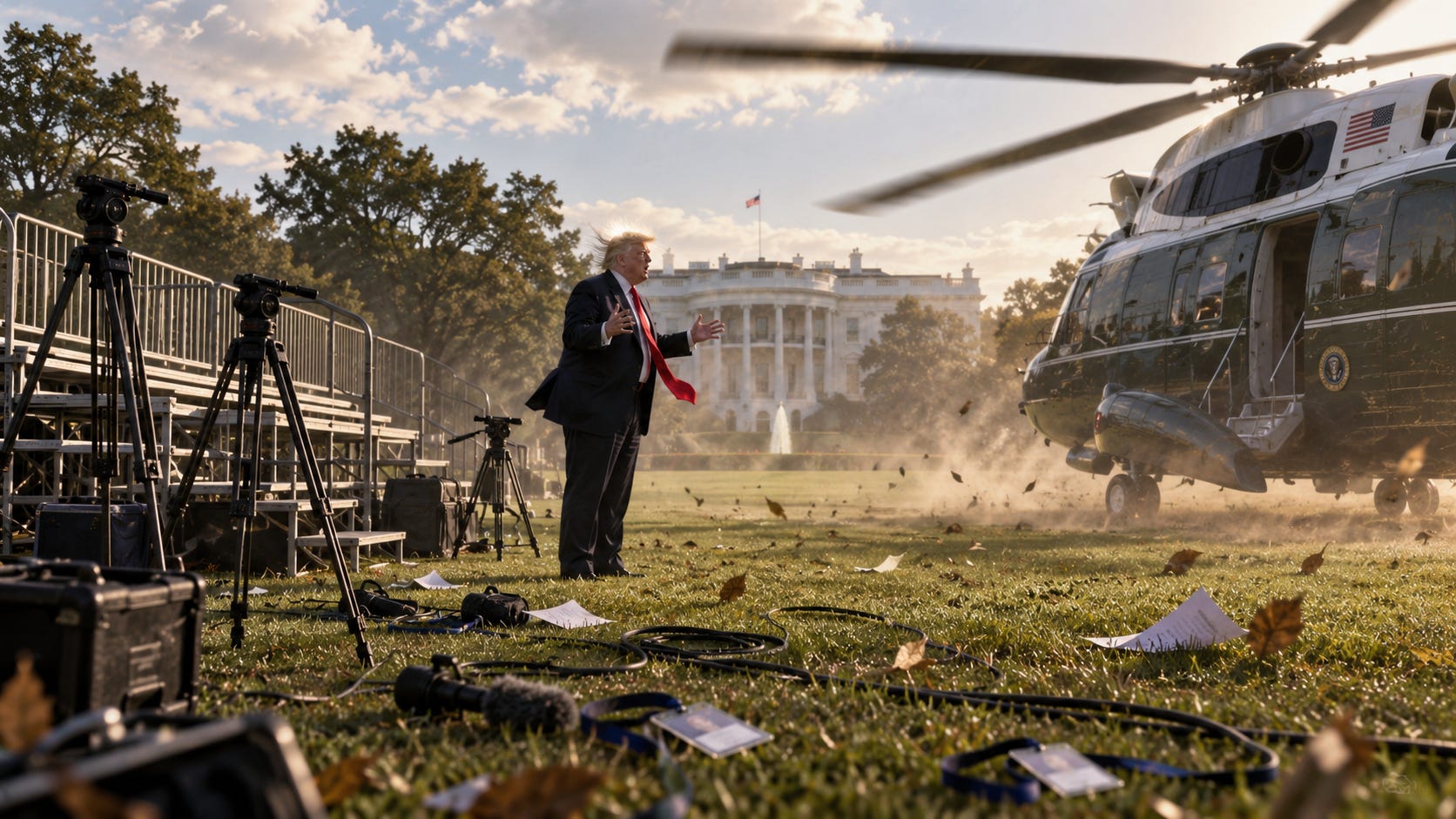
On Friday, September 18, Trump took to Truth Social—a platform that functions as the digital equivalent of shouting at a wall in a bathrobe—to announce he was banning CNN, MS NOW, and Politico from the White House, citing “their constant ‘reporting’ FAKE NEWS!” The next morning, security guards turned away reporters from all three outlets, collecting their hard passes like high school bouncers revoking hall privileges. By Sunday, CNN was officially booted from the travel pool for his trip to the United Nations.
It was petty. It was juvenile. And because Trump explicitly tied government access to whether he approved of their journalism, it created a textbook First Amendment viewpoint-discrimination problem.
Then came Monday, which is where Trump’s total ignorance of how presidential media coverage actually functions turned an illegal power trip into an absolute comedy of errors.