I am a Dave Chappelle fan. Have been since the late nineties when he was doing stand-up in smoky rooms and saying things out loud that most people only had the courage to think. I watched Chappelle’s Show the way my generation watched everything that mattered — obsessively, in real time, arguing about it the next day. So when I tell you that Chappelle has become one of the more polarizing figures in American entertainment over the last several years, understand that I am not saying it with any pleasure. I wanted to write about this interview the moment I finished watching it, but there were other pressing news stories demanding my attention first — that is what happens when you are writing about politics during Trump’s second non-consecutive term, where the news cycle operates like a fire hose aimed directly at your face. But this interview was too good to let slide, and Michel Martin is too good an interviewer to let go uncredited. So here we are.
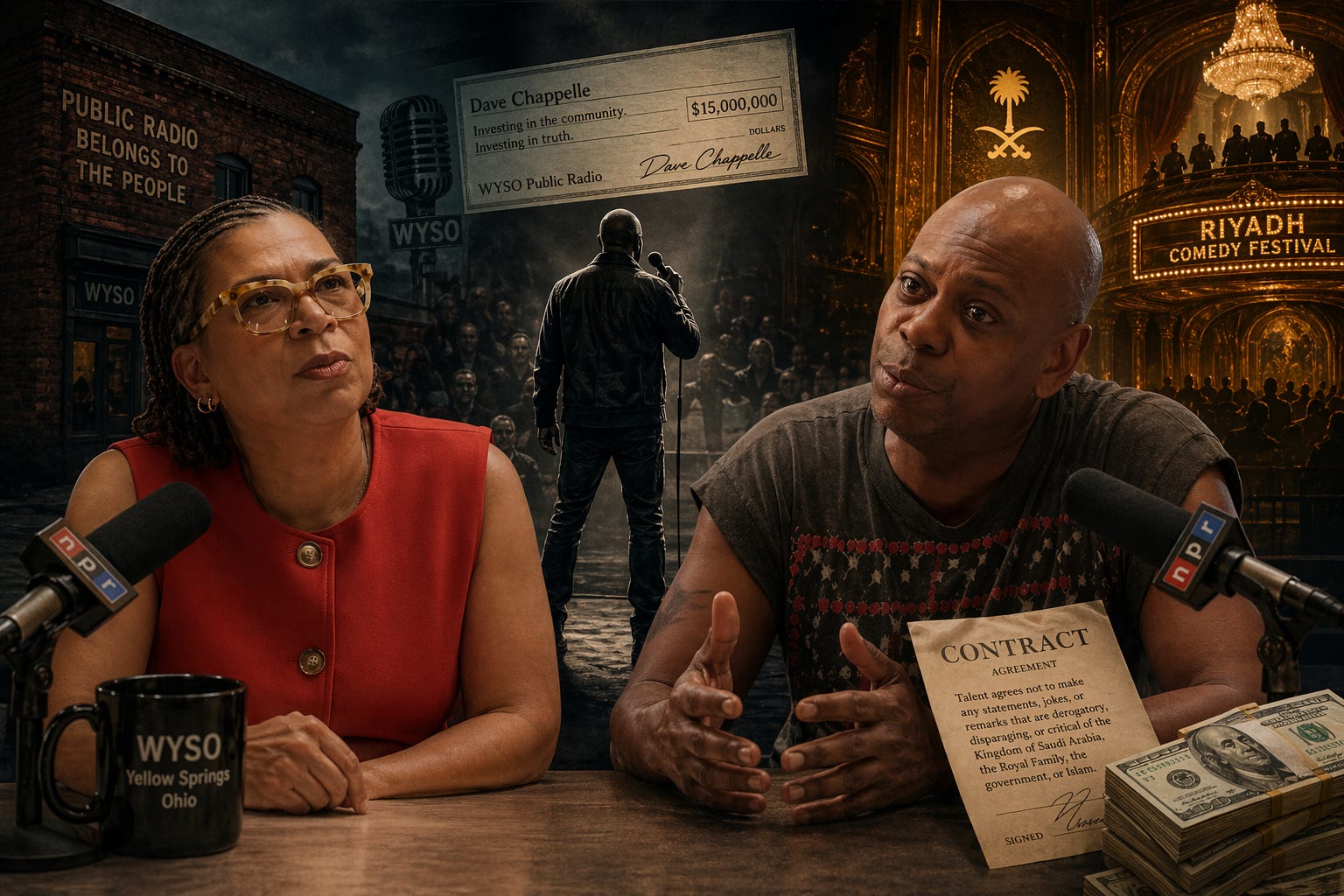
The interview in question is a nearly 39-minute conversation between Chappelle and NPR’s Michel Martin, posted to ▶NPR’s YouTube channel nine days ago as part of the Newsmakers series. It was recorded at WYSO’s brand new station in Yellow Springs, Ohio — inside a 150-year-old building that Chappelle personally renovated after investing $15 million to keep the local NPR affiliate from having to leave town. Let that number sit for a second. Fifteen million dollars. To save a public radio station in a small Ohio town where he actually lives. Not to slap his name on a stadium. Not to buy a sports team. To keep community radio alive in Yellow Springs. If you were unclear about where Dave Chappelle’s political sympathies actually lie, that check should settle the argument. In Trump’s second non-consecutive term — where the administration has been treating public media like a piñata — a Black comedian writing a $15 million check to an NPR affiliate is not just generosity. It is a political statement delivered in the most American language there is: money.
I am a lifelong devotee of public media and I do not say that casually. I grew up on Sesame Street, Reading Rainbow, and Mister Rogers’ Neighborhood. As I got older, Terry Gross on Fresh Air taught me what a real interview sounds like. Wait Wait... Don’t Tell Me! taught me that news and humor are not mutually exclusive. Tavis Smiley showed me that Black intellectualism had a home on public television. These were not just shows — they were an education I did not know I was receiving. Looking back as an adult, I understand now what was happening. Public media was feeding my brain while I was just trying to be entertained. That is the trick. That is why it matters.
I will also confess that I used to catch Art Bell’s Coast to Coast AM on AM radio late at night — not an NPR program, but it shared frequencies with stations that carried NPR programming, and it was exactly the kind of show that kept a kid’s mind running at two in the morning. For those unfamiliar, Coast to Coast AM was a paranormal and conspiracy-theory call-in show covering alien sightings, Bigfoot, time travelers, and government cover-ups. I knew it was nonsense even as a kid, but it kept the creative juices flowing. If only Art Bell could have seen what MAGA was going to do with conspiracy theories — he would have either been horrified or demanded royalties.
So yes, Chappelle investing in WYSO is, for me, personal. And for anyone still trying to decode his politics, this is your decoder ring. You do not write a $15 million check to public radio if you have been successfully recruited by the MAGA movement. That money is, to borrow a phrase from the man himself, a statement with a foundation.
Now — the interview itself. What made it exceptional was not any single exchange but the environment Michel Martin created from the jump. I spent years working in and around comedy clubs — never as a comedian, but as a bartender and club promoter — and I learned early that the room matters as much as the material. Martin walked into that interview and created a room where Chappelle did not need to perform defensiveness. She was not aggressive. She was not lobbing softballs. She was precise. Every hard question was framed with enough intellectual honesty that Chappelle had no excuse to dodge it with a joke — and to his considerable credit, he did not try. He sat in that chair and gave real answers to real questions without getting visibly annoyed, even when the questions required him to think rather than perform. That is rarer than it sounds from a man of his stature.
The Saudi Arabia section of the interview is where things got genuinely interesting — and where Chappelle’s argument was both partially right and partially something you could drive a truck through. His argument, in essence, was that the U.S. government does business with the Saudis, Netflix does business with the Saudis, everyone does business with the Saudis, the Saudis finance movies and boxing matches — and none of it was an issue until a Black man started making money there. He put it plainly: the minute a Black man can make money off the plantation, people tell you the money is dirty. Now, the racial double standard point has genuine weight to it, and we will get there. But the factual premise — that nobody said anything until he showed up in Riyadh — does not hold, and as someone who has been following Saudi Vision 2030 since it became a thing and covered the WWE-Saudi relationship during my time writing for Wrestlenomics, I can tell you with receipts in hand: plenty of people said something. They said it every single time.
WWE caught hell. When the wrestling company signed its ten-year deal with the Saudi General Entertainment Authority right after the assassination of Jamal Khashoggi, the backlash was bipartisan, loud, and sustained. Women were initially barred from the events entirely. When they were finally allowed to compete in 2019, they wrestled in government-approved attire while WWE ran promotional videos framing the whole arrangement as a women’s empowerment moment. Human rights advocates called it what it was: propaganda. Senators called for the events to be canceled. LIV Golf caught hell. When the Saudi Public Investment Fund launched its breakaway golf league and started writing nine-figure checks to players like Phil Mickelson and Dustin Johnson, the PGA Tour suspended those players and the sports media debated the ethics for months. Netflix caught hell when it expanded its Saudi content partnerships. The boxing world caught hell when major promoters started staging fights in Riyadh. Even Endeavor CEO Ari Emanuel — the man who eventually bought WWE — returned a $400 million Saudi investment over the Khashoggi murder. None of this is obscure. All of it is one Google search away. The idea that the civilized world looked the other way every time except when Dave Chappelle got a check is not accurate, and I say that as someone who is very much on his side for the broader argument.
Before we get to where Chappelle lands something real, I want to address a related argument that came up in the broader Saudi entertainer debate — one made by comedian Aries Spears when he tried to justify his own Riyadh appearance by pointing to America’s history of slavery. I wrote about this at length in my piece on that subject, but the short version is this: that is a textbook tu quoque fallacy. Tu quoque — Latin for “you also” — is the logical fallacy of deflecting criticism by pointing to the critic’s own wrongdoing, as if the existence of American slavery retroactively licenses performing for a government that murders journalists and imprisons dissidents. It does not. America having skeletons does not clean Saudi Arabia’s closet. The two things exist independently of each other, and using one to excuse the other is not a political argument — it is a rhetorical dodge dressed up in the language of historical consciousness. I would have had far more respect for Aries if he had just said the straightforward thing: they offered me money I was not in a position to say no to, and that is why I took it. Full stop. No sociology required. Honesty is always cleaner than gymnastics.
Now, Chappelle has said something in his most recent Netflix special, The Unstoppable, that I heard and did not want to let slide — that it felt easier to talk in Saudi Arabia than it does in the United States. I am not going to call outright bullshit on that statement, but I will call it a little disingenuous. And to his credit, Chappelle himself acknowledged in the same special that he knows the people in Saudi Arabia cannot say all the things he was allowed to say. He admitted his freedom there was contingent on a check from the king and a contract that reportedly barred him from saying anything critical about the Saudi royal family, the government, or Islam. So when he says he felt free in Saudi Arabia, what he means is that a rich American comedian with a $6 million appearance fee felt free to perform his specific set in a controlled venue under specific permission from the monarchy. That is not freedom. That is a very expensive hall pass. I promise you that freedom is not the average Saudi citizen’s experience — not the women who were still being imprisoned for demanding the right to drive, not the gay and transgender Saudis living under a legal framework where homosexuality is punishable by flogging or death depending on the circumstances, not the dissidents, not the bloggers, not the journalists. Saudi Arabia is not a place where people feel free. It is a place where a wealthy foreign celebrity was briefly allowed to tell pussy jokes because the government decided it served their international image.
Let us be specific about what we are talking about, because the Vision 2030 rebranding effort has done an impressive job of blurring the picture for Western audiences. According to the U.S. Department of State and human rights organizations including Amnesty International and the Human Dignity Trust, same-sex activity in Saudi Arabia is punishable under Sharia law by flogging, imprisonment, or death depending on the circumstances. Transgender people face arrest and prosecution for what authorities call cross-dressing. Adultery carries the penalty of stoning to death for married offenders under the law as written, and 100 lashes for the unmarried. Women’s rights activists have been imprisoned simply for publicly demanding basic civil rights. And critically, comedians who performed at the Riyadh Comedy Festival had to sign contracts prohibiting any material critical of the Saudi royal family, the government, or Islam. So Dave Chappelle felt free to make transgender jokes in a country where transgender people face flogging and imprisonment. I understand the irony was probably not lost on him — he even nodded to it in the special. But the argument that this constitutes some form of genuine freedom of expression, as opposed to a tightly managed performance within very specific parameters set by an authoritarian government, does not survive contact with the facts.
And here is my personal take, as someone whose relationship with this country (USA) is complicated to say the least: as often as this country gets on my nerves — and if you are a regular reader, you know it gets on my nerves frequently — I feel immeasurably more comfortable criticizing our government than I would if I were living under the Saudi system. Even with the Trump administration doing everything in its power to treat criticism of the president as a punishable offense, even with the dismantling of press protections and the weaponization of federal agencies against political opponents, I can still sit here and write this piece. I can still call a bad policy bad and a corrupt official corrupt and publish it under my own name. That option does not exist for Saudi citizens in the same way. So to his credit, in this NPR interview Chappelle contextualized his position more coherently than he did in the special — he acknowledged the limitations of his Saudi “freedom” and framed it more honestly as a commentary on his specific experience of American cancel culture rather than a genuine endorsement of Saudi governance. That is a more defensible argument, even if it still has some holes in it.
But here is where Chappelle lands something genuinely real, and I want to give him his flowers for it honestly. His deeper argument — that there may be no meaningful difference between making money off the plantation versus on the plantation — is a coherent philosophical challenge to the entire premise of morally clean money in America. The dollar itself was built on enslaved labor, stolen land, and centuries of compounding exploitation. The idea that there is some morally unimpeachable revenue stream available to a Black entertainer in this economy is a fantasy that mostly gets deployed selectively against Black people who make choices others dislike. And look, I am not in a position to judge anyone for taking Saudi money. If Saudi Arabia offered me a seven-figure check and I just said no to it without at least having a conversation with my wife about it, she would be side-eyeing me for months, possibly years. People love to tweet about selling out until they have to choose between their conscience and their mortgage — and the Saudis were not writing $50,000 checks. They were writing life-changing money to people who had spent decades grinding.
I am not currently a fan of Jeff Bezos, and yet I still find myself using Amazon’s products and occasionally experiencing a crisis of conscience about it. That tension does not resolve itself cleanly, and I am not going to pretend it does. Here is another example: depending on the classes I teach, a required textbook can run two hundred dollars or more. If a student tells me they found a two-hundred-dollar textbook for sixty-five dollars on Amazon, the last thing I am going to do is lecture them about the ethics of the platform. Their education matters more than my feelings about Bezos. The morally pure option is frequently a luxury that not everyone can afford, and the people doing the loudest complaining about Saudi money are often people whose own revenue streams would not survive serious scrutiny. Take the money if you need to take the money. Just do not waste everyone’s time building a philosophy around the transaction.
My personal framework on this is simple: I only consider someone a sellout on the Saudi question if they grandstanded about how horrible it is to go there and then went anyway. Which brings us to CM Punk. When Punk was in AEW, he was vocal about refusing to perform in Saudi Arabia, calling their money blood money in a tweet directed at The Miz that was so profane it would make a sailor blush. Then he went back to WWE, and in June 2025 he showed up in Riyadh for Night of Champions. But that was not even the most remarkable part. A fan confronted him about the old tweet during the kickoff show, and Punk stood on that stage and said, “I sincerely apologize to you and all of Saudi Arabia.” Triple H — Paul Levesque — went on camera afterward and said he was “incredibly proud” of Punk’s growth as a human being. Growth. The man who called Saudi money dirty apologized to the entire nation on a WWE stage, and the Chief Content Officer called it personal evolution. Dave Meltzer, the most respected journalist in professional wrestling, suggested the confrontation may have been a plant. Whether it was staged or spontaneous, the image of CM Punk standing in Riyadh apologizing to a crowd for having called their government murderous is one of the more complete sellout arcs in recent entertainment hi…