A handful of my readers reached out this week asking if I had seen the new interview between Bill Maher and Howie Mandel. I told them the only conversation I remembered between those two was from a few years ago, and it had left me completely unmoved—no urge to write about it, no urge to discuss it, no urge to do anything besides continue enjoying a life in which I was not thinking about Bill Maher. But my readers insisted, practically in unison: no, Kris, you have to see this one. So I watched it, expecting some new sit-down. It was the exact same interview, released in June 2022. The same clip I had already watched and shrugged at four years ago had simply gone viral again, recirculated so aggressively that people who follow my work assumed it was breaking news. It took me a minute to realize what was happening, which tells you everything about the internet’s content-recycling plant: nothing new has to occur. Somebody just digs an old clip out of the landfill, wipes off the banana peel, and puts it back on the shelf with a fresh expiration date.
Here’s my actual problem: I have zero incentive to write another full piece about Bill Maher or Stephen A. Smith this year. Not never again—I’m not taking a vow—but the law of diminishing returns applies to both men with brutal consistency. Every piece I could write about either of them is a rerun of something they already did, said, or apologized for badly. Their controversies have stopped being controversies and become a subscription service nobody asked to join. I tell my students the same thing I tell myself about capitalism: I don’t love it, I don’t hate it, but I have to move through it to pay my bills and take care of the people I love. Moving through it right now means admitting that the traffic on “here’s Bill Maher being Bill Maher again” is not what it used to be. Writing into the void isn’t activism. It’s an unpaid hobby, and I already have several of those.
So no, this isn’t a Bill Maher piece. But D.L. Hughley resurfaced the clip along with a couple of others, and buried underneath two men I’m bored with is a subject actually worth the word count: privilege. As a bonus, the word obviously irritates Maher, so I’ll take that as an incentive.
Privilege has become one of those words that transforms otherwise functional adults into toddlers defending a blanket fort, particularly white, male, MAGA-adjacent types who hear it and begin drafting a legal defense before the sentence is finished. Maher would insist that he doesn’t belong to that club, and technically he doesn’t. He merely prides himself on standing close enough to touch it, befriending enough people in the MAGAverse that he gets invited to cookouts nobody else on the left wants to attend. He has made contrarian proximity to the right part of his intellectual brand, apparently convinced that sharing dinner with Donald Trump made him an independent thinker instead of a houseguest who mistook access for insight. So when the word “privilege” comes up, Maher doesn’t respond like a detached observer. He responds like someone standing close enough to the blast radius that his first instinct is to duck and his second is to lecture everyone else about the physics of explosions.
The exchange itself is instructive. During ▶their conversation on Howie Mandel Does Stuff, Mandel describes something his Black friends have told him about raising children: in addition to the ordinary parental lecture about looking both ways before crossing the street, they must have another conversation about surviving a police traffic stop—keep your hands visible, make no sudden movements, comply first and challenge the treatment later. Mandel says his version of that childhood safety lecture apparently began and ended with looking both ways. He asks Maher directly whether being spared that second conversation is itself a form of privilege.
Maher’s answer is to reach for the one statistic he apparently memorized on the ride over and brandish it like he just defended a dissertation. Police fatally shoot roughly 1,000 people each year, he says, before asking Mandel how many of them are white. Mandel cannot produce the exact racial breakdown on command, which Maher treats as proof that the argument has collapsed. It is the kind of bargain-bin intellectualism Maher has perfected: demand an exact number the other person had no reason to memorize, interpret the pause as surrender, and sit back wearing the expression of a man who believes smugness underwent peer review.
But Maher’s statistic does not establish what he pretends it establishes. Roughly half of the people fatally shot by police are white—not “most,” as Maher’s framing suggests—but a raw total tells us almost nothing by itself. That white total includes people who were reportedly armed, people accused of presenting an imminent threat, people experiencing mental-health crises, people who were unarmed, and people killed under circumstances whose justification remains disputed. The totals for every other racial group contain the same range of cases. Maher separates none of those categories because he is not interested in comparing similarly situated people. He wants the largest white number available, stripped of circumstance and relieved of the burden of meaning. An aggregate body count cannot tell us whether comparable people received comparable treatment, whether a particular shooting was justified, or whether race influenced the chain of decisions that produced the encounter. It certainly cannot answer Mandel’s actual question about why Black parents routinely prepare their children for police encounters in ways white parents generally do not.
The denominator makes Maher’s little TED Talk even shakier. White Americans constitute a much larger share of the population, while Black Americans make up roughly 14 percent of the country and are fatally shot by police at more than twice the rate of white Americans. Maher briefly acknowledges the disparity and then buries it beneath the observation that police have more encounters with Black Americans, as though unequal contact were an explanation requiring no explanation of its own. It is not. Contact rates are shaped by where police are deployed, which neighborhoods are subjected to aggressive enforcement, whom officers choose to stop, what conduct attracts official attention, reported crime, socioeconomic conditions, and a long history of public policy that did not descend from the heavens racially neutral. Using unequal police contact to explain unequal police outcomes without examining why the contact is unequal does not resolve the disparity. It relocates it.
That is Maher’s entire statistical trick. He takes a question about unequal exposure to danger, replaces it with an absolute head count, removes the circumstances surrounding the deaths, ignores the relevant population rates, treats a downstream disparity in police contact as a self-explanatory cause, and then declares himself the only person in the room respecting the data. This is not empirical rigor. It is statistical taxidermy: Maher takes a living social problem, drains it of context, stuffs it with his preferred assumptions, and props up the remains as evidence that he is still the smartest mammal at the dinner party.
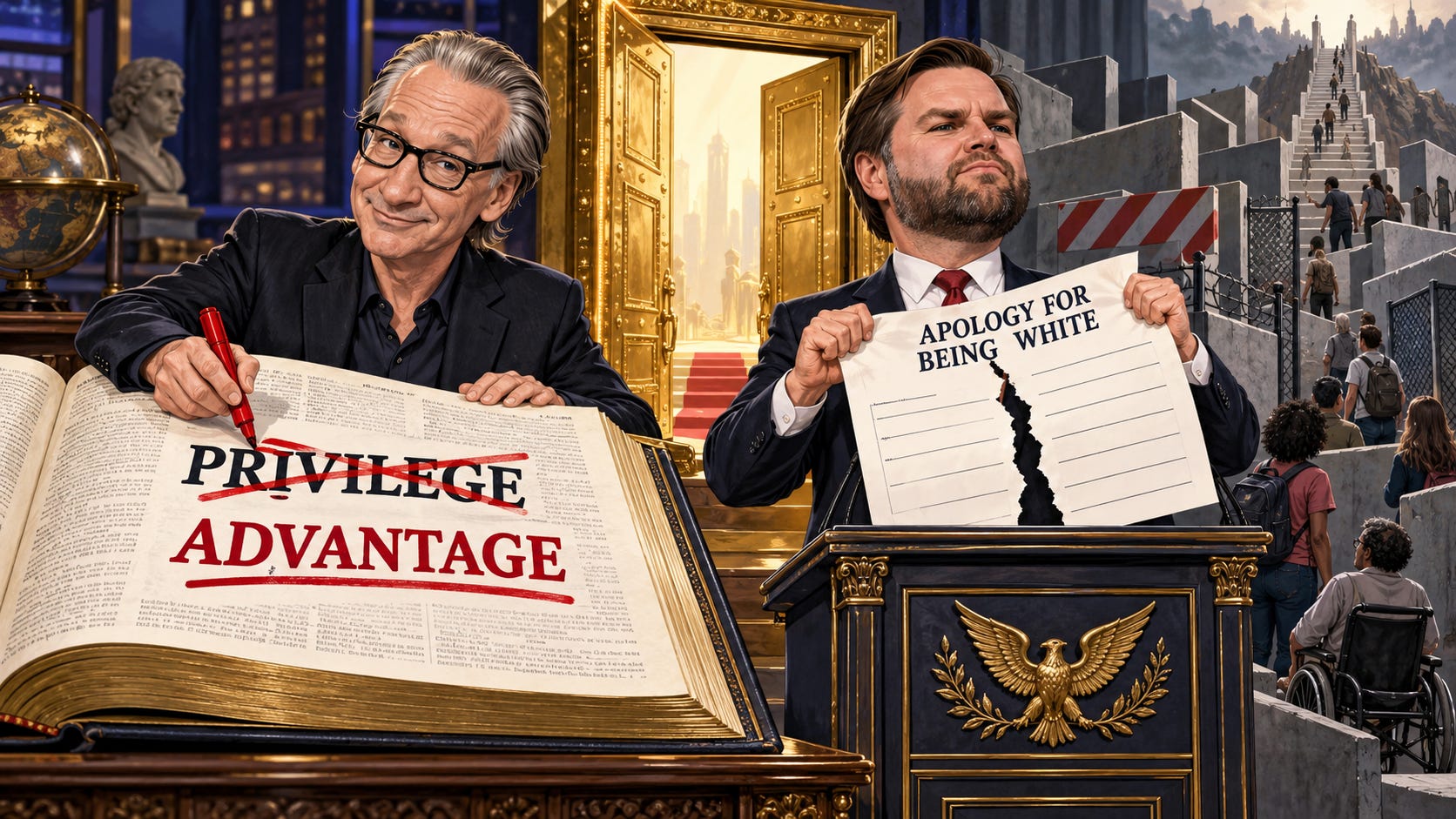
Then comes the part that earned this piece its headline. Maher tells Mandel he doesn’t like the word “privilege.” He would prefer “advantage.” His stated reasoning—and I want to represent the argument fairly, even if it arrives wearing clown shoes—is that “privilege” carries connotations that can become ridiculous, whereas “advantage” is supposedly the harsher and more accurate description of what is happening.
Read that again. Bill Maher believes “privilege” is too soft, so he would like to replace it with “advantage,” a word so much gentler that it sounds like something printed beside the continental breakfast on a hotel rewards brochure. He is softening the language while congratulating himself for toughening it, which is the sort of maneuver available only to a man who has spent so many years mistaking contrarianism for intelligence that he now assumes every disagreement with the dictionary qualifies as original scholarship. Maher is not refining the concept. He is dragging it through a thesaurus, changing its clothes, and presenting it to the class as new research.
Elliott Connie, a therapist who analyzed the clip in ▶a reaction video, offered the more clinical interpretation: replacing “privilege” with “advantage” allows Maher to preserve his comfort rather than confront what “white privilege” specifically implies. Jasmine Sanders, discussing the exchange on ▶D.L. Hughley’s Uncertain podcast, went further and identified the substitution itself as the tell. Maher is not merely parsing language. He is demonstrating the power the language describes. He assumes that his discomfort with a term gives him the authority to rename the experience of people who live with the consequences. That is not a rebuttal to privilege. It is privilege grabbing the microphone, correcting everyone’s vocabulary, and then demanding applause for its intellectual courage.
In social-scientific terms, an advantage can be situational: a favorable condition or temporary upper hand in a particular setting. Privilege describes a recurring pattern of unearned advantages attached to a person’s social position. It does not mean that every white person is rich, every man is happy, every heterosexual couple has a successful marriage, or Bill Maher has ever experienced the privilege of being as clever as he finds himself. It means that certain identities do not generate certain barriers. Privilege is structural, not biographical. It is not a claim that your life has been easy; it is an acknowledgment that one particular feature of your identity did not make it harder.
I have male privilege. Saying that costs me nothing because acknowledging privilege is not a confession, an apology, or an admission that I have never struggled. Being a man does not cancel out the discrimination I encounter as a Black person or the barriers I face as a disabled person. It simply means that gender creates advantages for me in situations where women may face assumptions, restrictions, dangers, or penalties that I do not. That is perfectly okay to acknowledge. Having privilege is not the moral failure. Pretending you manufactured every advantage through personal brilliance—or becoming theatrically offended when somebody notices the social structure—is the problem. Idiots like Maher either cannot understand that multiple forms of advantage and disadvantage can exist inside the same person, or his privilege has operated so efficiently that he has never been required to understand it. I suspect the second explanation is doing a lot of work for the first.
The same principle applies to my marriage. My wife and I can walk down the street holding hands without calculating whether somebody might harass us, threaten us, deny us service, or treat us differently because we are a heterosexual couple. We do not have to scan the people nearby, reconsider where affection is safe, or keep a de-escalation plan ready in case a stranger decides our relationship offends him. We are straight, and in that specific respect, we generally do not have to worry about being discriminated against because of whom we love. That is heterosexual privilege. It does not mean our marriage is effortless or that nothing bad can happen to us. It means being straight is not one of the things making our lives more difficult. Nobody issued us a loyalty card for heterosexuality. Society simply keeps applying the benefits automatically.
That is the cleanest way I explain privilege to my students: privilege often lives inside whatever you are not required to think about. Dominant social identities tend to feel neutral to the people who possess them precisely because institutions and customs were built to accommodate them. The absence of friction becomes so ordinary that it disappears from view. Maher mistakes his ability not to notice the machinery for proof that the machinery does not exist. A bird might struggle to explain air, but at least the bird does not have an HBO show where it calls everyone else irrational for breathing.
Before my brain surgery in 2022, walking was not something I thought about. My balance was simply there, the way water is simply wet. After the surgery, walking became a math problem. How many steps are there from this table to the bathroom? Does this restaurant have stairs I failed to notice on the way in? Is there an elevator, or am I about to learn the hard way that there isn’t? Accessibility stopped being an abstraction the moment I lost the privilege of assuming that every space would accommodate my body.
There were already plenty of rooms in which I was running a separate calculation: Am I being treated differently because I am Black? Now I have another list running beside it because apparently the universe looked at my existing workload and decided I needed a group project: Am I also being treated differently because of my disability? At the same time, I remain a man and a heterosexual person, identities that spare me other calculations women and LGBTQ people routinely have to make. None of those realities cancels the others. They coexist, which is the basic insight behind intersectionality: people occupy several social positions at once, and those positions distribute advantages and disadvantages differently depending on the setting.
Privilege, in my experience, is not hypothetical, and it is not a synonym for a painless life. It is the difference between running one background program in your head and running three. Maher’s mistake is assuming that because he can identify difficulties in his own life, he cannot possess privileges in other parts of it. But that is not analysis. That is a wealthy white man staring at a system designed to keep several of his background programs closed and concluding that everybody else must have imagined the software.
And it is not just Maher who cannot locate this concept with both hands, a flashlight, and a tenured sociologist standing beside him pointing directly at it. Earlier this year, JD Vance performed his own version of the same trick, which I examined in “JD Vance’s White Boy Christmas and the Myth of Apologizing for Whiteness” for Lincoln Square and in an earlier version of the piece on Medium. Speaking at Turning Point USA’s AmericaFest, Vance triumphantly announced that, in the United States, white people no longer had to apologize for being white. This was undoubtedly welcome news to the millions of white Americans who had awakened every morning, walked to the National Bureau of Caucasian Apologies, taken a number, and formally expressed regret for their melanin deficiency.
The obvious problem is that nobody serious was asking white people to apologize for existing. Vance manufactured that demand because “recognize the structural advantages associated with whiteness” does not sound nearly as sinister as “they want you to apologize for being white.” The first statement invites an examination of institutions, history, and unequal outcomes. The second allows Vance to climb onto a stage, defeat an argument nobody made, and accept thunderous applause for rescuing white people from an apology they were never scheduled to deliver. Academically, this is a straw man built from racial grievance: replace a structural analysis with a personal accusation, then encourage the audience to experience acknowledgment as humiliat…