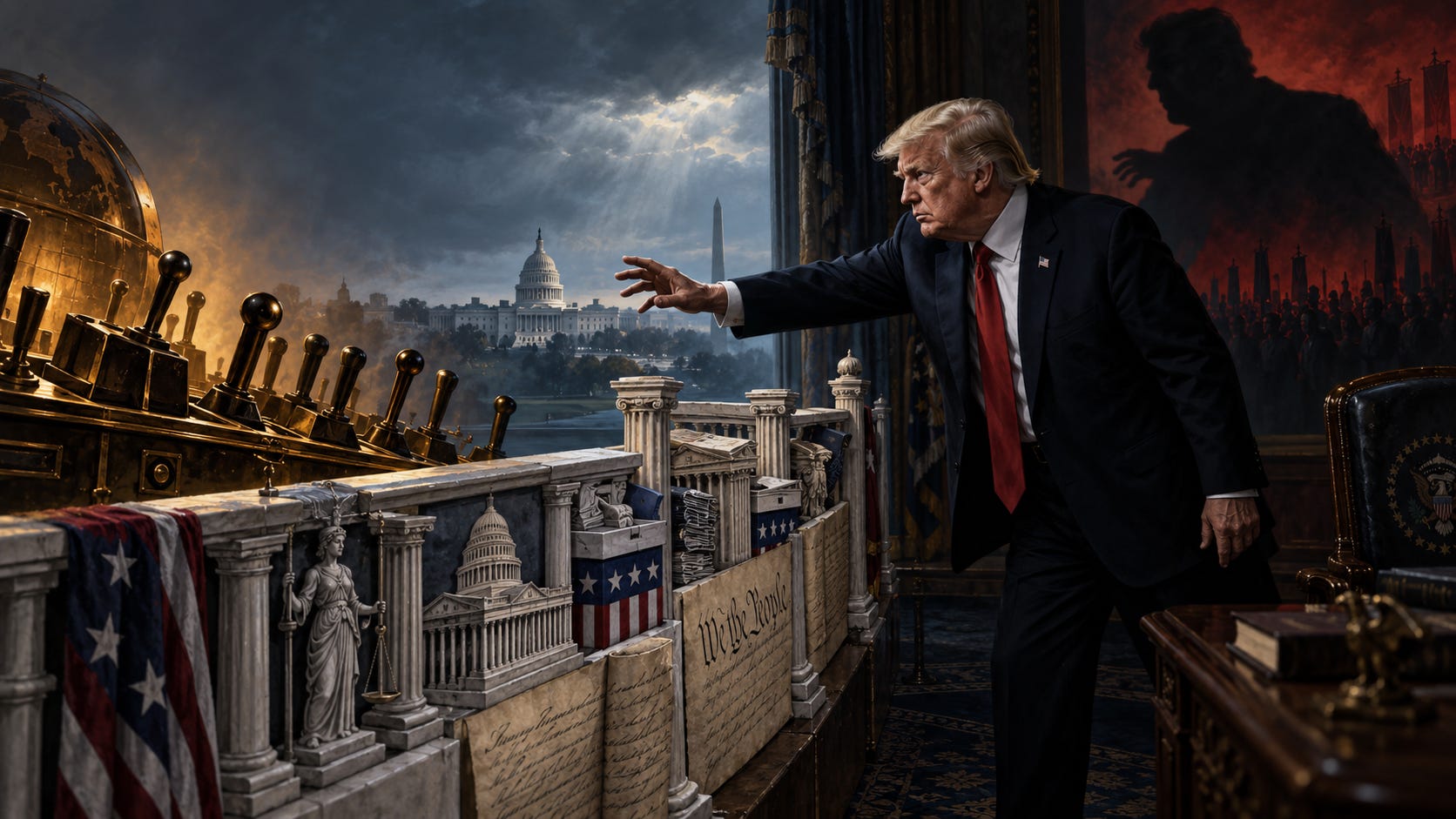
Donald Trump is not Adolf Hitler. He has not reproduced Hitler’s regime or committed the historic atrocities of the Third Reich. That is both historically obvious and analytically insufficient, because it answers a question I am not asking. I am not asking whether Trump has already become Hitler. I am asking something more revealing: If Donald Trump had the power to become what Hitler became, would anything within Donald Trump himself stop him?
A little over a year ago, I raised ▶a version of that question in a video for The Thinking Class after Larry David published “My Dinner with Adolf,” his satirical response to Bill Maher’s account of dining with Trump. Maher had returned from the White House marveling that Trump was “gracious and measured,” as though the president’s ability to complete dinner without overturning the table settled any outstanding questions about his character. David’s point was that private charm does not erase public conduct. A dangerous man does not become less dangerous because he passed the rolls and asked whether everyone enjoyed the salmon.
Maher responded by calling David’s satire insulting to the six million Jews murdered in the Holocaust and announcing that “the minute you play the ‘Hitler’ card, you’ve lost the argument.” That might have sounded like a principled objection if Maher had not played the same card himself. In September 2015, Maher said Trump was “a little Hitler-adjacent” because he was “stirring up xenophobic hate among an angry, humiliated population” and talking about “rounding up minorities.” Apparently, the Hitler card was perfectly valid when Maher played it from behind his HBO desk; it became an unforgivable insult only when Larry David slid it underneath Maher’s dinner plate.
Instead of confronting that contradiction or engaging the substance of David’s satire, Maher appointed himself bouncer at the velvet rope of historical inquiry and declared the entire subject off-limits. Nothing says fearless free thinker quite like the former host of Politically Incorrect announcing that a political comparison is too politically incorrect to examine. He was still attacking Trump-to-Hitler comparisons months later, apparently determined to prove that nine hundred words from Larry David could live in his head longer than most HBO shows remain on the air.
I recently watched my own response again. That video will not be joining the Criterion Collection anytime soon, but the question underneath it has aged considerably better than the production values. The standard objection to comparing Trump with Hitler rests on a category error. Historical comparison is not the same thing as historical equivalence. Two political figures do not need identical records, ideologies, institutions, or body counts before we can examine whether they share particular dispositions toward power. More important, the absence of an atrocity does not by itself establish the presence of moral restraint. A leader may stop because his democratic principles tell him to stop, or he may stop because courts, legislatures, military officers, elections, bureaucrats, and civil society prevent him from going any further. Those are not remotely the same thing.
As a political psychologist, that distinction between internal restraint and external constraint is the one that interests me. If the courts submitted, Congress surrendered its authority, the military treated presidential wishes as commands, the press could be silenced, political opponents could be imprisoned, and vulnerable populations could be targeted without legal consequence, would Trump’s character restrain him? Put more plainly: If Donald Trump possessed power comparable to the power Hitler ultimately accumulated, would he refuse to use it—or would he finally have the government he has repeatedly suggested he wants?
That counterfactual cannot be answered merely by announcing that Trump has not done everything Hitler did. It requires examining the political conditions that allowed Hitler to consolidate power, the institutional levers that made mass repression possible, Trump’s recorded attitudes toward those levers, and the conduct of the political elites and voters who would either restrain or enable him.
1. The Political Conversion of Economic Insecurity. Authoritarian movements do not rise simply because an economy deteriorates. Economic crisis is better understood as a permissive condition rather than a sufficient cause: it weakens confidence in existing institutions and creates an audience for leaders capable of transforming material insecurity into political grievance. The Nazi Party received only 2.6 percent of the parliamentary vote in 1928, when Germany was comparatively stable. After the Great Depression brought mass unemployment, bank failures, austerity, and governmental paralysis, its support rose to 18 percent in 1930 and 37 percent by July 1932. But economic suffering did not mechanically produce Hitler. The Nazis interpreted that suffering for voters, presenting the crisis as evidence of national betrayal, attaching economic fear to antisemitism, anticommunism, and humiliation over Germany’s postwar condition, and offering Hitler as the singular source of national restoration. Their message was not merely that the government had failed. It was that ordinary democratic politics had become incapable of saving Germany and therefore had to be replaced.
The United States in 2024 was not Weimar Germany, and inflation following a global pandemic was not the Great Depression. Pretending otherwise would make the historical comparison less useful, not more. Yet the political mechanism deserves examination. Although unemployment remained relatively low and the economy continued to grow, years of elevated prices left millions of Americans feeling that their wages no longer purchased what they once had. Donald Trump converted that legitimate frustration into a sweeping narrative of national collapse, blamed a complicated mixture of pandemic disruptions, housing shortages, corporate pricing, monetary policy, and global supply pressures on a rotating collection of politically useful enemies, and once again presented himself as the only person capable of repairing the country.
Trump did not merely promise that his policies would gradually reduce inflation. He announced, “When I win, I will immediately bring prices down, starting on Day One,” as though the nuclear football comes with a second button marked LOWER GROCERIES and every previous president had simply been too lazy to press it. Apparently, Trump intended to take the oath of office at noon, sign something with a very large Sharpie at 12:15, and have every Walmart employee in America replacing the price tags by lunch. Even he abandoned the fantasy before reaching the White House, conceding after the election that lowering grocery prices would be “very hard.” Day One had not even arrived, and the warranty on the promise had already expired.
The absurdity of that pledge is politically important. Democratic leaders ordinarily ask voters to judge competing policies operating through legislatures, executive agencies, markets, courts, and an independent central bank. Trump instead personalized the entire economy: prices were high because his enemies had ruined the country, and prices would fall because he had returned to command it. This is a common feature of personalist politics. Complex institutions and structural problems are pushed out of the public imagination and replaced by a supposedly indispensable leader who claims that his will, instincts, and presence can accomplish what normal governance cannot. The authoritarian element was not Trump’s recognition that groceries and housing had become too expensive. People did not hallucinate those bills. It was his effort to transform economic pain into distrust of democratic institutions, resentment toward designated outsiders, and dependence upon himself as the nation’s economic savior.
The experience of Trump’s second term makes that distinction more concrete. After campaigning on a promise to reduce prices immediately, he imposed tariffs that Federal Reserve researchers estimated had raised core goods prices by 3.1 percent through February 2026, and added 0.8 percent to core inflation overall. By August 2026, a Reuters analysis of the same grocery products Trump had displayed during his Bedminster campaign event found that their prices had risen 3.4 percent during the first nineteen months of his second term. Most of the groceries apparently never received the Day One memorandum.
When the Bureau of Labor Statistics released an unfavorable employment report in August 2025, Trump did not merely dispute an interpretation of the economy. He fired the agency’s commissioner and alleged, without presenting evidence, that the figures had been “rigged” to make him look bad. In Trump’s political universe, economic data are objective when they flatter him and become a Deep State spreadsheet when they do not. The response is revealing because independent statistics allow citizens, markets, journalists, and lawmakers to evaluate a government’s performance without relying exclusively on the ruler’s account of reality. A leader who attacks the legitimacy of those measurements whenever they become politically inconvenient is doing more than complaining about bad publicity. He is conditioning the public to treat his personal claims as more trustworthy than the institutions created to measure the facts.
None of this establishes that Trump is Hitler. It does, however, provide evidence relevant to the question this article is actually asking. Economic insecurity gave Trump a path back to power. He used that insecurity to promise an immediate restoration only he could deliver, pursued policies that increased some of the prices he had promised to reduce, and attacked the credibility of an independent institution when its findings contradicted his preferred story. When economic reality conflicts with Trump’s interests, his instinct is not accountability. It is to discredit the people who measured it, blame somebody else for producing it, and demand that the public accept his version instead.
Economic instability creates the opening. The remaining question is how a leader turns that opening into personal loyalty—and what happens when the party, the press, and the public help him do it.