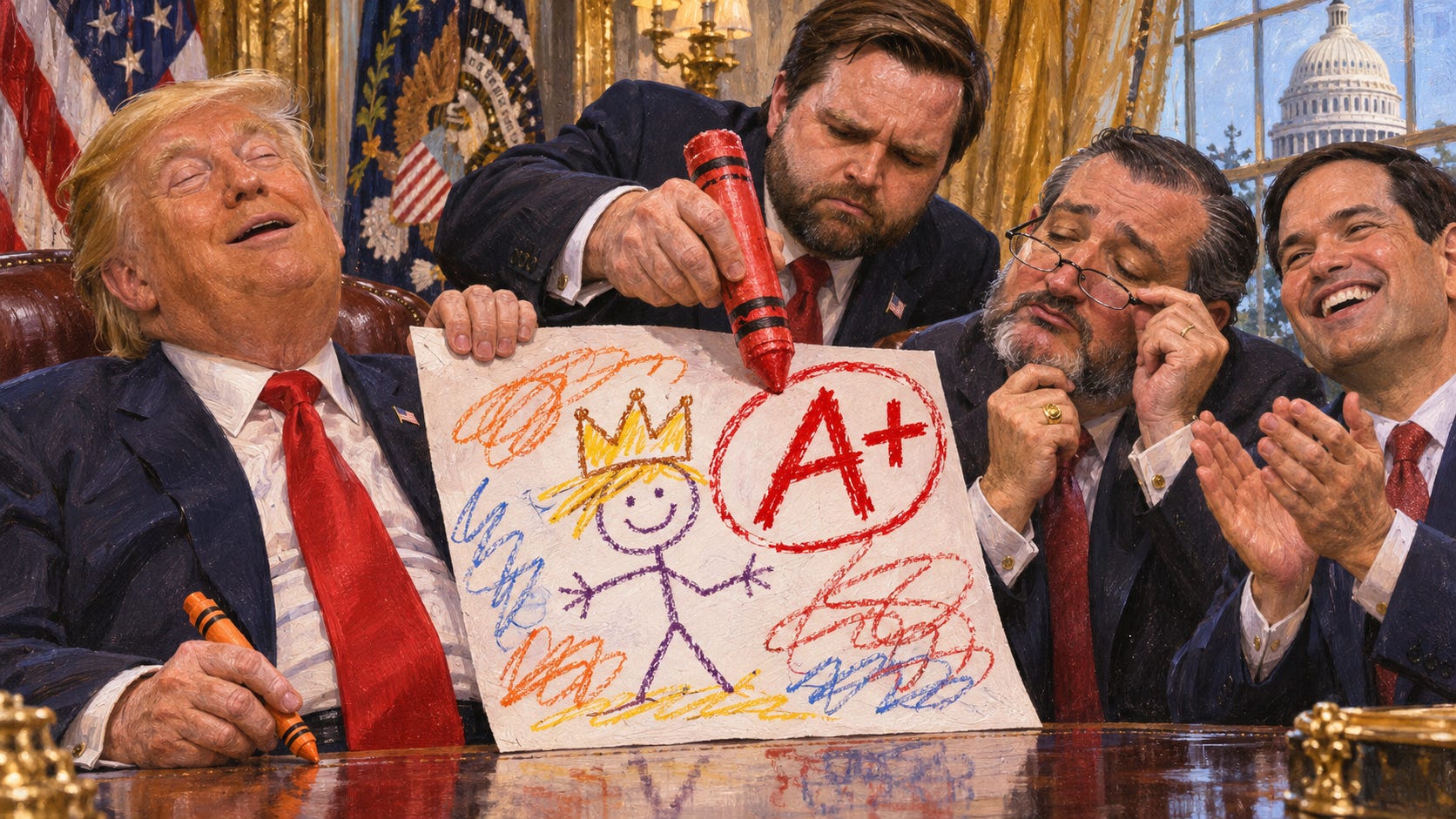
I have written more than a few times about the smart people who took one look at Donald Trump, decided he was beneath them, and then, once they saw the power he wielded over Republican voters, folded like lawn chairs at the end of a cookout. And again, I’m going to leave Kari Lake, Marjorie Taylor Greene and Lauren Boebert out of this. Those three came in with no real political experience, watched an idiot like Trump become president and thought to themselves, If he can do it, why can’t I? In fairness to them, once Donald Trump became president, what the hell was anybody supposed to say to that? Every grievance movement comes with an open casting call, and Trump had given those three every reason to believe they might get a callback.
The people I care about here are a different breed. The late Lindsey Graham earned his undergraduate and law degrees at the University of South Carolina and served as an Air Force lawyer. Marco Rubio has a law degree from the University of Miami. JD Vance went to Yale Law School. Mitch McConnell got his law degree from the University of Kentucky and spent four decades learning where every lever in the United States Senate is hidden. Hell, he probably hid a few of them himself. Pam Bondi went to Stetson Law and served two terms as Florida’s attorney general. Alina Habba has a degree from Lehigh and a law degree from Widener. Between them, these people ought to have been able to cross-examine Donald Trump without somehow ending up on his payroll.
Some of them came aboard early. Kellyanne Conway graduated magna cum laude from Trinity College, studied at Oxford, was elected to Phi Beta Kappa and earned her law degree with honors from George Washington University. She built her own polling firm and was a formidable political force long before anybody had heard the letters MAGA. In January 2016, while running a super PAC for Ted Cruz, she described Trump as “a man who seems to be offending his way to the nomination.” By August she was running his campaign. I’ve always wondered what that sounds like in a job interview. Mr. Trump, I believe I was the first person in this room to correctly identify your strategy.
Others took a little longer. In December 2015, Lindsey Graham went on CNN, called Trump “a race-baiting, xenophobic, religious bigot” and told Republicans that the way to make America great again was to tell Donald Trump to go to hell. In May 2016, he tweeted that if Republicans nominated Trump, they would get destroyed and they would deserve it. Then Trump won, and the man who told him to go to hell spent the rest of his life asking what time he wanted to tee off. Graham became Trump’s golf partner, errand runner and Sunday show defender. When he died in July, Trump said he was “like a member of the family.”
I do wish Lindsey Graham were still alive to see his prediction come true, because I think Dr. Annie Andrews would’ve beaten him. Instead, South Carolina got his sister Darline, the family understudy who finally got the lead just in time for the show to close. Lindsey spent ten years earning that ass-whipping, and poor Darline had to go down there and pick it up for him. Besides, after all those Sundays Graham spent on television defending Trump, I would’ve loved to see him back on CNN answering one last question. Senator, you said Republicans would get destroyed and deserve it. Now that Dr. Andrews has your seat, which part would you like to revise?
Marco Rubio called Trump a “con artist” who must never be allowed to take over the conservative movement. He now serves as the con artist’s secretary of state. Mitch McConnell called Trump “practically and morally responsible” for January 6 and, two weeks later, said he would “absolutely” support him if he were the nominee again. JD Vance once wondered in private whether Trump might be “America’s Hitler.” He is now his vice president. Of all the follow-up questions that comparison invites, how the fuck did Vance get from there to Does the job come with housing?
What I want us to remember is that these people had every tool they needed to know better. Several of them explained, on the record and in perfectly good English, exactly what was wrong with putting Donald Trump in power. I’ve argued before that a diploma has never protected anybody from a movement like this one. What interests me is what happens between Lindsey Graham telling the country that Donald Trump is a bigot and Lindsey Graham getting up on a Sunday morning, putting on a tie and going on television to explain what that same bigot really meant. There’s a whole education in what a smart man has to tell himself before he can sit down in that chair. And if we want to recognize this process the next time somebody asks us to surrender our own judgment, that’s where I think we ought to start.
What gave me the idea for this article was, of all people, Patricia Heaton. Debra Barone herself from Everybody Loves Raymond. Heaton graduated from Ohio State with a degree in drama, grew up in a devout Catholic household and has spent decades as one of the most outspoken anti-abortion conservatives in Hollywood. I can follow her politics just fine. It’s her relationship with Donald Trump that gives me trouble. I watched that woman keep track of every dumbass thing Ray Barone did for nine seasons. Donald Trump only has to wait her out until the next election.
In February 2016, Heaton tweeted that if Trump became the Republican nominee, “it won’t be my party.” He became the nominee. After the January 6 attack on the Capitol, she condemned the attack and announced she was registering as an independent. I took her seriously both times. A woman is entitled to take her time leaving a party she’s belonged to for decades. What interested me was how quickly she found her way back to the complaints department once she’d left.
After the 2024 election, Heaton was scolding the media for “fear-mongering” and telling people to stop calling Trump voters “uneducated.” Patricia, I just gave you the educational backgrounds of half a dozen lawyers who signed up for this shit. You and I are in complete agreement that a college education won’t save anybody. By February 2025, she was telling Fox News she wanted everybody to feel America was on the right track. Somewhere along the way we got a “Thank you President Trump.” And after the shooting at the White House Correspondents’ Dinner in April, she was pleading with her “friends on the left” to stop calling him dangerous or a fascist. In 2016, Trump had to change his behavior to keep Patricia Heaton in the party. Ten years later, the rest of us had to change our vocabulary to keep from upsetting Patricia Heaton.
She was the most prominent mainstream conservative I personally saw do this, so we’re naming the dance after her. I call it the Heaton Hokey Pokey. You put your right foot out, you announce to everybody that your right foot is out, you register that foot as an independent, and then you turn yourself around and tell the people who stayed put that they owe Donald Trump an apology. The beauty of the dance is that Trump can do the whole thing sitting down. He never has to take back a word, explain himself or give her a single reason to reconsider. Patricia handles the footwork, and by the time the music stops, somehow I’m the asshole for remembering why she left.
I hate to break it to you, Patricia, but words actually have definitions. The definition of fascism stays exactly the same even if the first person you associate with the word is the most evil son of a bitch you can think of. Teaching political science has shown me how much easier these conversations get once everybody knows what the word means. I can get a whole class through that part in five minutes. Imagine what a pain in the ass it would be if we had to spend the first twenty trying to get Piers Morgan on the phone to find out what fascism means that morning.
Fascism is a far-right, authoritarian political ideology that places the nation above individual rights and promises national renewal under a powerful leader. The leader claims to speak for the “real” people, casts opponents and supposed outsiders as threats to the nation, and treats repression and political violence as legitimate ways to restore its greatness. Those are features we can identify and argue about. If you think I’ve applied the term incorrectly, tell me which part I got wrong.
What fascinates me about Heaton and Piers Morgan is how quickly that discussion becomes an argument about whether the person in question is as evil as Adolf Hitler. Hitler comes to mind when you hear fascist? Fine. Michael Jordan comes to mind when I hear basketball player. I have yet to walk into a high school gym and tell ten kids to get the hell off the court until one of them wins six championships. Surely we can extend to political science the same courtesy we routinely extend to a sophomore having a rough night at the free-throw line.
Psychologist Eleanor Rosch’s work on prototypes helps explain the habit. We carry around a mental picture of a typical member of a category. Some examples fit that picture more readily than others. The trouble starts when the example in your head becomes the price of admission. Graham, Rubio, Vance and Conway had all the education they needed to recognize that little switch, and every political incentive to let it slide. Once “Is this fascist?” becomes “Has he done the worst thing Hitler ever did?” a politician can excuse an extraordinary amount of what’s happening right in front of him and still congratulate himself on knowing exactly where he’d draw the line. Patricia has already shown us how portable that line is.
I recently watched Piers Morgan interview Bill Maher for the premiere of Morgan’s new TIME Studios series. Maher used to be one of Trump’s harshest critics. These days he’s one of his more dependable rationalizers, particularly on the subject of why he keeps going back to the White House to have dinner with a man who gives him a bad review after every meal. In February, Trump called Maher a “jerk” and said their first dinner was a “total waste of time.” Bill went back in October. Days later, Trump called him a “complete and total loser” and told him to stop calling. A few weeks after that, Maher was sitting across from Piers crediting Trump with “the greatest comeback ever.” Personally, I thought the greater comeback was Bill getting himself invited to that second dinner. If a man tells the whole country that the first four hours he spent with me were a total waste of his time, I’m inclined to let him have the next four back.
I’ve said this before, and I told my wife the same thing. Trump will never fully disavow Bill Maher. He needs Bill in the role of the reasonable liberal, the one who can sit down with the president because he’s free of what right-wing sycophants call “Trump Derangement Syndrome,” which itself is a phrase they use to rationalize Trump’s behavior. Trump gets to insult him in public and still produce him as a character witness. Bill, in turn, gets to explain to the rest of us that he’s independent-minded enough to have dinner with a man who just called him a complete and total loser. Both men seem satisfied with this arrangement, although only one of them has to go on television afterward and explain why he has self-respect.
In practice, TDS functions as a thought-terminating cliché, a ready-made phrase that shuts down an inquiry just as somebody might otherwise have to answer the damn question. Watch how neatly it shifts the burden of proof. I bring up something Trump did. You diagnose me with TDS. Now I’m supposed to establish my psychological fitness before we can discuss an event you watched on the same television I did. And if I get irritated because you’re dodging the question, congratulations, you’ve discovered a second symptom. That’s a self-sealing argument. My objection counts as evidence for your diagnosis, and your diagnosis gives you permission to disregard my objection. The man at the center of the dispute enjoys the considerable benefit of being the only person in the conversation whose behavior requires no explanation. But that’s an article for another day.
What neither Maher nor Morgan seems to fully grasp is how useful simple cordiality can be to a man like Trump. Trump damn near gave away the trick himself when he called the White House “a very seductive and beautiful place” in the same post where he trashed Maher. Bill’s own defense is that it doesn’t matter who Trump is at a private dinner with a comedian. Fair enough, Bill. Then how come the rest of us have had to hear so much about what he was like at dinner with a comedian? My friend AT2 made a point I wish somebody had put to Maher. ▶Pick just about any evil figure in history and I’m sure you could find somebody who enjoyed talking to him. Imagine sitting through four hours of dinner with a man whose approval you don’t need, at the most famous address in America, and coming away impressed that he managed to make you feel important.
Psychologist Edward Thorndike described the halo effect, our tendency to let a favorable impression in one area color our judgment in another. Trump is perfectly pleasant to Bill over dinner. That tells us something about Trump’s ability to be pleasant to Bill over dinner. The halo shows up when that experience starts buying Trump credibility on subjects considerably more consequential than whether he knows how to pass the potatoes. Add psychologist Robert…