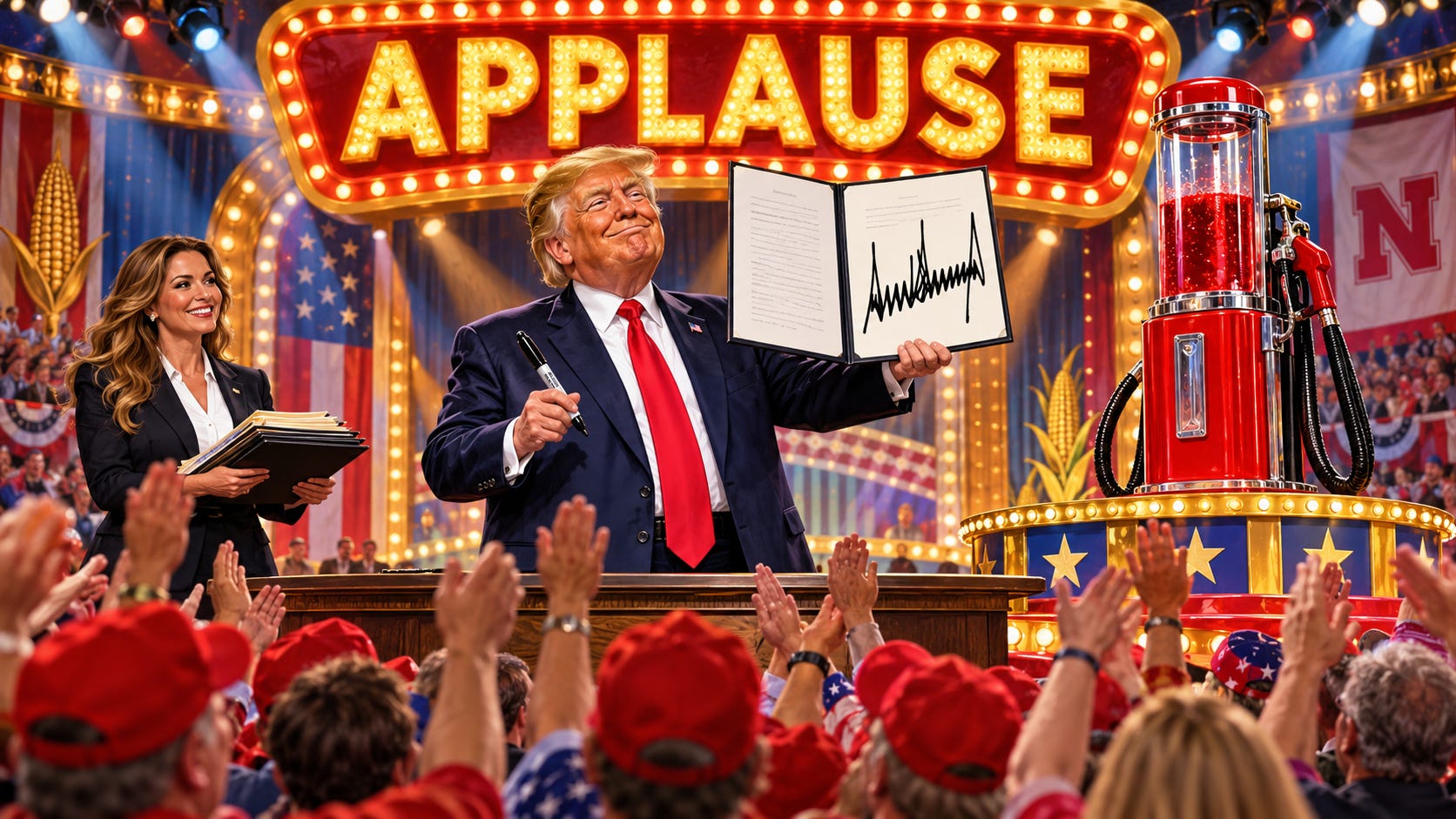
On a Monday night in Grand Island, Nebraska, White House aide Natalie Harp—a woman whose primary job description appears to be serving as a human printer, personal hype-man, and golf-cart sprinter—strutted onstage to hand Donald Trump an executive order. Trump beamed at her like a gameshow host admiring a glamorous assistant, literally comparing the moment to * The Price Is Right* before casually admitting he had no idea what the paperwork actually did. The document was about red-dyed diesel. “
When I decided to become a political science professor over twenty years ago, I thought I was choosing a disciplined, predictable craft. At least when I was bartending, the drunks were honest about wanting another round and knew what was in their glass; in political science, you used to expect a baseline of adult governance rather than a room full of marks throwing a parade for a toddler waving an empty glass. Back then, politics was mostly background noise. Sure, it had its dramatic highlights—Bill Clinton’s scandals, George W. Bush blundering into endless wars in the Middle East, or Barack Obama making history as the first Black president. But for the vast majority of Americans, politics ran on low volume. If you were a junkie, you tuned in; if you weren’t, you went about your life assuming the guardrails would hold.
Even during crises like 9/11, when shock snapped everyone to attention and patriotism spiked, the underlying baseline returned: a belief that, for better or worse, functional adults were at the wheel and normalcy would reassert itself. But while normal people were happily tuned out, assuming the system was fine, a bitter, resentment-fueled subset of the electorate never stopped nursing their grievances. In the quiet background, while the rest of the country went to work and raised their families, these folks allowed their vitriol to ferment and fester, waiting for a savior who would validate their bitterness.
Then Donald Trump rode down that golden escalator in 2015, tapped directly into that long-simmering resentment, and gave those angry, gullible crowds a license to stop pretending to care about substance altogether. The tragic reality is that a figure like Trump wasn’t an anomaly—he was an inevitability, four hundred years in the making.
The South losing the Civil War was the first obvious sign of this national pathology. Lincoln signed the Emancipation Proclamation in 1863, the 13th Amendment was ratified in 1865, and the losers immediately demanded their bruised egos be cushioned in velvet. This country has produced some brilliant institutional concepts—checks and balances, independent judiciaries—but an embarrassing portion of its political history consists of coddling sensitive, entitled losers. Andrew Johnson handed out pardons like party favors. The Compromise of 1877 traded away Reconstruction to make Southern oligarchs feel whole again. And the nation allowed those defeated Confederates to litter public squares with racist monuments so they could pretend, at the end of the day, that they hadn’t lost a catastrophic war to preserve slavery.
Most of those bronze statues weren’t even erected to mourn dead soldiers. They went up in two distinct, calculated waves: the first around 1900, right as Southern legislatures were writing Jim Crow into law, and the second during the 1950s and ’60s as panicking segregationists fought tooth and nail against basic civil rights. Those weren’t historic memorials; they were institutional middle fingers aimed at Black Americans. Even after legal emancipation, we maintained a pervasive, brutal system of legal apartheid that wasn’t even meaningfully chipped away until Brown v. Board of Education in 1954—nearly a century later.
The ideological descendants of the Confederacy didn’t disappear when explicit segregation became bad PR. They just adapted. Some sanitized their vocabulary, turning racial grievance into coded dog whistles about “states’ rights” and “law and order.” Others rebranded their resentment under the umbrella of Christian nationalism. But the most cynical intellectual heist in modern politics was their weaponization of Martin Luther King Jr.’s legacy. They stripped MLK’s famous line—that people should be judged by “the content of their character, not the color of their skin”—completely out of context and converted it into an anti-wokeness bludgeon.
In their twisted, bad-faith logic, “colorblindness” now means dismantling diversity initiatives, ignoring centuries of systemic inequality, and recasting comfortable white men as the single most persecuted demographic in human history. It’s an astounding piece of rhetorical gymnastics: taking the words of a Black civil rights martyr and turning them into a bulletproof shield for middle-aged white guys who throw a full-blown existential crisis the second they aren’t the default center of the universe. It’s a level of fragile, self-pitying delusion that would be hilarious if it weren’t driving actual policy.
A country that spends 160 years reassuring its sorest losers that they’re actually champions inevitably breeds a political movement led by a man who needs a crowded room to cheer his paperwork just to convince himself he isn’t a loser. Trump standing on a stage in Nebraska, signing an order for a fuel he couldn’t define, wasn’t some unexpected glitch in American history. It was the direct, logical outcome of a century and a half of institutional appeasement. It was always going to happen; Donald Trump was just the guy willing to hold the pen.
Please let the sheer, unadulterated lunacy of this sink in. In front of thousands of people packed into a fairgrounds expo center, the President of the United States stood on stage, was handed an executive order by his glorified human printer and personal hype-assistant, openly confessed to the crowd that he had no idea what the hell the policy actually meant, signed it anyway—and those people fucking cheered for it.
I’ve brought this up in past articles and in my lectures, calling it a “green ribbon presidency“: a performative carnival where sycophants constantly invent new, meaningless awards to hand him just so he feels validated, showering him with gushing praise for fulfilling the basic mechanical requirements of staying conscious. But this is a whole new baseline of pathetic. A standard participation trophy at least requires you to run around the field. Trump didn’t even have to comprehend the words on the paper. He just had to scribble his name, hold it up like a spelling-bee contestant who just correctly spelled his own name, and let a room full of marks treat him like a conquering hero.