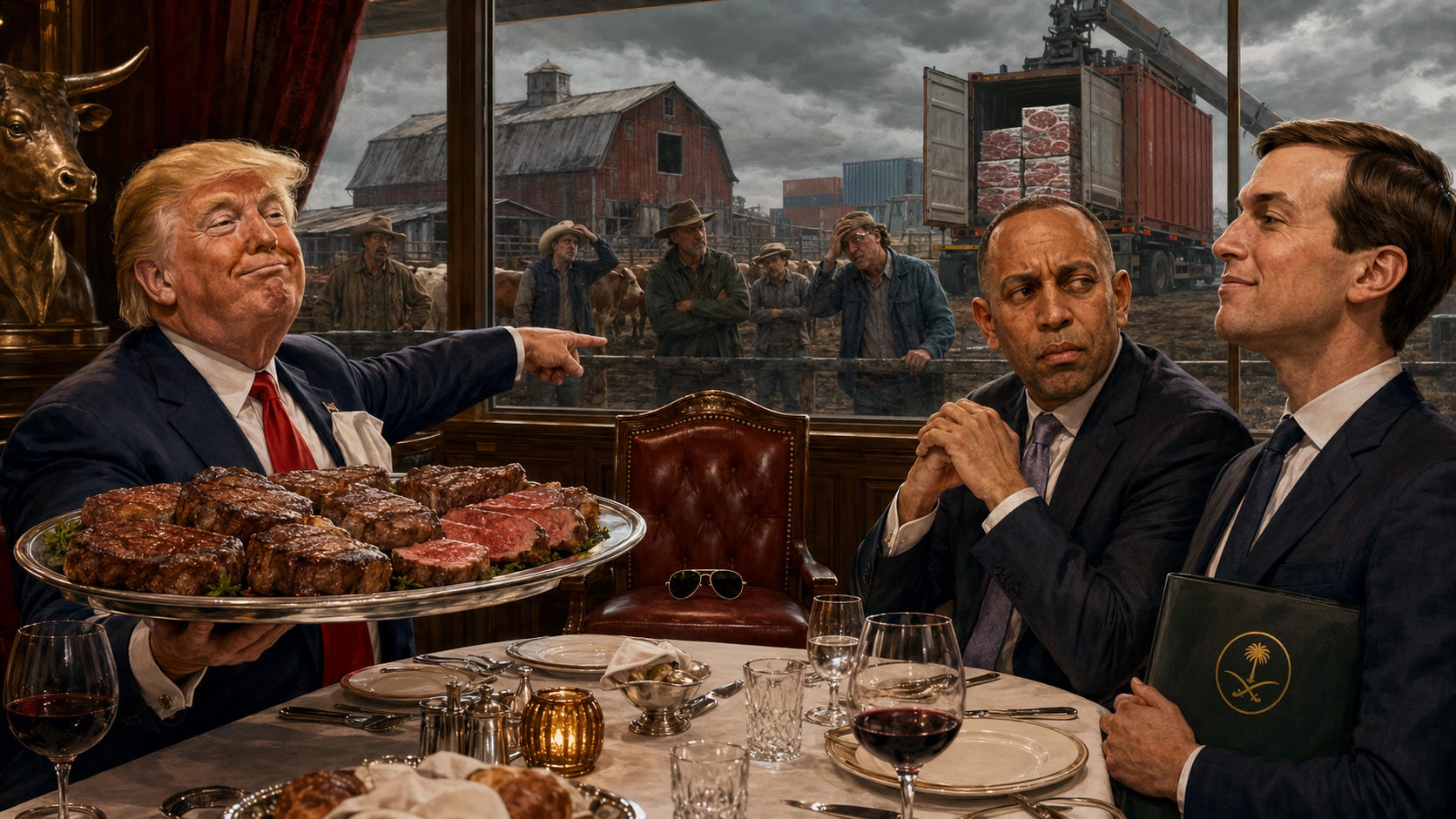
This is the third time in eleven months Donald Trump has tried to lower the price of beef by making life worse for the people who raise it. First came Argentina in October, when he floated quadrupling beef imports and immediately discovered that even members of his own coalition have limits—apparently somewhere between being called ungrateful and having their livelihoods used as a prop in his next grocery-store photo op. Then came Argentina again in February, when a presidential proclamation added another 80,000 metric tons to the tariff-rate quota, delivered with the confidence of a man repeating an experiment that had already failed but assuming the problem was insufficient volume. Now comes Friday’s announcement: 300,000 metric tons of tariff-free foreign beef, no disclosure of which countries have supposedly agreed to supply it, and no serious explanation for why doing the same thing a third time should produce a different result. If you are waiting for this administration to learn something, get comfortable. We are going to need the whole hour, an intermission, and possibly a substitute teacher.
Trump’s version of events, posted to Truth Social on Friday, blames Joe Biden for ground beef reaching $6.69 a pound last December—then a record in the federal data—and naturally credits Donald Trump with riding to the rescue. Biden has been out of office for nineteen months, but in Trump’s telling he remains the country’s most powerful economic policymaker, apparently controlling beef prices remotely from a beach chair in Delaware. Trump has now occupied the White House long enough to redecorate it, monetize it, attach his name to everything that does not run away, and begin constructing a ballroom, but responsibility for the price of hamburger remains constitutionally vested in Joseph Robinette Biden Jr. If beef prices fall, Trump did it. If they rise, Biden apparently sneaked out of retirement, tiptoed past the Secret Service, and personally slapped another dollar on the ground chuck.
The proposed fix is that, for ninety days, as much as 300,000 metric tons of product intended for ground beef can enter the country without the usual out-of-quota tariff, accompanied by what Trump describes as a commitment from unnamed foreign suppliers to sell it at 25 percent below current market prices. Strip away the campaign framing and Trump’s underlying diagnosis is not irrational on its face. The United States really did enter January with 86.2 million cattle and calves, the smallest herd in seventy-five years. Years of drought, wildfires, high production costs, and screwworm-related restrictions on cattle crossing from Mexico really have squeezed supply. That part is true. It is also the only part of Trump’s explanation that survives contact with the people who actually own cattle rather than merely posting about them in capital letters.
The National Cattlemen’s Beef Association, which represents more than 175,000 cattle producers and feeders through its state and breed affiliates and is not exactly a hotbed of Democratic Socialists of America membership, called the plan political theater. CEO Colin Woodall said the organization was “disappointed,” warning that the announcement and “other market interventions throw cold water on the prospect of herd expansion and sacrifice long-term stability for short-term messaging.” That is the polite trade-association version of asking the president to stop helping before he kills something.
Nebraska Senator Deb Fischer—a Republican and cattle rancher herself—said plainly that lowering prices at the expense of American producers is not a solution and that flooding the market with foreign beef undermines the actual long-term answer: rebuilding the American herd. Florida ranchers piled on through their state association, calling it unsound policy to interfere with the cattle market while producers are already absorbing record input costs. None of these people are resistance liberals hiding Elizabeth Warren stickers beneath their saddles. These are Republicans and ranchers begging a Republican president to stop practicing central planning on their cattle because he saw an unpleasant grocery number and needed someone other than himself—and preferably Joe Biden—to blame for it.
The U.S. Cattlemen’s Association, a separate trade group, went further. It cited the recent recall of nearly 30,000 pounds of Argentine beef imported without the benefit of federal inspection as evidence that the food-safety system is already being tested, then noted that 300,000 metric tons equals roughly half of all American beef exports during the first part of this year. That is an enormous volume shift to force into the market on ninety days’ notice, particularly when producers are deciding whether it is financially safe to expand their herds. Trump is attempting to produce a short-term price reduction by weakening the incentive required to solve the long-term shortage. It is the agricultural equivalent of lowering the temperature in your house by setting fire to the thermostat.
Sitting underneath all of this is a contradiction nobody in the administration appears eager to explain in words that must coexist in the same paragraph. Whenever economists point out that Trump’s tariffs raise costs for American businesses and consumers, the White House insists that foreign countries absorb them and Americans pay nothing. Fine. Put that claim in your pocket and do not lose it. Because the premise of Friday’s announcement is that suspending a tariff will reduce what Americans pay for beef. Trump is simultaneously arguing that tariffs do not increase consumer prices and that removing one will decrease consumer prices. This is not a coherent economic theory. It is two press releases wearing the same necktie.
Asked which countries would supply the 300,000 metric tons of miracle beef, Trump told reporters, “I don’t want to say which countries, but there are a few countries.” California Congressman Ted Lieu asked the obvious question online: Why hide it? Nobody has answered him. Trump claims to have secured cheaper beef from countries he cannot identify, through commitments he has not produced, at prices nobody has independently verified. Ordinarily, when a man tells you he has an extraordinary deal but cannot reveal who is involved, where the merchandise originated, or how the numbers work, you do not put him in charge of national trade policy. You stop responding to his Facebook Marketplace messages.
None of this is theoretical for the people actually running cattle, although some of them have worked extraordinarily hard to experience it as a surprise. Corbitt Wall is a commercial cattle manager and market analyst who told Al Jazeera, without hedging, that he “totally supports Trump and everything he does.” Everything. That is not a political opinion so much as a waiver of independent thought. Even Wall conceded that there was not a person at any level of the cattle business who was not insulted after Trump declared in October that ranchers would be “doing just as they’ve done for the past 20 years—Terrible!” without him. Imagine announcing that you support everything a man does and then appearing startled when one of the things he does is insult you publicly and endanger your livelihood. At that point, you are not evaluating a president. You are maintaining a subscription.
The funniest part—if watching people repeatedly vote themselves into an agricultural wood chipper can still be considered funny—is that these farmers have already seen this movie. During the first of Trump’s nonconsecutive terms, his trade war invited Chinese retaliation against American agriculture, cost farmers export markets they had spent years cultivating, and forced Washington to authorize tens of billions of dollars in bailout payments to contain the damage created by Washington. Trump broke their windows and then expected gratitude because he arrived later carrying a roll of duct tape purchased with taxpayer money. A remarkable number of farmers watched all of that, called it economic patriotism, and voted to let the same contractor back inside the house.
Now some of them are standing amid the familiar wreckage asking how the tariffs, retaliatory trade barriers, volatile markets, higher production costs, and improvised import schemes could possibly have happened again. I do not know how to make this gentler: when a mule kicks you once, blame the mule. When it kicks you twice because you returned wearing a “Mules for Trump” hat and positioned your head behind its hind legs, eventually the Department of Agriculture has to classify you as a preventable workplace accident.
Todd Armstrong runs a 200-year-old family cattle and crop operation in Indiana, voted for Trump in 2024, and told CNN that the beef plan is “hypocritical”—that a president who ran on America First produced a policy containing nothing that puts America first. Todd, my brother in beef, the hypocrisy was not concealed in the fine print. Trump spent his first term imposing tariffs, triggering retaliation, disrupting agricultural exports, and then passing out bailout checks as though he were rescuing farmers from a natural disaster rather than reimbursing them for a fire he started himself. Armstrong’s farm has survived two centuries, which means his family successfully navigated wars, depressions, droughts, mechanization, and dramatic changes in the global economy. Donald Trump’s policy history was apparently the threat that slipped past the institutional memory.
Jim Richardson, a 77-year-old self-described conservative in Georgetown, Texas, voted for Trump twice and now says he is “disappointed,” worrying that the consequences could follow the next Republican onto the ballot. “Disappointed” is doing heroic work there. Disappointed is what you feel when the restaurant forgets your side of coleslaw. When a politician repeats the same destructive trade strategy you already watched him conduct during his first term, after spending years explaining exactly what he intends to do, that is not disappointment. That is recognition arriving several elections late with no luggage.
Then there is John Boyd Jr., president of the National Black Farmers Association and himself a cattle and soybean farmer. Boyd deserves considerably more credit than the men now discovering that Trump’s trade policy may not have been designed by an agronomist. He spent months warning row-crop farmers about what was coming before the soybean market collapsed. Rather than listen to a Black farmer who had decades of experience, national organizational leadership, and the irritating habit of being correct, too many people treated his warnings like another DEI grievance. Apparently expertise becomes identity politics when the expert is Black, but “I totally support Trump and everything he does” qualifies as serious agricultural analysis when delivered from near a feedlot.
Boyd was not surprised by the beef announcement because, unlike Trump’s MAGA farmers, he did not begin studying trade policy last Friday afternoon. “I believe that this is a raw deal,” Boyd told MS NOW’s Katy Tur on Monday, observing that Trump “keeps making the announcement that he loves farmers, he loves cattlemen, and then undermines us with 300,000 metric tons of foreign beef that we don’t even know where it’s coming from.” That is the difference between affection as political branding and policy as material consequence. Trump loves farmers the way a casino loves gamblers: warmly, publicly, and for as long as they continue surrendering something of value.
Boyd also challenged the administration’s claim that consumers are guaranteed to benefit. “There’s no guarantee that the American people are going to see any savings in the local grocery stores,” he said. “This is more about helping meatpackers, in my opinion.” He put numbers behind the warning: according to Boyd, the country is losing 77 farmers and cattlemen every day, approximately 300 farm foreclosures are pending, and producers are confronting historically high fertilizer and diesel costs made worse by the administration’s war with Iran. A day earlier, he told NewsNation that the import plan was “a direct slap in the face to America’s farmers,” emphasizing that many of the people positioned to absorb the loss are the same people who voted the policy into office.
Boyd tried to warn them the first time. They dismissed him, voted for the man he warned them about, experienced the consequences he predicted, and have now returned to television to announce that something seems amiss. He was treated like a “DEI farmer” by people whose own agricultural forecasting model consisted of a red hat, a Trump flag, and the conviction that consequences only happen to Democrats. The most frightening part is not merely that Boyd was right. It is that many of these farmers will admit he was right, watch Trump do exactly what Boyd warned them he would do, and still need several months to determine whether the Black farmer with the receipts knows more about farming than the bankrupt casino owner.
MAGA is handing Democrats the argument in language no consultant had to invent and no focus group had to sand down. A cattle manager who says he supports everything Trump does is nevertheless admitting that Trump insulted his entire industry. The owner of a 200-year-old family farm is calling the signature policy of an “America First” president hypocritical. Farmers who voted for Trump are explaining, on camera and in their own words, how his policies threaten their livelihoods. Democrats spend hundreds of millions of dollars every election cycle trying to manufacture testimonials this politically useful. Trump is producing them for free and distributing them through the Associated Press.
This is the kind of opening a political party may wait years to receive. Democrats do not have to convince these voters that Trump betrayed them. They only have to press Record while the voters explain the betrayal themselves. The responsible strategy is to widen that opening loudly, specifically, and repeatedly until November: television advertisements in agricultural markets, digital c…