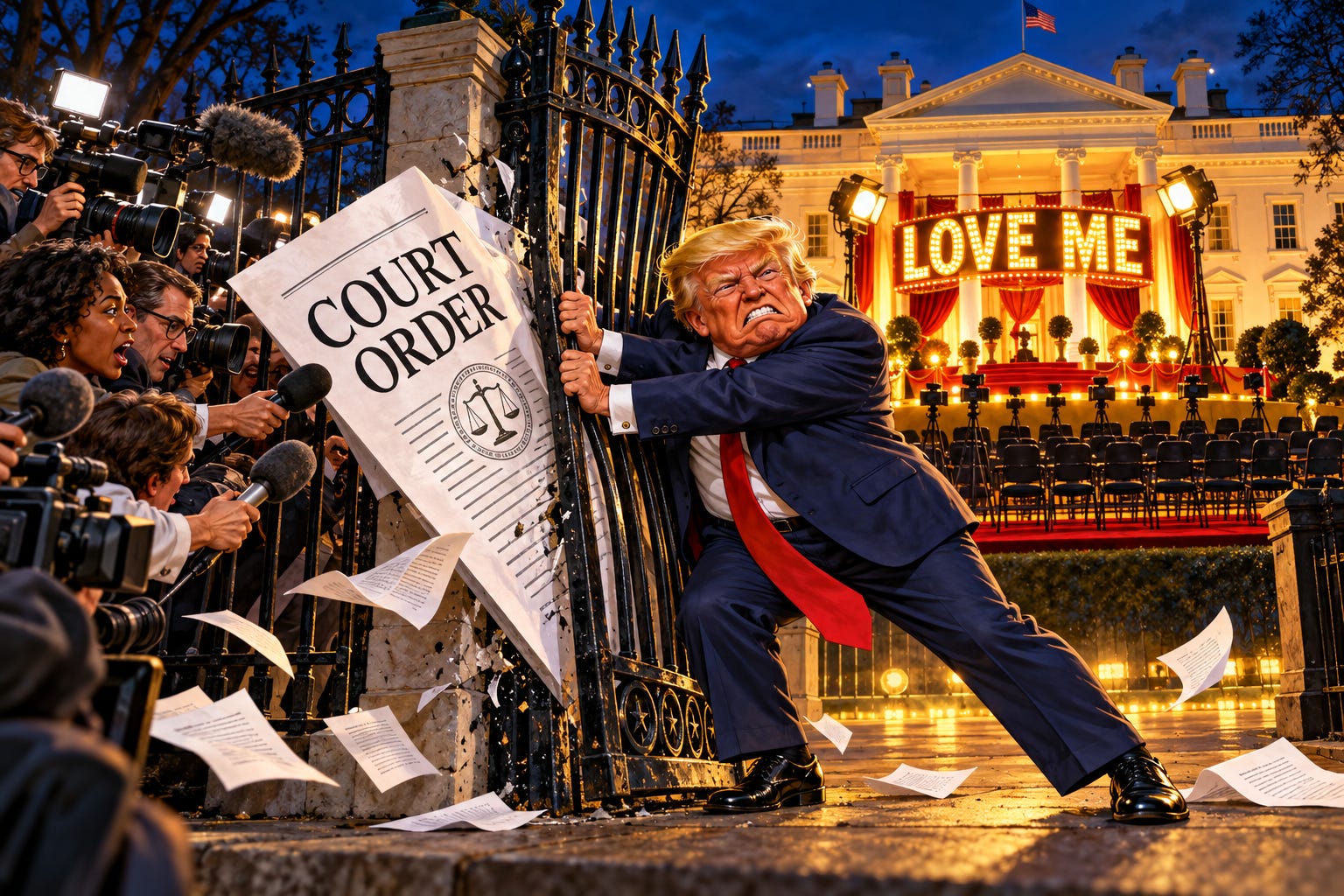
In a twist that blindsided absolutely no one with even an introductory grasp of First Amendment jurisprudence, CNN, MS NOW, and Politico got their White House credentials back on Thursday. Judge Timothy Kelly—a Trump appointee, no less—signed the order late Wednesday night. By Thursday afternoon, the reporters banished from the grounds a week earlier were back on the North Lawn.
On its surface, the entire episode was a masterclass in administrative futility and fiscal waste. Department of Justice attorneys spent days attempting to construct a sober, national-security doctrine around a retaliatory policy the president impulsively announced on Truth Social. They then walked into a federal courtroom and watched it implode. But measuring this exercise by standard legal metrics misses the point. Winning in court was never the objective; the objective was manufacturing a public conflict to mask a far more existential crisis.
When an administration’s core political capital begins to vaporize, executive behavior predictably shifts from governance to narrative coercion. The press pass ban didn’t happen in a vacuum. It arrived the exact same week an American Research Group poll registered presidential approval at a subterranean 29 percent—the first time his numbers have broken the 30-point floor in either of his terms. Even the standard baseline surveys offered no shelter: Reuters/Ipsos pegged him at 32 percent, the absolute nadir of his political life. You do not need a doctorate in political science to understand why an executive sitting on historic disapproval ratings suddenly felt an urgent operational need to pick a high-profile fight with press credentials.
When political outputs fail, authoritarian optics demand that you control the inputs. But when those controls hit the judiciary, the resulting pileup happens faster than the press office can draft damage control.
Consider the sequence. On Friday, the Supreme Court shut down Missouri’s Trump-backed congressional map for the third time, dismantling a gerrymander explicitly engineered to purge Kansas City Democrat Emanuel Cleaver from his seat. Yielding zero recorded dissents, the bench issued a blunt warning that forcing mid-cycle map changes would induce “electoral chaos.” Two days prior, an Iowa state judge threw out the president’s lawsuit against the Des Moines Register and pollster J. Ann Selzer with prejudice, ruling that methodology failing to deliver a favorable outcome does not constitute actionable fraud. Counsel for Selzer at the Foundation for Individual Rights and Expression (FIRE) distilled the administration’s entire legal philosophy into a single sentence: “fake news” is “not a thing in the law.”
Then came the ideological fracture that best illustrates how deeply the political bedrock is shifting. Karl Rove—the undisputed architect of modern Texas conservative hegemony—publicly announced he would vote for a Democrat for only the second time in his life. The trigger was Republican Railroad Commission nominee Bo French circulating overtly racist remarks regarding South Asian students at UT Austin. Rove’s prognosis on the state of his party was clinical: “I’ll have no part of it.”
When the man who built the modern red-state machine decides his own party platform has become a radiological hazard, standard political alignment has broken down completely. Predictably, the president resorted to his default rhetorical reflex, dismissing Rove as a “stone cold loser.” Rove, leaning into the absurdity, immediately promised to monetize the insult with “Stone Cold” merchandise. As someone who covers professional wrestling, I am duty-bound to point out that the Chief Executive just inadvertently handed Karl Rove the foundational elements of a Steve Austin gimmick. The administration’s insult apparatus has become so structurally inefficient that it now accidentally builds brand equity for its targets.
Which brings us back to the courtroom, where the government’s defense didn’t just fail; it actively ate itself.