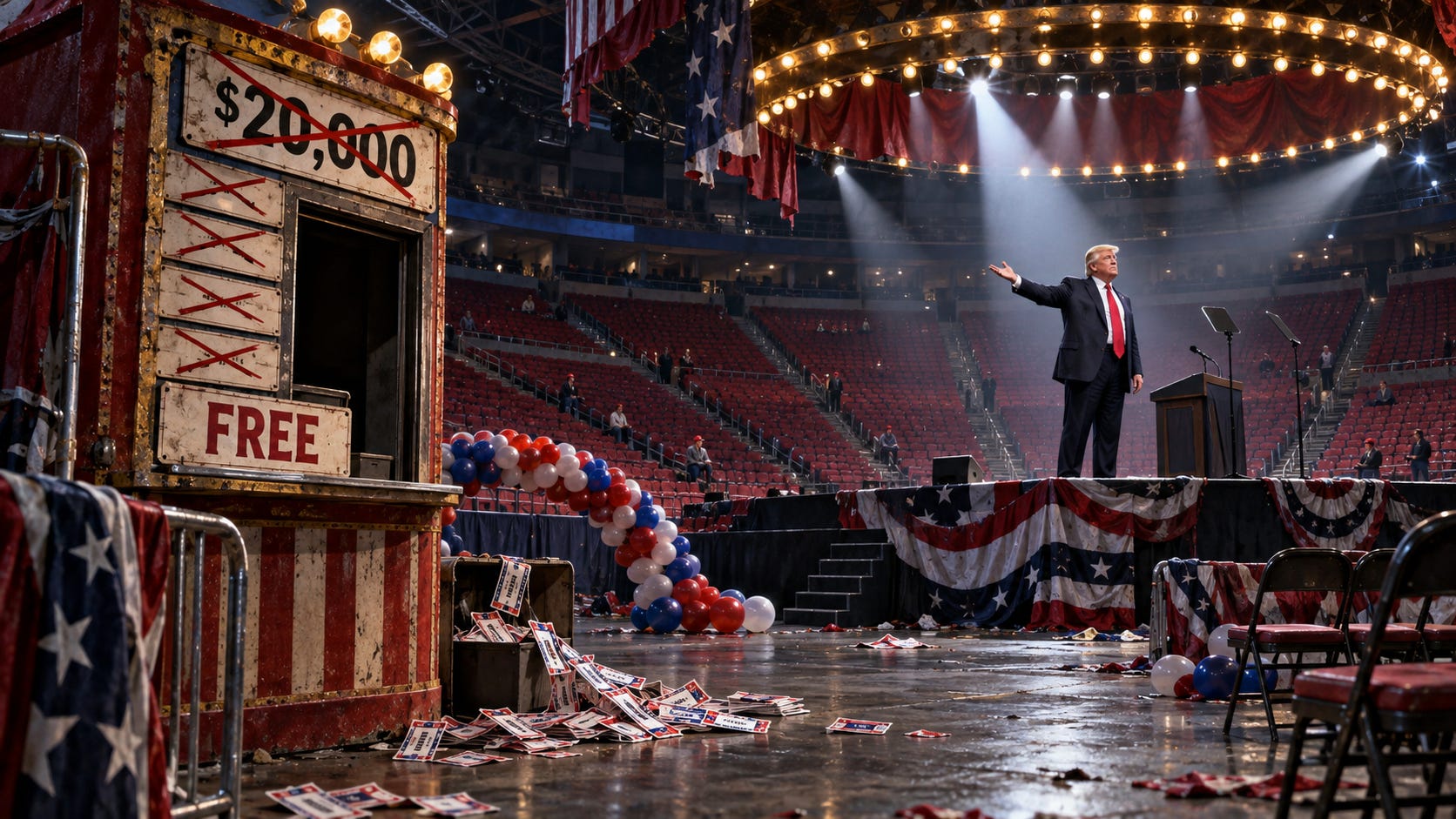
Worth is the number you print on the price tag. Value is what the customer decides the product is worth after inspecting it under decent lighting. This week, Donald Trump learned that those two numbers can be separated by approximately $20,000. The Republican Party rolled out the ballroom pageantry, slapped “Trumpapalooza” on the box, promised two nights of prime-time Trump, and apparently assumed Americans would start throwing money at them like bridesmaids fighting over a bouquet. Instead, the market inspected the merchandise, noticed it was the same grievance bundle it had been seeing for a decade, and kept walking. The RNC eventually marked admission all the way down to zero and began cold-texting strangers like a timeshare salesman who had already exhausted his immediate family. Still, the country’s response appeared to be: unsubscribe.
“Trumpapalooza” has attracted the kind of public excitement generally reserved for a mandatory software update. People are not storming the barricades to get inside. They are not organizing elaborate boycotts. Many are simply scrolling past it the way you scroll past a Facebook ad announcing that one weird spice can reverse aging, eliminate belly fat, and terrify every doctor in America. The event itself is real, for the record. It runs Wednesday and Thursday at the American Airlines Center in Dallas—the first midterm convention the Republican National Committee has ever held—built almost entirely around a president who will not appear on any ballot this November. JD Vance delivers the keynote on night one; Trump closes both nights himself as part of a 109-speaker lineup, because apparently somebody looked at a political convention and decided its chief defect was brevity. RNC Chairman Joe Gruters has promised a gathering bigger than the 2024 convention in Milwaukee, which is a bold sales pitch for an event whose organizers have progressed from charging thousands of dollars to shouting “FREE TICKETS” into strangers’ phones.
Nothing exposes the humiliation quite like the price collapse: how in the hell do you go from $20,000 to free? That is not a markdown. That is a cry for help with a promotional code attached. Imagine walking onto a car lot where the dealer offers you a vehicle for twenty grand. You decline and start heading back to your Uber. Before you reach the curb, he drops it to fifteen. Then five. Then he chases you into traffic waving the keys and yelling, “Fuck it, just take the goddamn thing!” At that point, you are no longer wondering whether you can afford the car. You are wondering what died in the trunk. A product does not tumble from $20,000 to complimentary because demand is overwhelming. Taylor Swift has never had to stand outside an arena begging pedestrians to please take two.
The descent was magnificent. First came the Texas GOP’s $20,000 “Honorary Delegate” package, which included hotel accommodations, floor seating, credentials, a Texas shirt and a cowboy hat. Twenty thousand dollars for a souvenir outfit and permission to stand closer to politicians is not a ticket package; it is Build-A-Bear for county chairmen. And “honorary delegate” is doing Olympic-level work there, considering these delegates had no party business to conduct and no delegates to elect. You were essentially paying twenty grand to cosplay democracy in a cowboy hat.
When that did not generate enough enthusiasm, the RNC opened a public lottery offering free admission and VIP treatment, dangling front-row seats like prizes beneath the silver coating of a gas-station scratcher. Then came the unsolicited text messages screaming “FREE TICKETS” in all caps. They looked so much like phishing attempts that Dallas news outlets had to reassure people that the messages were legitimate. Imagine producing political outreach so suspicious that the local news has to announce, “No, surprisingly, this is not identity theft. The Republican Party genuinely wants you to click that link.” Trumpapalooza had completed the full economic journey: exclusive political experience, luxury donor package, public giveaway, mysterious text your aunt warns you not to open. That is not price discovery. That is the market conducting an autopsy.
Naturally, this catastrophic collapse in consumer demand only applied to the plebeians. If you possessed an accredited portfolio, price discovery remained utterly immune to market forces. A cool $250,000 still bought a roundtable seat with Trump, with a secondary, non-refundable tribute of $88,600 required for the mantelpiece photo-op. The result was a masterclass in aggressive price discrimination: a national political party spamming suburban retirees like a desperate online casino while simultaneously squeezing six-figure rents out of captive mega-donors. It wasn’t a promotional discount; it was a tiered oligopoly charging top-dollar for an asset that every middle-tier consumer had already marked down to zero. Somewhere there is a Venn diagram of “people who got a spam text begging them to come for free” and “people who wrote a six-figure check for a photo,” and the fact that both circles are attending the same event in the same building is the whole article in miniature.
The resulting institutional absenteeism only proved how toxic the inventory had become. Senate Majority Leader John Thune and House Speaker Mike Johnson quietly sanitized the convention floor from their schedules—with Thune slipping into Dallas purely for closed-door capital extraction before sprinting back to his gate at DFW like a man who has somewhere else, anywhere else, to be. Michigan Representative Tom Barrett excised himself from the docket entirely, while former First Lady Melania Trump was nowhere to be found on the speaker list, which is its own quiet verdict—when the woman who is contractually and maritally obligated to stand near you decides Dallas can go ahead without her, that is not a scheduling conflict, that is a review. Beyond the marquee leadership, the National Republican Congressional Committee managed to offload roughly 2,000 tickets, yet barely a hundred actual candidates risked showing their faces in Dallas—an impressively empty room for a chairman promising the political equivalent of Woodstock, and roughly the attendance-to-hype ratio of a strip-mall grand opening that only got the balloon arch half-inflated. Meanwhile, the taxpayers of Dallas were left to absorb over $2 million in uncompensated security costs, essentially forced to subsidize the security detail for a party that couldn’t even fill its own venue. Somewhere in Dallas city government there is a budget line item that just reads “protecting an empty room,” and nobody has the stomach to say it out loud.
That behavioral impulse—proclaiming eternal loyalty in press releases while executing frantic evasive maneuvers in real life—deserves its own diagnostic manual. Call it Association Anxiety Syndrome, or more accurately, electoral proximity panic. It isn’t irrational paranoia; it is rational self-preservation built on a year of utterly catastrophic empirical receipts. The presentation is always the same: the patient issues a full-throated statement of support, praises the President’s leadership, thanks him for his service to the movement—then is later found to have a previously unannounced “scheduling conflict” in a different state entirely. Symptoms include sudden fundraiser attendance in the same city on the same day as the event they’re avoiding, a newfound passion for “getting back to the district,” and an almost supernatural ability to be photographed literally anywhere else. There is no known cure, because the disease is reelection.
During the 2025–2026 special election cycle, Democrats systematically dismantled GOP margins nationwide, flipping one out of every five contested Republican-held seats. Across nearly every down-ballot contest, Republicans suffered severe net swing decay compared to their baseline 2024 presidential performance—underperforming even in the gerrymandered redoubts they managed to keep. In Florida’s House District 87—the actual home precinct of Mar-a-Lago, a detail so on-the-nose it feels like it was written by a Democratic super PAC—a seat Trump won easily was inverted by a Democratic challenger. In Texas, a state Senate district that Trump secured by more than 17 points suffered a hilarious 31.8-point net swing straight into the Democratic column. Nationwide, Democrats have consistently flipped state legislative seats, while the Republican total net capture remains sitting at absolute zero—not low, not disappointing, zero, the same number of seats a losing fantasy football team flips at the trade deadline. So when vulnerable GOP incumbents run the numbers on standing next to Donald Trump three months before election day, they aren’t committing party treason. They are looking at the statistical evidence and deciding they’d rather not be the control group in a political crash test.
The economic law of diminishing marginal utility is as unforgiving in political science as it is at the dinner table. You can only consume pizza for so many consecutive cycles before consumer preference demands a fundamental menu update—it doesn’t matter how aggressive the marketing campaign is, nor how deep the brand loyalty runs. At a certain point of dietary saturation, the electorate simply craves a vegetable. Donald Trump has been an inescapable fixture of American public life since 2015—a decade if measured from the golden escalator launch, or nearly two if you factor in the years spent cultivating birther conspiracy theories. That isn’t standard media exposure; it’s systemic cultural ubiquity, the political equivalent of a restaurant that has been “under new management” four times but somehow still serves the exact same mozzarella sticks. And there are only so many ways a political party can re-plate the same ideological recipe before the market exhausts every conceivable variation: the baseline grievance, the stadium rally chants, the golden escalator sequel, and now the “Trumpapalooza” midterm rebrand, which is less a new dish than the same cold slice put back under the heat lamp with a new laminated menu description. Eventually, the kitchen runs out of novel toppings, leaving leadership to reheat the exact same slice and insist it’s gourmet dining, and the customers—who have, again, been eating this pizza since 2015—are entitled to send it back.
That is precisely the menu the RNC placed before the public. The scheduling itself reflected a masterclass in strategic tone-deafness—counterprogramming the launch against the NFL season opener while anchoring the calendar near the solemnity of the September 11th anniversary, a logistical collision event organizers anticipated and barreled into anyway, apparently on the theory that nothing pairs better with a pep rally than national remembrance and Sunday Ticket. Meanwhile, down-ballot dynamics in the marquee Texas Senate race captured the broader institutional fatigue. With Attorney General Ken Paxton trailing Democrat James Talarico in fundraising and public polling, Paxton’s operation responded by debuting an AI-generated attack ad directly during the convention broadcast—a fitting monument for a party that, having run out of organic political momentum, resorted to manufacturing synthetic reality. When your campaign’s closing argument is a chatbot’s idea of your opponent, you have not found a shortcut; you have announced, in writing, that the real version of your argument didn’t poll well either.
The electorate inspected the offering, recalled the previous nineteen helpings, and declined the invitation. Price discovery was never the underlying issue; party leadership assigned whatever nominal value it wished, right up until the moment it had to give the product away and still couldn’t fill the room. It was perceived utility—the ultimate metric calculated independently by the consumer, the one line item no press release can spin and no discount can manufacture—that “Trumpapalooza” could not generate at any price point. The RNC spent a decade insisting this man was priceless. This week, in a building in Dallas with several thousand empty seats and a security bill nobody budgeted for, the American public finally got to name its own price. It said free, and it still passed.