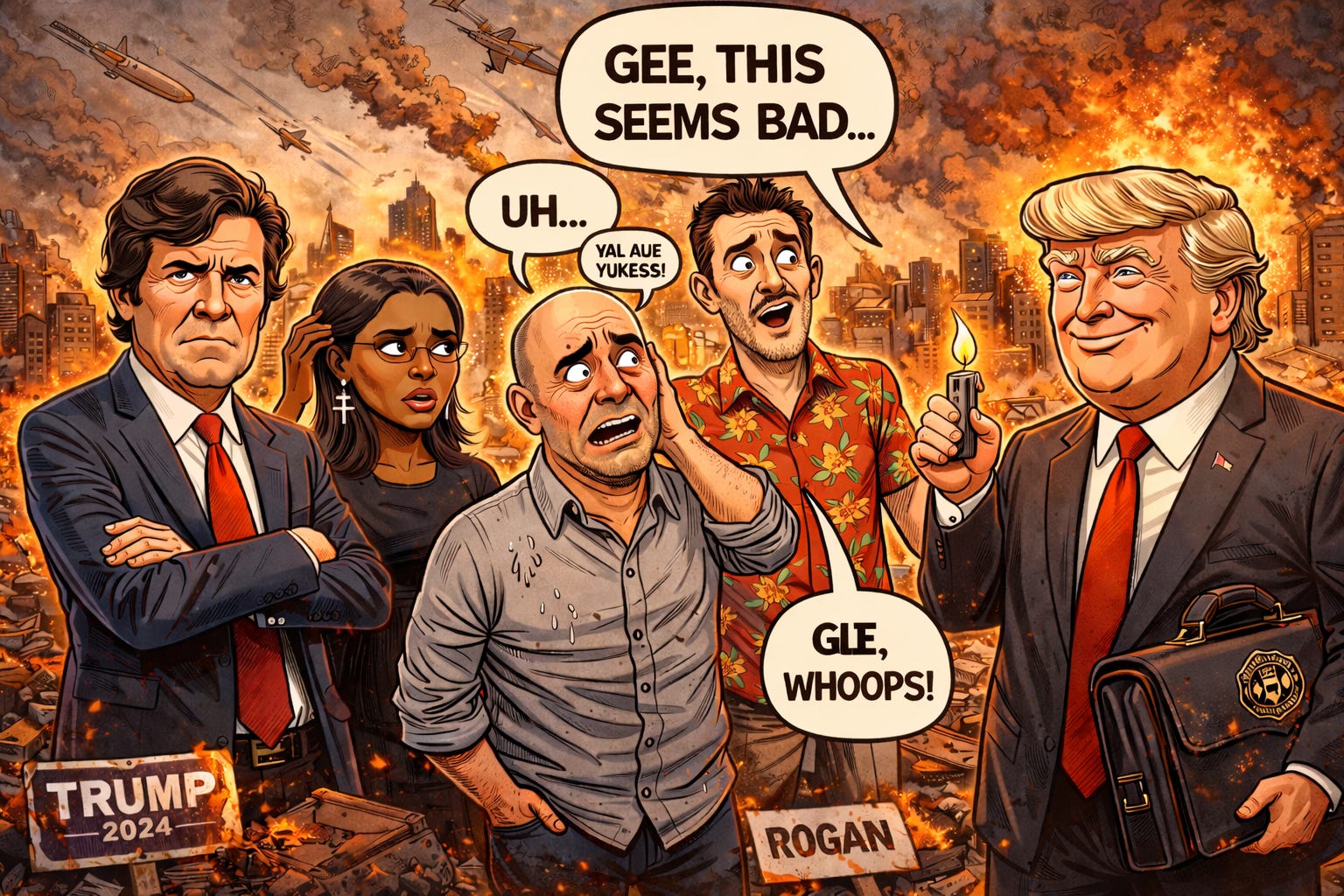
Politics in America has always been a team sport. Pick a side, wear the colors, defend your guys even when they’re down forty points with two minutes left, and never — under any circumstances — admit that the other team had a point. For most people, that’s just the background noise of living in a two-party democracy. Annoying. Exhausting. Occasionally funny. But for some people, the jersey stops being something they wear and starts being something they are. The party, the movement, the leader — it stops being an affiliation and becomes an identity. Political scientists call this ** identity fusion**: the psychological process by which the boundary between the self and the group dissolves so completely that an attack on the leader registers as a personal wound. You see it in religions. You see it in gangs. You see it in multilevel marketing schemes where grown adults will bankrupt themselves before admitting the product doesn’t work. And you see it in podcast studios, where men with eight-figure net worths sat around giggling at Donald Trump like he was doing tight five minutes at the Comedy Cellar — treating the most consequential election in modern American history like content — and are now watching bombs fall on Iran going “huh, this seems bad.”
I am an academic. I have advanced degrees. I teach political science at the college level, and I love my students — all of them, regardless of their party, their background, their age, or how many times they have voted directly against their own economic interests. In the classroom, I extend grace. I extend patience. I meet people where they are. That is the classroom. This is not the classroom. Because outside of it I have exactly zero patience — not a molecule, not a crumb — for Tucker Carlson, Candace Owens, Joe Rogan, Andrew Schulz and his merry band of frat-house philosophers, Marjorie Taylor Greene, Alex Jones, or any of the other media personalities and influencers who spent 2024 either actively campaigning for Donald Trump or lending him the cultural credibility of their massive platforms — and who are now standing in the rubble of everything they helped build, pointing at it, making the confused face.
No. Absolutely not. We are not doing this.
The ** sunk cost fallacy** is the cognitive trap where people continue pouring resources into a bad investment because they’ve already put so much in that admitting failure feels worse than doubling down. It’s the guy who stays in the bad relationship for six years because he already wasted three. It’s the gambler who keeps feeding the machine because he’s already down five hundred. In politics, the sunk cost fallacy takes a specific and particularly American form that I call
Voter’s Indemnity is different from ordinary denial because it requires you to hold two completely contradictory thoughts at the same time and refuse to let either one win. You have to simultaneously acknowledge that the disaster is real and insist that you bear no responsibility for it. That takes genuine psychological effort. And nobody — nobody — is working harder at it right now than the people I just named.
Start with ** Candace Owens**. On March 31st, Candace Owens sat down with Piers Morgan and delivered what might be the most pristine real-world demonstration of Voter’s Indemnity ever captured on camera. She called Trump a “chronic disappointment.” She said she was “embarrassed” that she encouraged her audience to vote for him, because the things happening under his administration — specifically the foreign policy and the military strikes — are not what she promised her followers he would do. And then, when asked directly whether she regretted her vote, she said no. She does not regret voting for Trump over Kamala Harris. Read that sequence again slowly. She regrets the evangelism but not the gospel. She recruited people into a burning building, watched it burn, went on international television to call the arsonist a genocidal lunatic — and her official position is that she personally did nothing wrong. That is Voter’s Indemnity in its purest, most crystalline form. Frame it. Put it in a museum. It is a psychological artifact.
This Iran war is an Epstein files distraction. The timeline is not subtle. The Epstein files dropped. The MAGA base — the same people who stood by Trump through the Access Hollywood tape, through two impeachments, through the attempt to overturn a free and fair election, through a pandemic he managed like a man actively trying to lose a bet — said no. For the first time, the base drew a line. The Epstein files were the moment the cult looked at the cult leader and said you do not get to spin this one. And then, with a swiftness that would impress even the most practiced wartime president, bombs started falling on Iran. ** Joe Rogan** — who endorsed Trump, who had him on his podcast, who personally delivered a generation of young men to the Republican Party like a gift-wrapped demographic — said it himself on air: historically, a war is how leaders bury their problems at home. He called the idea psychotic. He just declined to mention that he helped hire the psychotic, handed him the keys, and told eleven million listeners that he was the move.
This is the same Joe Rogan who sat in his studio in the fall of 2024 and told his audience that Kamala Harris was dangerous. Too establishment. Too hawkish. Not authentic enough. Too aligned with the system. And now he’s out here saying “I can’t believe we went to this war” and “it genuinely feels like there’s a real possibility we might be entering World War III.” The audacity of the confusion. The sheer nerve of the bewilderment. You spent your cultural capital telling young men that the woman warning about exactly this outcome was the wrong choice — and now you’re confused. Rogan at least has the decency to sound genuinely troubled. I’ll give him that. But troubled is not the same as accountable. Troubled is a man watching a fire he helped start and expressing surprise that things are hot. Voter’s Indemnity, eleven million listeners per episode, $250 million Spotify deal, absolutely no intention of connecting the dots back to himself.
Here is what makes all of this so much worse: the blueprint was public. I read ** Project 2025** and Agenda 47 — not for pleasure, because nobody reads nine hundred pages of Heritage Foundation fever dreams for pleasure — but because understanding what a candidate actually plans to do requires reading what they actually wrote down. Project 2025 labeled Iran the world’s leading state sponsor of terrorism, explicitly opposed any return to the nuclear deal, called for regime change posturing, and advocated deepening military cooperation with Israel as the primary counter-Iran strategy. It wasn’t hidden in a footnote. It was the foreign policy chapter. Agenda 47 was even more direct. This was not a mystery. This was not something that required intelligence clearance or insider access to figure out. It was a publicly available document that any person with a podcast, a research team, and a platform reaching millions of people could have read, summarized, and told their audience about. Instead, Joe Rogan talked about vibes. Andrew Schulz giggled. Tucker performed MAGA loyalty for the paycheck and the audience. And now they’re all confused. Did these motherfuckers not read it? Because some of us did. Some of us were out here saying exactly what was going to happen, in plain English, while the podcast bros were busy making Trump seem like an interesting conversation rather than an existential threat. Newsweek eventually noted that Trump didn’t even follow Project 2025 — he went further than it. Further. Than the nine-hundred-page authoritarian policy document. And somehow this is a surprise. No. The answer is they didn’t read it. Instead they decided to believe the greatest hits of campaign bullshit: that Trump was going to lower grocery prices on day one. Lower gas prices on day one. End inflation on day one. Stop the war in Ukraine in twenty-four hours — twenty-four hours, he said that out loud, with his whole chest, and people nodded. End all foreign wars immediately.
Make everything affordable again starting the morning of January 20th, as if the President of the United States is a regional manager who can just call a meeting and tell the economy to knock it off. He stood in front of a table full of groceries at his golf club in New Jersey like a man auditioning for a Home Depot commercial and told the country he would immediately bring prices down on day one. Gas prices. Egg prices. Grocery bills. Day one. And people believed it. People with podcasts and platforms and research teams believed it — or performed believing it, which is worse. If any of these clowns had sat through a single semester of American Government — one semester, fifteen weeks, a basic survey course that I teach to eighteen-year-olds who are still figuring out how to do laundry — they would know that the President of the United States does not have the unilateral authority to lower grocery prices, end a foreign war in twenty-four hours, or single-handedly restructure the global energy market before lunch. The president is not a king. There are three branches of government. There is a Federal Reserve that operates independently. There are market forces that do not give a damn what anyone promised at a rally in Pennsylvania. This is not obscure constitutional theory. This is the first three weeks of the course. And yet here we are — bombs falling on Iran, gas prices at record highs because of a war the no-more-wars president started, eggs still expensive, Ukraine still at war — and the people who handed this man the keys are sitting in their studios going “I feel betrayed.”
You were not betrayed. You were not deceived by some elaborate sophisticated con. You chose to believe things that a basic civics education would have told you were impossible, because believing them felt better than doing the reading.
And then there is ** Andrew Schulz**. I will keep this brief because Schulz does not deserve a long paragraph. It must be a genuinely wonderful thing to be rich enough that politics is entertainment. To sit around with your boys — giggling at Trump, treating an election like content, laughing at the bit like he was workshopping material before a Netflix special — and then when the bombs start dropping and the market craters and the body bags begin coming home, to pivot seamlessly to “I don’t have an agenda, I’m just intellectually curious about both sides.” Charlamagne Tha God, to his credit, said it plainly on their own podcast: if you’re wrong and the country goes to shit, you have to eat that. Schulz’s response was to pick up the menu and order something else. That is not intellectual curiosity. That is the luxury of a man whose wealth insulates him so thoroughly from being wrong that he has never once had to develop the muscle for accountability. Some of us teach the kids who are going to get drafted. Some of us don’t get to be curious about it from a distance. And a man who giggles at fascism while sporting a haircut that his own fanbase on Reddit took to calling “Fuhrer Schulz” probably should have thought a little harder about who he was giggling at.
Meanwhile, Tucker Carlson — who privately called Trump a “demonic force” and said he hated him passionately in text messages that came out during the Dominion lawsuit, and who then spent years publicly performing MAGA loyalty because the audience was there and the money was good — went on his podcast on Easter Sunday and called Trump’s profanity-laden threat to destroy Iranian civilian infrastructure “vile on every level.” He accused Trump of making a mockery of Christianity. He told White House officials and military personnel to resign rather than carry out nuclear strike orders, and he ended with the line: “Figure out the codes on the football yourself.” Tucker then called this act of conscience. Trump called it something else. “Tucker’s a low IQ person that has absolutely no idea what’s going on,” the president told the New York Post. “He calls me all the time. I don’t respond to his calls. I like dealing with smart people, not fools.” And that, right there, is the first rule of cult politics that Tucker Carlson spent years pretending not to know: nothing less than total loyalty will suffice. You can give 99.9 percent. You will still end up as a fool who doesn’t get his calls returned.
Alex Jones is watching his lifeboat sink, by his own description. MTG called for Trump’s removal. Theo Von and Joe Rogan sat together on a podcast and said “just fucking stop it.” The apostles are not quietly drifting away. They are breaking loudly, publicly, and all at the same time, over a war that is costing a billion dollars a day and has already taken American lives. And every single one of them is doing it while declining — firmly, creatively, sometimes elaborately — to connect their current horror to their past choices.
There is a misattributed quote circulating online — the one where Harris supposedly said “if we elect Trump we will be at war within six months” — that she never actually said. Doesn’t matter. The real record is more than sufficient. During the 2024 campaign Harris called Iran America’s greatest adversary. She warned about Trump’s recklessness on foreign policy. She noted that he had threatened to abandon NATO and encouraged Putin. She said she would never hesitate to take action necessary to defend American interests — but that she would approach matters of war and peace with steadiness and discipline. The press called her hawkish for it. The podcast bros said she was dangerous. The vibes crowd said she wasn’t authentic. And then, standing outside a Detroit small business on February 28th, the day the bombs started falling, she said: “Donald Trump has dragged us into a war the American people do not want. He has put American troops in harm’s way. I unequivocally oppose this war of choice.” At ** Jesse Jackson’s funeral** in March she told the congregation: “I predicted a lot about what’s happening right now. I’m not into saying I told you so, but we did see it coming.” She was not saying it to be vindicated. She was saying it in a church, at a funeral, watching the country absorb the consequences of a choice that millions of people made while being told by Tucker Carlson, Joe Rogan, Andrew Schulz and the rest that she was the one they should be afraid of.
This country has a shame vacuum. Shamelessness has become a personality type, a political identity, a cultural aesthetic — Trump operates as the spiritual leader of the Proudly Shameless, and it trickles down. The appropriate emotional response to watching someone you helped elect do damage to real people is not detachment or deflection. It’s shame. Not guilt. Not self-flagellation. Shame. ** Shame is a moral smoke detector**. Shame says: I contributed to this. I need to understand how. I need to do better. Without it, people become dangerous. Voter’s Indemnity is the specific mechanism people use to avoid that reckoning. It is the psychological technology that lets you watch a war of choice unfold on your television, watch the man you campaigned for threaten to wipe out an entire civilization on Easter Sunday morning in a profanity-laden Truth Social post that ends with “Praise be to Allah” — and still not connect that outcome to the choice you made. The indemnity protects you from the mirror.
I know because I have stood in front of that mirror myself. I ** voted for Ralph Nader in 2000**. I was nineteen years old and I thought I was making a principled stand, and I have been eating that particular meal for twenty-five years. George W. Bush won Florida by 537 votes. I have thought about that number more times than I can count. And I’m not saying it destroyed me or defined me — I’m saying the shame of it taught me something that no…