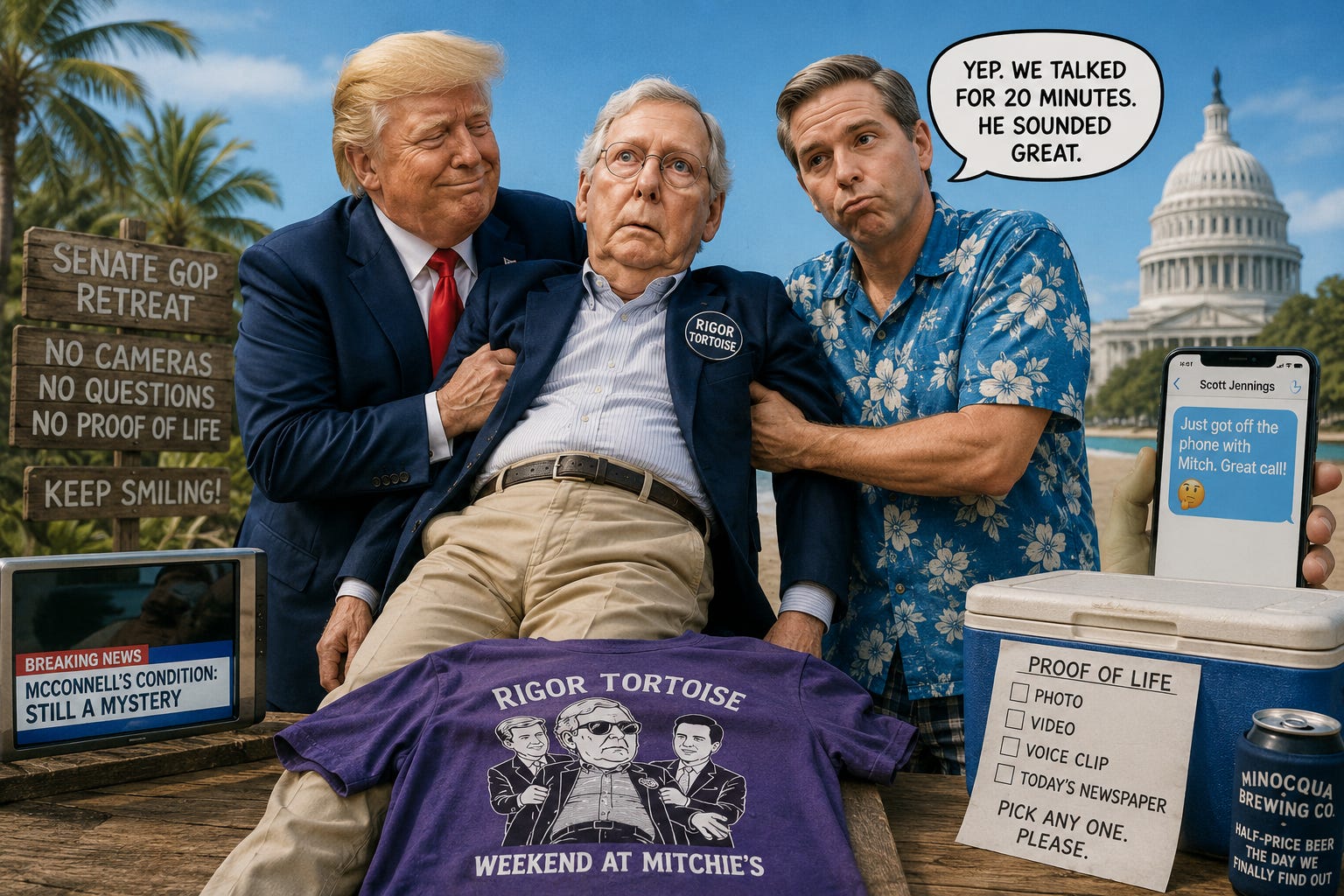
▶Weekend at Bernie’s is about two employees who discover that their corrupt boss is dead and, rather than notify the authorities like people who have not completely lost their minds, decide to spend the weekend pretending he is still alive. They drag Bernie around Long Island, prop him up at parties, straighten his sunglasses, rearrange his limbs, and depend on everyone they encounter being too drunk, too distracted, or too stupid to notice that the man has not blinked, spoken, or drawn an independent breath in several hours.
The entire movie rests on one idea: as long as somebody keeps moving Bernie’s body, nobody has to admit Bernie is dead and the party is over.
Replace those two employees with the Senate Republican conference. Replace Bernie with Mitch McConnell. Replace the Long Island beach house with the United States Capitol, and you have a fairly accurate description of what Republicans have been asking the country to believe for the last two months.
McConnell disappears from public view, and his staff releases statements assuring everyone that he is recovering and fully engaged. Republican senators who apparently have not seen him tell reporters that he is tough. Carefully staged photographs appear every so often like proof-of-life images from the world’s most boring hostage negotiation. Then Scott Jennings announces that he spoke with his old boss for nearly 20 minutes and discussed politics, Senate business, the future of the country, the weather, bourbon, the migration patterns of Canadian geese, and presumably everything except the one subject every living person in America wanted him to address: How the hell are you doing, Mitch?
We are apparently expected to believe Jennings got McConnell on the telephone after weeks of silence, enjoyed a long and detailed conversation with him, hung up, went on national television, and somehow neglected to obtain the one thing that would have ended the entire controversy: Mitch McConnell speaking publicly in his own voice.
Not a medical chart. Not an MRI. Not a hostage video with that day’s newspaper. Just put the man on speakerphone.
Instead, CNN eventually had to clarify that Jennings’s account was his personal experience and not CNN reporting, which is corporate language for: Scott says he talked to Mitch, but please do not drag us into whatever séance may or may not have occurred.
I did not invent the Weekend at Bernie’s comparison. A Wisconsin brewery got there first, put Donald Trump behind McConnell’s body, printed “Rigor Tortoise” across a T-shirt, and somehow produced a more credible update on the senator’s condition than the people being paid to communicate on his behalf.
I have been writing about politics since the summer of 2000, when I was a wide-eyed political science student at Pellissippi State Community College and still thought the phrase “public servant” described an actual job rather than a long-running prank. Since then, I have covered senators caught in affairs, closeted conservative lawmakers exposed in gay sex scandals, Dick Cheney shooting a man in the face and somehow making the victim apologize, Donald Trump bragging about grabbing women and getting rewarded with the presidency, anti-vaxxers earning medical degrees from Facebook University, and politicians discovering that a microphone was live only after saying the racist part out loud.
I thought I had seen the entire political freak show. Then Mitch McConnell entered a state somewhere between hospitalized, incapacitated, missing, retired, deceased, and “Scott Jennings says he sounded terrific.”
For the last three months, people have asked me more about McConnell’s health than tariffs, redistricting, immigration raids, or anything else happening in American politics. Mitch McConnell has somehow become the nation’s most prominent missing-person case, except nobody is allowed to call him missing because every few weeks a Republican claims to have heard his voice somewhere.
People stop me like I operate the McConnell family’s customer-service line.
“Is he alive?”
I do not know.
“Is he conscious?”
Couldn’t tell you.
“Can he still serve?”
At this point, I would settle for a live video of him blinking twice, stating the date, and correctly identifying at least one member of his immediate family.
Nobody outside a tiny circle of staffers seems to know what is actually happening, and those staffers are protecting the information like Mitch McConnell’s pulse is a nuclear launch code. Either they signed nondisclosure agreements, blood oaths, or whatever paperwork Senate Republicans use when they need to keep a man’s vital signs classified.
My wife has asked me more than once why Kentucky Gov. Andy Beshear has not simply made Mitch McConnell prove he is alive. Not prove he can run a marathon. Not make him recite the Constitution backward. Just appear somewhere with a pulse and answer a question that was not prerecorded by his communications director.
My aunt was even less diplomatic. After watching weeks of mysterious hospital updates, secondhand testimonials, and Republicans insisting everything was fine while producing approximately zero Mitch McConnell, she finally told me, “Kris, you know that old man is dead.”
All I could say was, “I only know what has been reported to me.”
That is the responsible answer. It is also the answer you give when every available piece of evidence has your aunt looking like the lead detective and the United States Senate looking like it is waiting for the coroner to finish buffering.
My wife’s question is completely reasonable. Unfortunately, the answer is not nearly as satisfying: Beshear cannot force McConnell to appear, speak, blink on command, or hold up a copy of today’s Louisville Courier Journal. The governor does not have some giant red PRODUCE MITCH button hidden beneath his desk. He does not possess the legal tool people assume he has.
Here is what we actually know. McConnell, 84, was hospitalized after falling at his home on June 14. His office then spent weeks revealing almost nothing beyond the fact that he was hospitalized, which is less a medical update than a confirmation that hospitals continue to exist.
The silence became so long and peculiar that an emergency dispatch call from McConnell’s residence later surfaced referencing a reported cardiac arrest. That did not exactly lower the temperature. When people are already asking whether a senator is alive, “There may have been a cardiac arrest, but we have no further details” is not how you shut down the rumor mill. That is how you pour gasoline into it, hand it a microphone, and book it on cable news.
McConnell’s office eventually released a statement attributed to him explaining that complications from childhood polio, followed by pneumonia, had prolonged his recovery. By then, however, he had already missed weeks of Senate business, his absence would eventually stretch beyond forty days, and the public had received more verifiable sightings of Bigfoot than of Kentucky’s senior senator.
His Republican colleagues were left vouching for a man many of them apparently had not seen or spoken with. Kansas Sen. Roger Marshall assured reporters that McConnell was “tough as nails,” which sounds supportive but tells us absolutely nothing. A coffin nail is also tough as nails. Nobody accepts that as proof of life.
North Dakota Sen. Kevin Cramer came closer to acknowledging the obvious: when you refuse to provide real information, people fill the vacuum themselves. Of course they do. McConnell’s office created a mystery, refused to release the final chapter, and then acted surprised when half the country decided he had already been written out of the series.
Rep. Alexandria Ocasio-Cortez finally said what everyone outside McConnell’s immediate circle had been thinking. Watching a sitting senator disappear for more than a month with no real explanation while control of Congress rests on margins thin enough to be measured with dental floss was, in her words, “not normal. Not normal at all.”
She is right. Senators have gotten sick before. Senators have missed votes. Senators have even died in office. What we have not seen is an entire political party treat a senator’s possible incapacitation like the location of the nuclear codes.
There is no precedent for a caucus collectively deciding that the public does not need to know whether one of its elected officials can speak, vote, recognize his surroundings, or remain upright without a staffer just outside the camera frame holding a broomstick against his back.
Everyone around McConnell appears to have made the same calculation: a vague statement, one carefully cropped photograph, and several Republicans insisting “he sounded great” are apparently cheaper and easier than producing the actual senator.
And, incredibly, it has worked.
This is where my wife’s question starts looking less like a casual observation and more like the most competent oversight hearing anyone has conducted. Kentucky Gov. Andy Beshear eventually asked McConnell almost exactly what she had been asking me: please address the people of Kentucky directly, verbally, and in real time—or resign.
That is the entire demand.
Beshear did not ask McConnell to run the forty-yard dash. He did not ask him to solve a Rubik’s Cube, identify all fifty states, or successfully complete the “I’m not a robot” test on the first try. He asked an elected senator to speak publicly and demonstrate that he remains capable of serving.
That should not be a radical request. It should be slightly more demanding than confirming your dentist appointment.
Beshear still cannot force the issue, because Kentucky Republicans—McConnell very much included—rewrote state law in 2024 specifically to make sure a Democratic governor could not simply appoint a replacement if McConnell’s seat became vacant. They spent years preparing for the possibility that Mitch McConnell might leave office, but apparently no time preparing for the possibility that nobody would know whether he already had.
Under that law, Beshear’s real authority begins only after the seat is officially vacant. He can call a special election, but he cannot personally declare the seat vacant just because McConnell has vanished from public view and his staff has begun communicating like the Vatican during a papal death watch.
So the entire process now depends on McConnell’s own political operation acknowledging that something has happened to McConnell’s political operation.
That is the trap.
The people with the strongest incentive to keep the seat occupied are also the only people positioned to admit that the man occupying it may no longer be capable of doing so. Washington has essentially placed the “Is Mitch still serving?” determination in the hands of the same people currently asking us to accept a press release, a photograph, and Scott Jennings’s personal séance as proof of life.
So no, I do not think Andy Beshear is being timid, and I do not think Kentucky Republicans have frightened him into silence. I think he is holding a perfectly reasonable request with absolutely no enforcement mechanism, aimed at a political operation whose entire strategy is apparently to stare directly through him until he goes away.
What is Beshear supposed to do?
Show up at the rehab facility with a laminated form reading, CURRENTLY DECEASED? CIRCLE ONE: YES / NO / PREFER NOT TO SAY?
Hire a hostage negotiator to stand outside with a bullhorn yelling, “WE ARE NOT ASKING FOR MEDICAL RECORDS, MITCH. JUST TAP ON THE WINDOW”?
Start a true-crime podcast called Where’s Mitch? and promise bonus episodes to anyone who submits a recent sighting?
Buy a trail camera, strap it to a tree outside the McConnell residence, and start uploading grainy nighttime footage captioned, CRYPTID, SENATOR, OR PATIO FURNITURE? YOU DECIDE?
None of those are serious options. Neither, apparently, is receiving a serious answer.
At this point, public opinion has divided into several camps. Some people believe Mitch McConnell is alive. Some believe he is not alive. Others appear to believe he occupies a third category somewhere between life and death—less “living human being” and more “federal office still technically receiving mail.”
Whenever people ask whether I think McConnell is dead, I give them the only honest answer available: being dead and being above ground are not always as different as we would like to believe.
I cannot say Mitch McConnell is dead. I have no evidence establishing that. I can only say he appears to be about as alive as a two-way pager, a Nokia brick phone, a PalmPilot, a BlackBerry with the little rolling ball, a Blockbuster membership card, or the phrase “You’ve got mail.” All of those things may still exist somewhere, but if someone claims to have seen one recently, I am going to need a photograph with that day’s newspaper.
And proving that a person is alive should not be this difficult.
Proof of life is supposed to settle questions. It is not supposed to create twelve new ones, require a CNN disclaimer, inspire a congressional scavenger hunt, and leave half the country studying the shadows in a staged photograph like amateur investigators examining the Zapruder film.
If your proof that someone is alive requires a spokesman, two senators, an old employee, a carefully worded statement, one suspiciously angled photograph, and a follow-up clarification from a cable network, you have not provided proof of life. You have assembled the least convincing escape room in Washington.
Which is why the funniest—and possibly most honest—response to this whole spectacle has come from a beer company.
Minocqua Brewing Company, a Wisconsin brewery that has built much of its identity around antagonizing Republicans, started calling McConnell “Rigor Tortoise” and selling a shirt depicting the exact scene this article opened with: Donald Trump propping him up Weekend at Bernie’s-style while everyone around them is expected to admire the tailoring and ignore the body language.
The brewery has also promised half-price beer whenever McConnell’s death is officially confirmed. That may sound tasteless, but at this point a brewery promotion has become one of the more transparent information systems available to the American public. Apparently, we are all waiting for happy hour to function as the official death notification.
And that is what makes the joke work. A four-decade Senate career has ground down into a question nobody in power is willing to answer directly, while the rest of the country waits for a Wiscons…