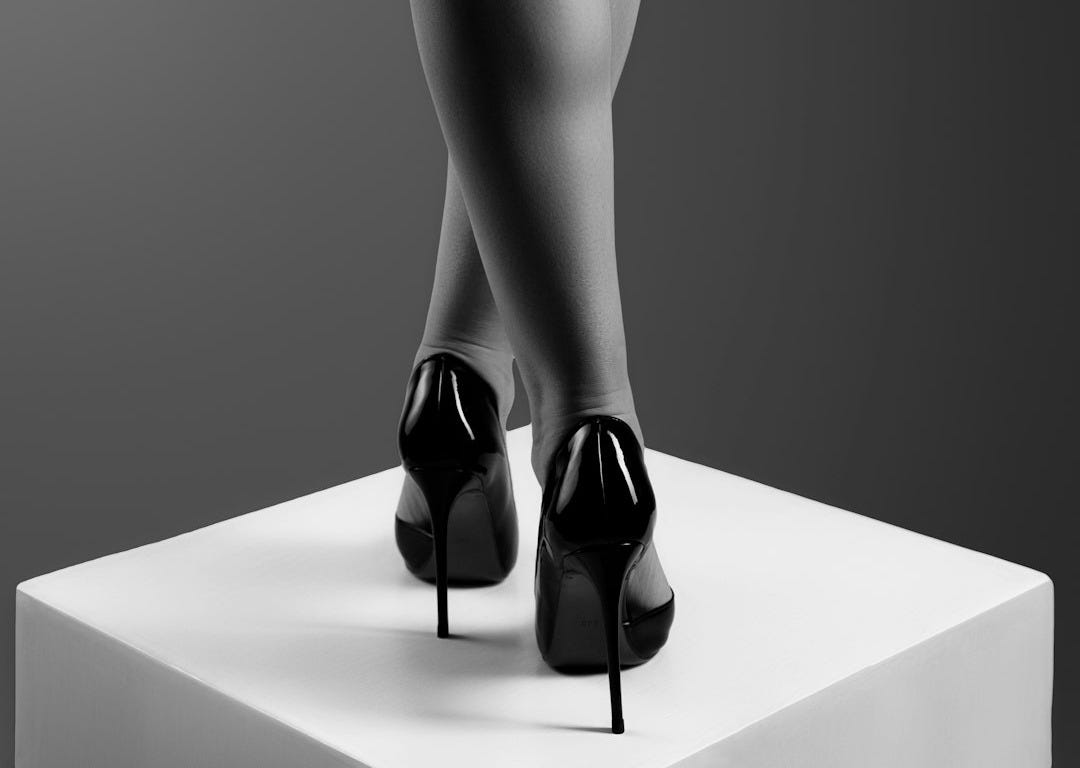
I’ve always been fascinated by beauty standards and how women execute on them, specifically the openness to which women admit they are grooming, primping or dressing a certain way “for men.” Or not for men.
This topic is so heavy for women because we are raised, basically from day one, to have a really concrete idea of what men find attractive. Even if the men in your life don’t say anything about it, awareness of male preferences is inescapabale. A big part of red pill and black pill manosphere ideologies is the devastating realization that women care about shallow things, and will not dole out their attention based on which man behaves the best, but by who they find the most attractive. But for women, this is not a revelation because we already know. I cannot remember a time in my life when I was confused by, or oblivious to, the idea that boys would treat me better and be more interested in me if I was pretty.
I don’t say this to blame “men” for this in any kind of vengeful or Male-Tears-mug-coded way. As I’ll cover soon, many women hold themselves to exaggerated versions of conventional standards which most individual men would never impose on them. But I also don’t blame the women for this perception. These expectations are everywhere around them, to the point that they become second nature, even if the individual men in their lives aren’t putting any pressure on them.
Because women are steeped in these male-preferred beauty standards *so *deeply and *so *early, they become a sort of muscle memory for many of us. Most women do not consciously think, for example, about the specific waist-hip ratios that men prefer. They don’t have to think about it. They can look at every Disney princess and well-known sex icon and have their answer even without a numerical value (I’m aware some man will remind me that boys are aware of ultra-muscular superheroes, and there’s no disagreement there, but I maintain that assessing your own attractiveness against a conventional standard is more ingrained in a young girl’s mind than a young boy’s.) Most straight women, therefore, are surrounded by male preferences and often adhere to them in a way that does not feel conscious or deliberate. Sometimes, adhering to these standards may even feel completely self-driven, if not feminist, because being seen as attractive can feel “empowering.”
This is not a unique concept that I invented. The idea that “nothing exists in a vacuum” has been circulated among feminist writers much smarter than myself for ages. See, Sandra Bartky in 1988 or Naomi Wolf pre-vaccine-quackery in 1991. But I’m interested in where we draw the line, or if the line can be drawn at all. If beauty standards are so subconscious, how can we really know—and does it even matter—if our fashion, grooming, or primping is “for men” or for ourselves?